
Approximate location
Also recognized by Taubergassen Road in Vienna
From BackToLuther:
After such a long struggle God wanted to reveal his glory and Tauber’s faith. Once again the tyrants tried to persuade him to revoke. Many men and a great crowd gathered, eager to all learn if he would recant. But the pious Christian was not weaker but stronger and more joyful through so much pain and shame. He desired not to withdraw, but only to die.
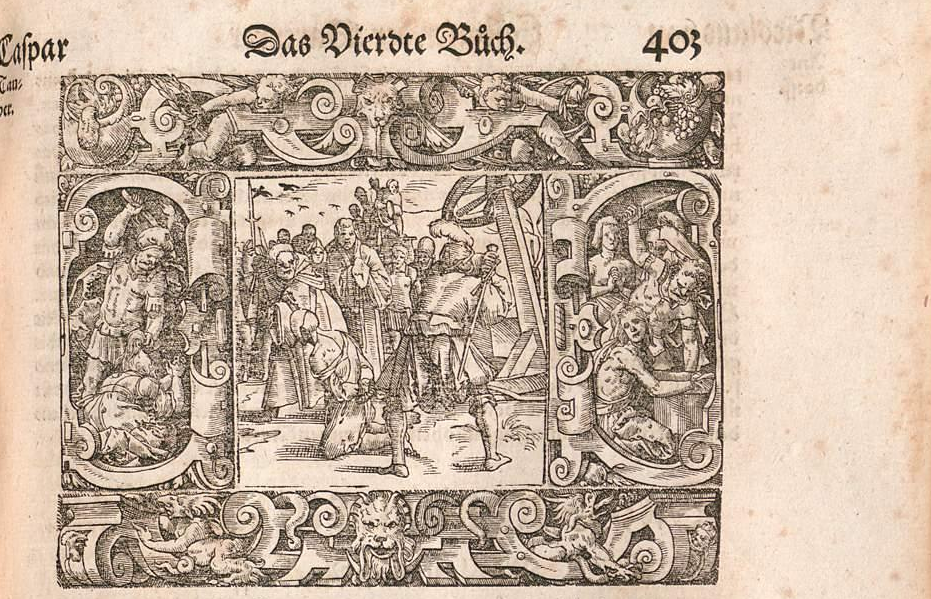
On September 17, 1524 he won the martyr’s crown. Early in the morning at 6 o’clock he was taken to be executed on a cart. Before him was a Roman Catholic priest who reproached him with a little board painted with a crucifix and the image of the Virgin Mary; behind him sat the executioner, beside him were seven servants of the mayor and four henchmen. So the train went secretly behind the town wall by the exchange gate out on the gravel. Arriving at the place of execution, he went joyfully from the carriage and asked all those present that they should not be bad-tempered nor enemies towards those who would be so responsible for his death, for thus it would please God.
Then spoke the papal priest; “Tauber, will you not confess?” The martyr replied: “Arise, my idleness, createth your cause. I have confessed God, my heavenly Father.” The priest replied, “You should see to it that your soul is supplied.” Tauber said, “I have already supplied my soul; and if I still had eighty thousand souls, they would all be supplied today through my faith in God.”
Having said this, he looked up to heaven, and said, “O [Page 5] Lord Jesus Christ, you who have died for our sake and for us, I give Thee thanks that you chose me, unworthy, and hast made me worthy to die for the sake of thy divine Word.” Then he made a cross with his right foot upon the earth and knelt down joyfully on it.
As now the executioner took off his red cap, the dear martyr spoke to him: “Dear Master, take it and carry it from me!” Then the executioner he tore the shirt of the neck Tauber however, very willing and eager to die, wound his hands one over the other, raised his eyes to heaven and said three times with a loud voice, and joyful, fervent heart. “Lord Jesus Christ, into your hands I commend my spirit.”
And immediately his head fell, from which his body was dragged to a large pyre and burned. Thus he fell asleep in the Lord.
From https://religion.orf.at/stories/3226656/
Evangelical martyr Tauber beheaded 500 years ago
500 years ago, on September 17, 1524, the cloth merchant and enthusiastic supporter of Luther’s writings, which were just spreading, Caspar Tauber, was beheaded and his body was burned as that of a heretic. Several ecumenical memorial events in Vienna commemorate the Protestant martyr Tauber.
_____
Caspar Tauber was an early Protestant martyr whose death reflected the intense religious conflict that accompanied the spread of Reformation ideas in sixteenth-century Europe. His execution in Vienna in 1524 demonstrated the determination of authorities to suppress teachings associated with Martin Luther and the growing Reformation movement.
Little is known about Tauber’s early life, but he lived in Vienna during a time when Luther’s writings and ideas were rapidly spreading across the German-speaking world. These teachings challenged many long-standing doctrines and practices of the medieval church, including the authority of the papacy and the system of indulgences. Tauber became an outspoken supporter of these reforming ideas and reportedly shared them openly with others in the city.
Authorities soon took notice of his activities. Because the Holy Roman Empire had declared Luther’s teachings dangerous and heretical, individuals who publicly defended them could face severe punishment. Tauber was arrested and brought before church officials and civil authorities for questioning. During his trial he was urged to renounce the doctrines he supported, but he reportedly refused to abandon his convictions.
After being condemned as a heretic, Tauber was sentenced to death. On September 17, 1524, he was executed in Vienna, becoming one of the earliest individuals put to death in Austria for adherence to Reformation beliefs. His death occurred only a few years after the beginning of the Protestant movement in 1517.
Although not widely known today, Caspar Tauber’s martyrdom illustrates the risks faced by those who embraced Reformation ideas in the early sixteenth century. His story stands as a reminder of the profound religious struggles that shaped the course of European Christianity during the Reformation era.
_____
Image Source/Credit:
• Katholisch.At. “Vor 500 Jahren Wurde Der Evangelische Märtyrer Tauber Hingerichtet.” katholisch.at, www.katholisch.at/aktuelles/149933/vor-500-jahren-wurde-der-evangelische-maertyrer-tauber-hingerichtet&ts=1773428439529
Related
Sorry, no records were found. Please adjust your search criteria and try again.
Sorry, unable to load the Maps API.