From Wikipedia:
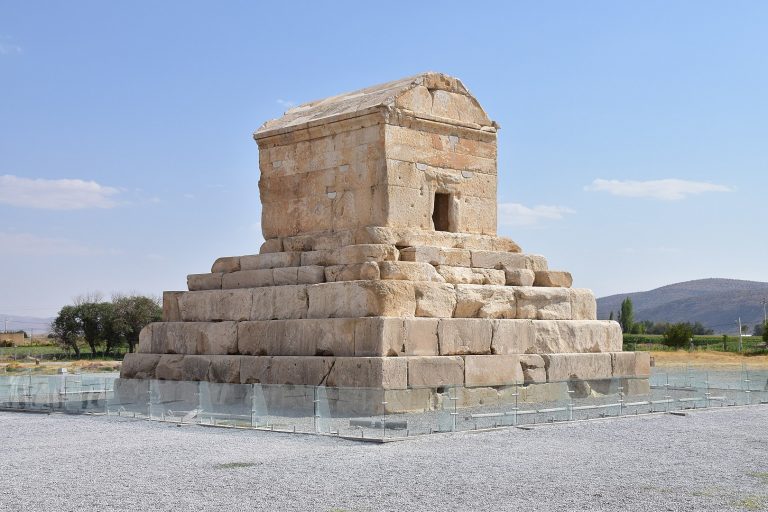
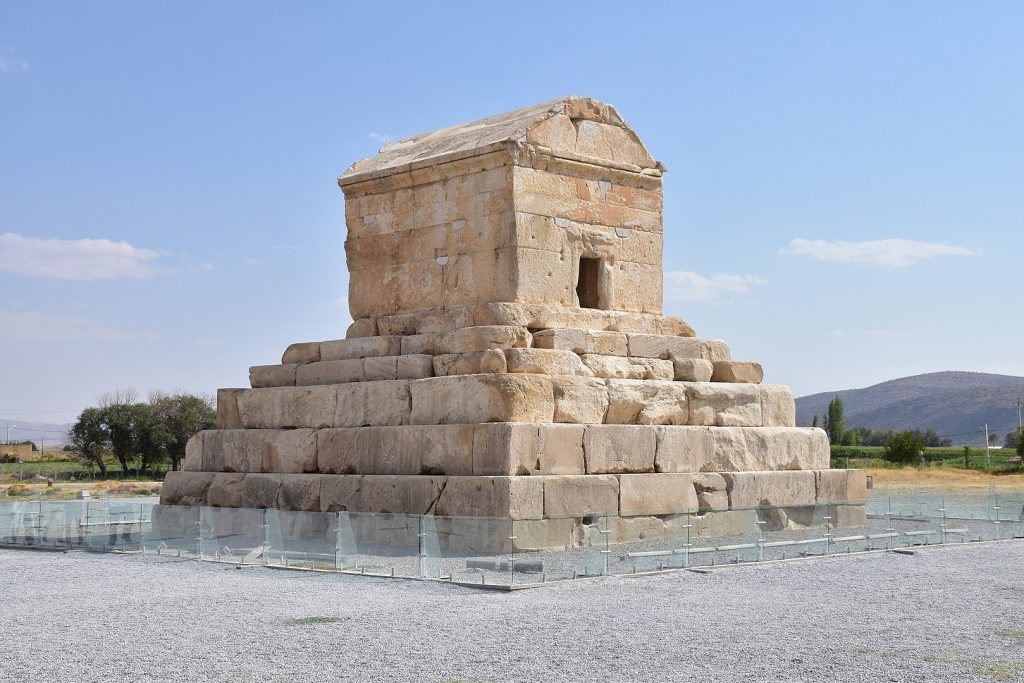
The tomb of Cyrus the Great is located in Pasargadae, which was the first capital city of his Achaemenid Empire and is now an archaeological site in the Fars Province of Iran.
The mausoleum is a significant historical example of earthquake engineering as it is said to be the oldest base-isolated structure in the world, allowing it great resilience against seismic hazards.[4] It is one of the key Iranian UNESCO World Heritage Sites, as part of the archaeological site of Pasargadae.[5]
Identification
Prior to being identified with Cyrus the Great by the British diplomat James Justinian Morier in 1812, it was attributed to a certain “Mother of Solomon” in legendary accounts that had emerged at some point after the Muslim conquest of Iran; Morier’s understanding, drawing upon the works of the German traveller Johan Albrecht de Mandelslo, was that it referred to Wallada bint al-Abbas ibn al-Jaz, who was the mother of Sulayman ibn Abd al-Malik (r. 715–717) of the Umayyad Caliphate. Similar beliefs suggested to the Venetian explorer Giosafat Barbaro in the 15th century asserted that it was the resting place of Bathsheba, who was the mother of Solomon (r. 970–931 BCE) of the Kingdom of Israel and Judah. It was also later identified by Johan Albrecht de Mandelslo.[6]
It was first identified as the Tomb of Cyrus in the early nineteenth century, first in 1812 by James Justinian Morier and then in 1821 by Robert Ker Porter.[7]
Morier described the tomb as follows:
[It] is a building of a form so extraordinary that the people of the country often call it the court of the deevis or devil. It rests upon a square base of large blocks of marble, which rise in seven layers pyramidically… On every part of the monument itself are carved inscriptions, which attest the reverence of its visitors; but there is no vestige of any of the characters of ancient Persia or even of the older Arabic. The key is kept by women, and none but females are permitted to enter. The people generally regard it as the monument of the mother of Solomon, and still connect some efficacy with the name; for they point out near the spot a certain water to which those who may have received the bite of a mad dog resort, and by which, if drank within thirty days, the evil effects of the wound are obviated. In eastern story almost every thing wonderful is attached to the Solomon of Scripture: the King however, to whose mother this tomb is said to be raised, is less incredibly, (as the Carmelites of Shiraz suggested to Mandelsloe), Shah Soleiman, the fourteenth Caliph of the race of Ali. But though this supposition is more probable than that it is the monument of Bathsheba, it is not to my mind satisfactory, as it differs totally from all the tombs of Mahomedan saints which I have ever seen in Persia, Asia Minor, or Turkey.[8]
From Anabasis of Alexander:
[Alexander the Great] was grieved by the outrage committed upon the tomb of Cyrus, son of Cambyses; for according to Aristobulus, he found it dug through and pillaged. The tomb of the famous Cyrus was in the royal park at Pasargadae, and around it a grove of all kinds of trees had been planted. The park was also watered by a stream, and high grass grew in the meadow. The base of the tomb itself had been made of squared stone in the form of a rectangle. Above it there was a stone building surmounted by a roof, with a door leading within, so narrow that even a small man could with difficulty enter, after suffering much discomfort. In the building lay a golden coffin, in which the body of Cyrus had been buried, and by the side of the coffin was a couch, the feet of which were of gold wrought with the hammer. A carpet of Babylonian tapestry with purple rugs formed the bedding; upon it were also a Median coat with sleeves and other tunics of Babylonian manufacture. Aristobulus adds that Median trousers and robes dyed the colour of hyacinth were also lying upon it, as well as others of purple and various other colours; moreover there were collars, sabres, and earrings of gold and precious stones soldered together, and near them stood a table. On the middle of the couch lay the coffin which contained the body of Cyrus. Within the inclosure, near the ascent leading to the tomb, there was a small house built for the Magians who guarded the tomb; a duty which they had discharged ever since the time of Cambyses, son of Cyrus, son succeeding father as guard. To these men a sheep and specified quantities of wheaten flour and wine were given daily by the king; and a horse once a month as a sacrifice to Cyrus. Upon the tomb an inscription in Persian letters had been placed, which bore the following meaning in the Persian language: “O man, I am Cyrus, son of Cambyses, who founded the empire of the Persians, and was king of Asia. Do not therefore grudge me this monument.” As soon as Alexander had conquered Persia, he was very desirous of entering the tomb of Cyrus; but he found that everything else had been carried off except the coffin and couch.
_____
Image Source/Credit:
• By Bernd81 – Own work, CC BY-SA 4.0
Related
Sorry, no records were found. Please adjust your search criteria and try again.
Sorry, unable to load the Maps API.