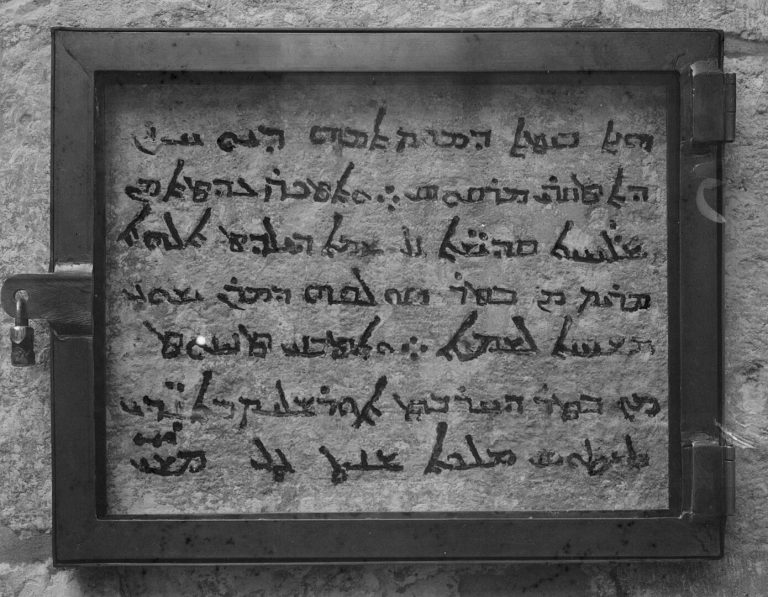
Traditional site of John Mark’s mother’s house, where Peter went after being released from prison:
12 And when he had considered the thing, he came to the house of Mary the mother of John, whose surname was Mark; where many were gathered together praying.
13 And as Peter knocked at the door of the gate, a damsel came to hearken, named Rhoda.
14 And when she knew Peter’s voice, she opened not the gate for gladness, but ran in, and told how Peter stood before the gate.
15 And they said unto her, Thou art mad. But she constantly affirmed that it was even so. Then said they, It is his angel.
16 But Peter continued knocking: and when they had opened the door, and saw him, they were astonished.
17 But he, beckoning unto them with the hand to hold their peace, declared unto them how the Lord had brought him out of the prison. And he said, Go shew these things unto James, and to the brethren. And he departed, and went into another place.
Translation of inscription:
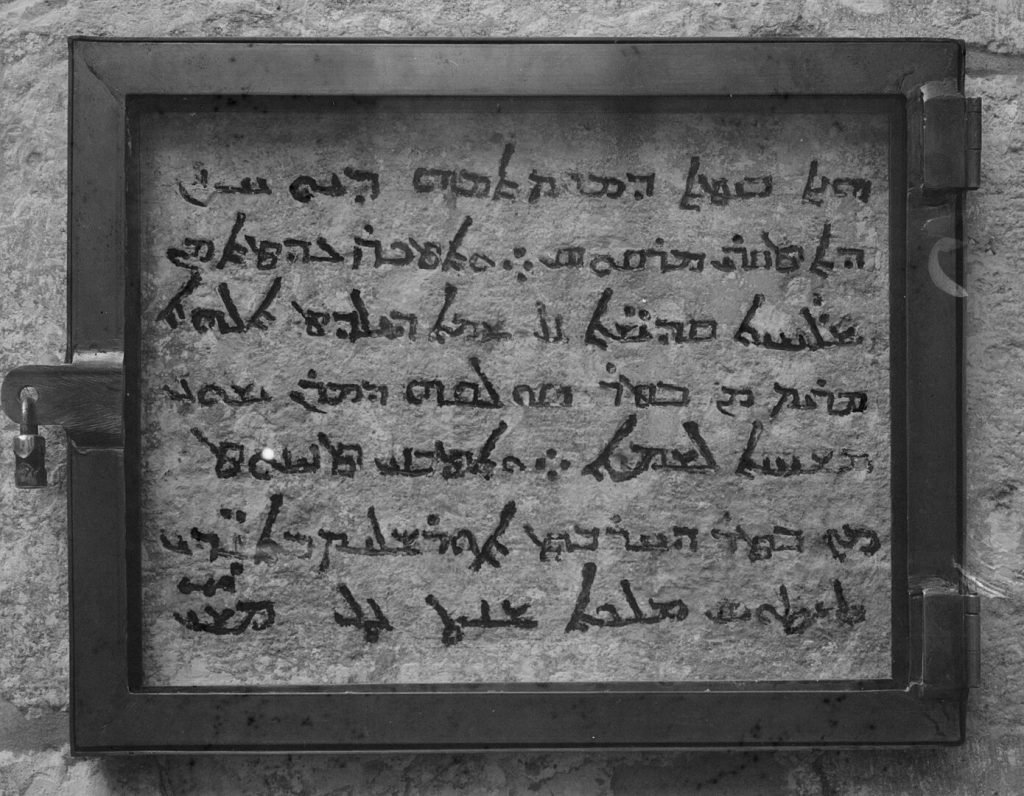
This is the house of Mary, mother of John, called Mark. Proclaimed a church by the holy apostles under the name of the Virgin Mary, mother of God, after the ascension of our Lord Jesus Christ into heaven. Renewed after the destruction of Jerusalem by Titus in the year A.D. 73.
♦ _____ ♦
The Monastery of St. Mark, located in the Old City of Jerusalem, holds a unique and venerable place in Christian history. Revered especially within the Syriac Orthodox Church, the monastery is traditionally associated with some of the earliest events of the Christian faith, giving it both historical depth and enduring spiritual significance.
According to long-held tradition, the Monastery of St. Mark stands on the site of the house of Mary, the mother of John Mark. This house is believed by many to be the location of the Last Supper, where Jesus Christ shared His final meal with His disciples before His crucifixion. It is also associated with other important New Testament events, including the gathering of the disciples after the resurrection and the descent of the Holy Spirit at Pentecost. While other sites in Jerusalem are also connected with these traditions, the Syriac Orthodox community has preserved this particular location as a sacred memory for centuries.
The origins of the monastery itself are ancient, with roots that may reach back to the earliest Christian communities in Jerusalem. Over time, the site developed into a place of worship and monastic life, particularly under the care of Syriac-speaking Christians. These believers brought with them a rich liturgical and linguistic heritage, preserving the use of the Syriac language, a dialect closely related to the Aramaic spoken in the time of Christ.
Throughout its long history, the Monastery of St. Mark has endured periods of hardship and change. Jerusalem’s turbulent past, marked by conquests and shifting political powers, affected all its religious communities. Yet the monastery remained a place of continuity, maintaining its traditions and identity even in difficult times. Its relatively modest size and quiet presence have perhaps helped preserve its character as a place of reflection and devotion.
One of the most remarkable aspects of the monastery is its connection to the ancient Syriac Christian tradition. The liturgy celebrated within its walls reflects practices that have been handed down through generations, offering a living link to the early centuries of Christianity. Inscriptions and manuscripts preserved at the site further testify to this heritage, providing valuable insight into the history of Eastern Christianity.
The legacy of the Monastery of St. Mark lies in its faithful preservation of tradition and its witness to the diversity of the Christian world. While larger and more prominent sites in Jerusalem often draw greater attention, this monastery represents a quieter, yet deeply rooted, expression of faith. It reminds visitors that the history of Christianity is not confined to a single culture or language but has been shaped by many communities across time.
Today, the monastery continues to function as a place of worship and pilgrimage. Visitors are welcomed into its peaceful courtyard and chapel, where they can reflect on the traditions associated with the site and the centuries of devotion it represents. Its enduring presence in the heart of Jerusalem speaks to the resilience of faith and the importance of preserving sacred memory.
In its history and legacy, the Monastery of St. Mark stands as a testament to continuity, humility, and devotion. It offers a window into the early Christian world and a reminder that even the most unassuming places can hold profound spiritual significance.
_____
Image Source/Credit:
• American colony photographers., Public domain, via Wikimedia Commons
Related
Sorry, no records were found. Please adjust your search criteria and try again.
Sorry, unable to load the Maps API.