
The ancient city of Jezreel and the account of Naboth’s Vineyard together form one of the most powerful moral episodes in the history of Israel. Set during the reign of Ahab, this narrative weaves together themes of power, injustice, and divine judgment in a way that has resonated for centuries.
Jezreel was an important royal city in the northern kingdom of Israel, situated in the fertile Jezreel Valley. Its strategic location made it both an administrative center and a desirable residence for the kings of Israel. Archaeological excavations at sites such as Tel Jezreel have revealed fortifications and structures that suggest it served as a royal complex during the time traditionally associated with Ahab’s reign.
The biblical account in 1 Kings 21 introduces Naboth, a Jezreelite who owned a vineyard adjacent to the royal palace. When Ahab desired the vineyard for his own use, he offered to purchase it or exchange it for a better piece of land. Naboth, however, refused, citing the ancestral inheritance laws of Israel, which held that family land was not to be permanently transferred. His refusal was not merely personal but rooted in a deep respect for the covenantal traditions of his people.
Ahab’s reaction was one of frustration and resentment, but it was his wife, Jezebel, who took decisive and tragic action. Determined to secure the vineyard, she orchestrated a false accusation against Naboth, charging him with blasphemy against God and the king. As a result, Naboth was condemned and executed, and Ahab took possession of the vineyard.
This act of injustice did not go unanswered. The prophet Elijah was sent to confront Ahab. In a striking moment, Elijah met the king in the very vineyard he had seized and pronounced divine judgment upon him and his household. The prophecy foretold not only Ahab’s downfall but also the violent end of Jezebel, emphasizing the seriousness of their actions.
The account of Naboth’s Vineyard stands as a powerful illustration of the abuse of power and the consequences of injustice. It highlights the tension between royal authority and divine law, reminding readers that no earthly ruler is above moral accountability. Naboth himself, though a relatively obscure figure, is remembered as a man who remained faithful to his principles even at great personal cost.
The legacy of Jezreel and Naboth’s Vineyard extends beyond its historical and geographical setting. It has served as a moral lesson in both religious and cultural traditions, often cited as a warning against corruption, greed, and the misuse of authority. The story underscores the importance of justice, integrity, and respect for what is rightfully entrusted to others.
Today, the site of Jezreel continues to be studied by archaeologists and visited by those interested in biblical history. While the physical remains offer insight into the ancient city, it is the enduring story of Naboth that gives the place its lasting significance. Together, they stand as a testament to the enduring power of truth and the ultimate accountability of all who wield authority.
♦ ——— ♦
According to 1 Kings 21:1-2, Naboth’s vineyard was located next to King Ahab’s heikal. A heikal is a large, important building, possibly of a military or religious nature. Unfortunately in this context, and in this context only, heikal is always translated into English in the Hebrew Bible as “palace.” In all other instances the word armon is used to denote a palace. We know that the Hebrew word heikal is related to the Akkadian ekallu, a military compound. There is now archaeological and textual evidence that many Assyrian cities contained an ekallu. The fact that Jezreel was the mustering place for the Israelite army means that there probably would have been a large military structure here, a heikal.
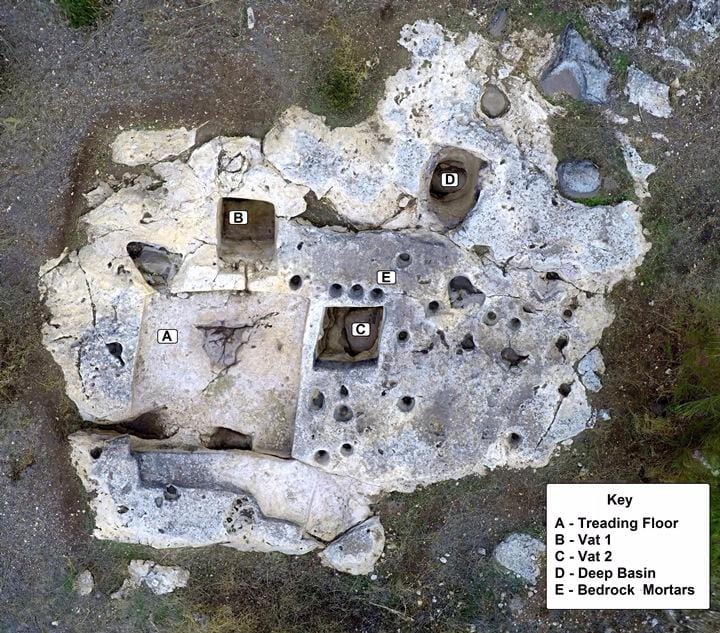
Vineyards do not leave archaeological remains, but circumstantial evidence suggests that Jezreel likely had one. Kibbutz Yizre’el alerted us to the fact that they had independently conducted a soil analysis and found a plot of land with proper quality for growing grapes, whereas the soils in the fields further west were found to be better suited to growing olives.[8]This plot is immediately north of an ancient winery, and during the biblical period wine processing areas were generally located next to vineyards.[9]
_____
Image Source/Credit:
• Tercatin, By Rossella. “Archaeologists Might Have Identified Jezreel Winery Featured in Bible.” The Jerusalem Post | JPost.com, 7 June 2020, www.jpost.com/israel-news/archaeologists-might-have-identified-jezreel-winery-featured-in-bible-630642.
Related
Sorry, no records were found. Please adjust your search criteria and try again.
Sorry, unable to load the Maps API.