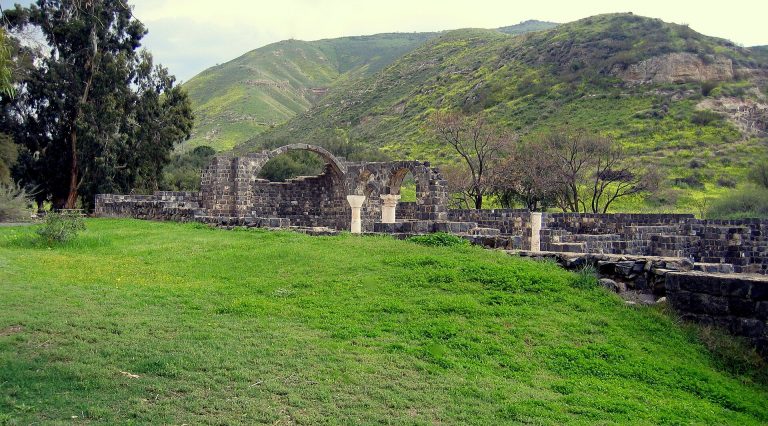
The site of Kursi National Park, located on the eastern shore of the Sea of Galilee, is traditionally associated with one of the most dramatic miracles recorded in the Gospels—the casting out of demons and the subsequent destruction of a herd of swine. This event, often referred to as “The Miracle of the Swine,” is described in the accounts found in the Gospels of Matthew, Mark, and Luke, and has long been connected with the region known in antiquity as the country of the Gadarenes or Gerasenes.
According to the biblical narrative, Jesus and His disciples crossed the Sea of Galilee and came to a region inhabited largely by Gentiles. There they encountered a man possessed by many demons, living among tombs and unable to be restrained. In the Gospel of Mark, the demons identify themselves as “Legion,” indicating their number and power. The man’s condition was desperate—isolated, tormented, and beyond human help.
At the command of Jesus, the demons were driven out of the man. They then requested permission to enter a nearby herd of swine, which was grazing on the hillside. When this was granted, the demons entered the animals, causing the entire herd to rush down a steep slope and plunge into the sea, where they perished. The dramatic nature of the event, along with the complete restoration of the afflicted man, left a strong impression on those who witnessed it.
The location of Kursi has been identified by many scholars as the most likely setting for this miracle. The geography of the site aligns closely with the Gospel description, featuring a steep hillside descending toward the water—an essential detail in the narrative. Archaeological excavations have further strengthened this identification. Remains of a Byzantine monastery and church, dating from the fifth century, have been uncovered at Kursi, suggesting that early Christians regarded this place as the site of the miracle and established a place of commemoration there.
The Byzantine complex at Kursi included a large basilica, courtyards, and living quarters for monks. It served as a pilgrimage destination, where believers could reflect on the power of Christ over evil and the restoration of the afflicted. One notable feature is a chapel built near a cave, which may have been associated with the tombs mentioned in the Gospel account. The presence of these structures indicates the importance of the site in early Christian devotion.
The legacy of Kursi and the Miracle of the Swine extends beyond its historical and archaeological significance. The event itself has been interpreted as a powerful demonstration of authority over spiritual forces and a sign of compassion for those suffering under affliction. It highlights the transformative impact of divine intervention, turning a life marked by despair into one of restoration and peace.
At the same time, the reaction of the local population, who asked Jesus to leave after witnessing the loss of the swine, serves as a reminder of the tension between material concerns and spiritual realities. The story invites reflection on how people respond to acts of power and grace, especially when they challenge established ways of life.
Today, visitors to Kursi encounter both a serene natural setting and the remains of a once-thriving place of worship. The site continues to draw those interested in the historical context of the Gospels as well as those seeking a deeper understanding of their message. In its quiet landscape and enduring tradition, Kursi stands as a testimony to a moment that has captured the imagination and faith of generations.
♦ _____ ♦
Wikipedia:
Kursi (Medieval Greek: Κυρσοί, Hebrew: כורסי, Arabic: الكرسي) is an archaeological site in the Golan Heights containing the ruins of a Byzantine monastery and identified by tradition as the site of Jesus‘ “Miracle of the Swine“.[1] Part of the archaeological site is now an Israeli national park. Kursi takes its name from the Talmudic site.[2] A marble slab with Aramaic text discovered in December 2015 seems to indicate that the settlement had, as of c. 500 CE, a Jewish or Judeo-Christian population.
_____
Image Source/Credit:
• Photo Talmoryair, CC BY 3.0
Related
Sorry, no records were found. Please adjust your search criteria and try again.
Sorry, unable to load the Maps API.