
The Catacombs of Marcellinus and Peter are among the most significant early Christian burial sites in Rome. Located along the ancient Via Labicana, these catacombs provide a vivid window into the life, faith, and artistic expression of the early Christian community during the late Roman Empire.
The catacombs are named after two early Christian martyrs, Marcellinus and Peter, who were believed to have been executed during the persecution of Christians under the Roman Emperor Diocletian in the early fourth century. According to tradition, they were buried in this location, and their graves soon became places of veneration. Over time, the site developed into an extensive underground cemetery, reflecting the growing number of Christians in Rome.
Constructed between the late third and early fourth centuries, the catacombs consist of a complex network of galleries, chambers, and burial niches carved into the soft volcanic rock beneath the surface. These passageways, sometimes stretching for miles, were used not only for burial but also for quiet remembrance and, at times, for worship. While the idea of Christians hiding in the catacombs during persecution has often been exaggerated, the site nonetheless represents a period when the Christian faith was not yet fully accepted within Roman society.
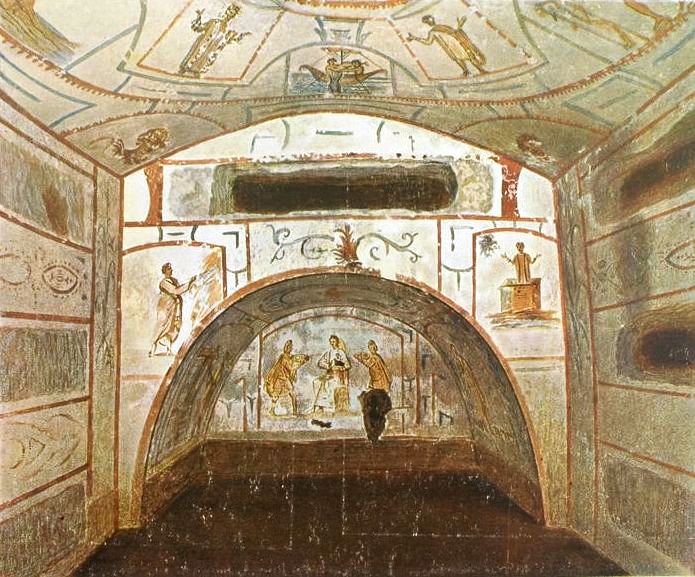
One of the most remarkable features of the Catacombs of Marcellinus and Peter is their rich decoration. The walls and ceilings are adorned with frescoes that provide insight into early Christian beliefs and artistic traditions. These paintings include biblical scenes such as the story of Jonah, the Good Shepherd, and the raising of Lazarus. The imagery is often symbolic, reflecting themes of salvation, resurrection, and eternal life. These works are among the earliest examples of Christian art and show how believers expressed their faith visually in a time of uncertainty.
The catacombs also contain numerous inscriptions, many of which offer a glimpse into the daily lives of early Christians. Simple epitaphs reveal names, relationships, and expressions of hope in the afterlife. Together, these elements create a powerful testimony to the faith and community of the early church.
Following the legalization of Christianity under Emperor Constantine in the early fourth century, the use of catacombs gradually declined. As public worship became more accepted and churches were built above ground, burial practices changed. Nevertheless, the Catacombs of Marcellinus and Peter continued to be revered, particularly as a site associated with martyrdom.
In later centuries, the catacombs fell into relative obscurity, as attention shifted to more prominent churches and relics. However, they were rediscovered and studied in modern times, leading to a renewed appreciation of their historical and religious significance. Today, they are preserved as an important archaeological and cultural site, open to visitors who wish to explore the early history of Christianity in Rome.
The legacy of the Catacombs of Marcellinus and Peter lies in their witness to a formative period of Christian history. They remind us of a time when faith was often practiced quietly and at great cost, yet remained steadfast. Through their art, inscriptions, and sacred associations, the catacombs continue to speak of hope, endurance, and the enduring promise of life beyond death.
♦ _____ ♦
From Wikipedia:
The Catacombs of Marcellinus and Peter are found approximately three kilometers from southeast Rome and the ancient Via Labicana, and date to the 4th century AD.[1] The catacombs were named in reference to the Christian martyrs Marcellinus and Peter who may have been buried there according to legend, near the body of St. Tiburtius.[2]
During excavations performed from 2004 to 2010, an estimated 20,000 skeletons were discovered in these catacombs; the skeletons were buried in loculi (individually buried within a niche), arcosolia (a burial under an arched recess), or cubicala (individuals grouped together into a burial chamber).[1] The catacombs “cover 3 hectares with 4.5 kilometers of subterranean galleries on three different levels”.[1]
Within the catacombs is a variety of frescoes representative of pagan and Christian traditions and a few small artifacts. The significance of the pieces of art can be traced to the time period they were commissioned and some possible influence from the inhabitants of the catacombs.
_____
Image Source/Credit:
• AnonymousUnknown author, Public domain, via Wikimedia Commons
Related
Sorry, no records were found. Please adjust your search criteria and try again.
Sorry, unable to load the Maps API.