The Arch of Titus is one of the most significant surviving monuments of ancient Rome, both for its artistic achievement and for the historical events it commemorates. Located on the Via Sacra at the entrance to the Roman Forum, the arch was constructed to honor the Roman emperor Titus and his victory in the Siege of Jerusalem during the First Jewish–Roman War.
Erected shortly after Titus’s death in 81 CE by his brother and successor, Domitian, the arch served both as a memorial and as a political statement. It celebrated Titus’s military success while reinforcing the legitimacy of the Flavian dynasty. In ancient Rome, triumphal arches were powerful symbols, designed to commemorate victories and to glorify the achievements of emperors. The Arch of Titus is among the earliest surviving examples of this architectural form and set a precedent for later monuments throughout the Roman world.
The arch is constructed of marble and stands approximately 15 meters high. Its single, large passageway is flanked by engaged columns, giving the structure both strength and elegance. The simplicity of its exterior contrasts with the rich sculptural decoration found within. The interior reliefs are among the most important artistic features of the monument, offering a vivid depiction of the Roman triumph that followed the conquest of Jerusalem.
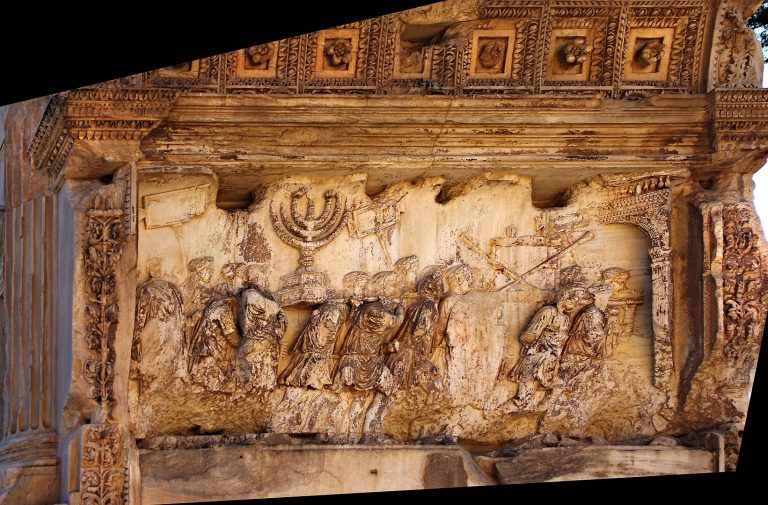
One of the most famous relief panels shows Roman soldiers carrying spoils taken from the Second Temple in Jerusalem. Among these sacred objects is the menorah, the seven-branched lampstand that held deep religious significance for the Jewish people. This image is one of the earliest surviving representations of the menorah and has become an enduring symbol, reproduced in various forms over the centuries. Another panel depicts Titus himself riding in a triumphal procession, crowned with a laurel wreath, accompanied by figures representing victory and honor.
The arch also bears an inscription dedicating it to the “divine Titus,” reflecting the Roman practice of deifying emperors after their death. This inscription underscores the dual purpose of the monument: it commemorates a historical event while also elevating the status of the emperor to a near-divine level. In this way, the arch functioned as both propaganda and memorial.
Historically, the Arch of Titus holds deep significance beyond Roman history. For the Jewish people, it represents a moment of profound loss—the destruction of Jerusalem and the Second Temple, events that led to the dispersion of the Jewish population. For centuries, the arch stood as a symbol of that defeat. In modern times, however, it has also been reinterpreted as a reminder of resilience and continuity.
During the medieval period, the arch was incorporated into a fortress and later fell into disrepair. It was restored in the nineteenth century, preserving its original features while ensuring its survival for future generations. Today, it remains one of the most visited landmarks in Rome, drawing scholars, tourists, and those interested in both ancient history and religious heritage.
The Arch of Titus continues to serve as a powerful link between past and present. Its reliefs provide invaluable insight into Roman art and imperial ideology, while its historical associations evoke reflection on the broader consequences of conquest and conflict. As a monument, it stands not only as a celebration of Roman achievement but also as a reminder of the complex and often painful history that shaped the ancient world.
_____
Image Source/Credit:
• Paolo Villa, CC BY-SA 4.0 <https://creativecommons.org/licenses/by-sa/4.0>, via Wikimedia Commons
Related

Sorry, no records were found. Please adjust your search criteria and try again.
Sorry, unable to load the Maps API.