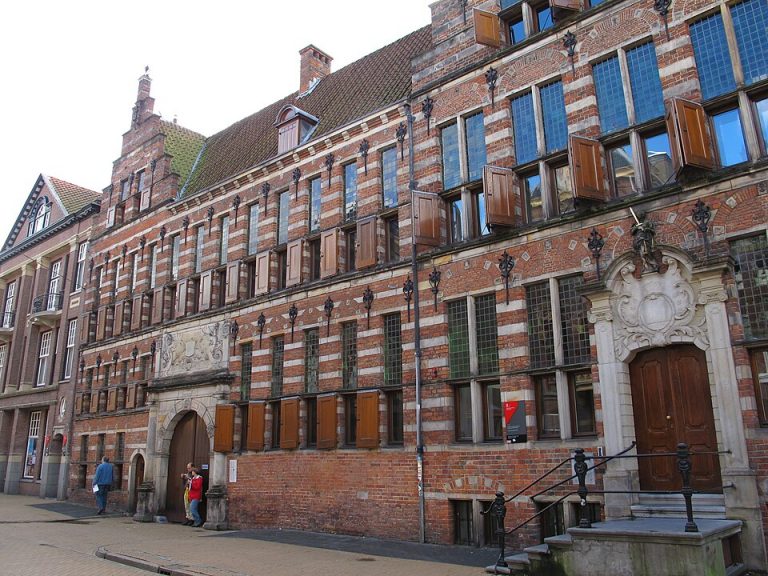
The historic buildings at Oude Boteringestraat 36-38 in Groningen represent one of the most significant architectural and judicial landmarks in the city’s past. Situated along one of Groningen’s oldest and most distinguished streets, this complex reflects centuries of civic life, legal authority, and urban development.
The origins of the structure date back to the late medieval period. Parts of the building, particularly in its core construction, can be traced to as early as the fifteenth century, with some elements possibly reaching even further into the fourteenth century. Like many buildings in the historic center of Groningen, it began as a substantial town house, belonging to members of the local elite. In the seventeenth century, it was remodeled into the residence of Abel Coenders van Helpen, a prominent mayor of the city, reflecting its status as a patrician dwelling.
A decisive transformation occurred in 1754, when the building was expanded and adapted to serve as the seat of the provincial court, known as the Hoge Justitiekamer of Stad en Lande. This change marked the transition of the property from a private residence to a center of public authority. To accommodate its new role, a richly decorated courtroom and associated legal chambers were added. These interiors, featuring carved woodwork, formal paneling, and symbolic ornamentation, conveyed both the dignity and the gravity of judicial proceedings in the eighteenth century.
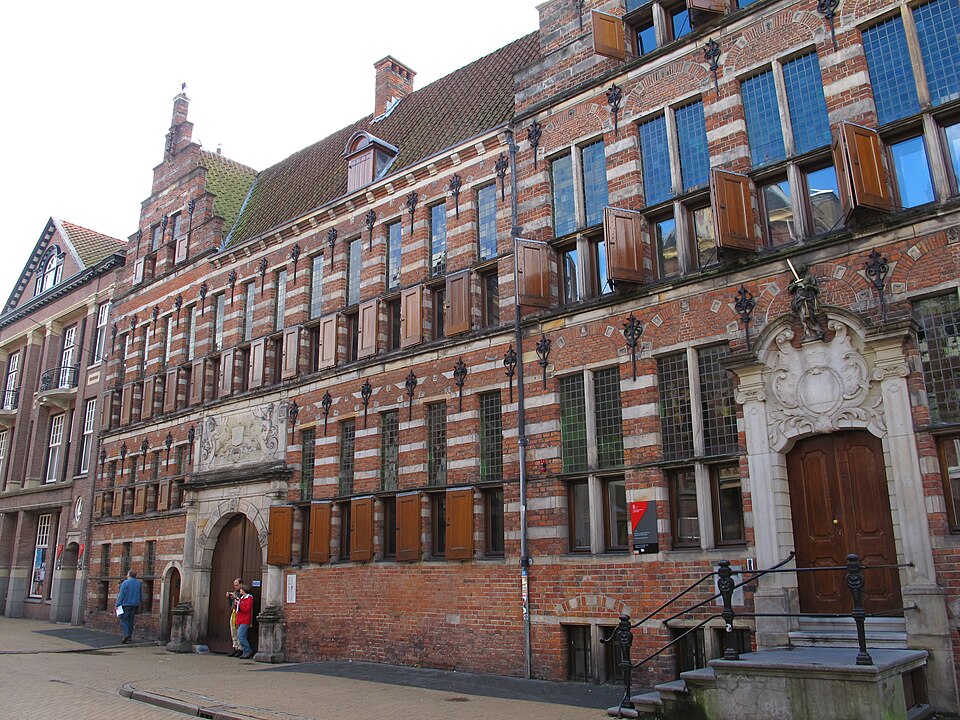
Architecturally, the building presents a layered history. Its façade, restored in the early twentieth century to reflect seventeenth-century stylistic elements, includes traditional Dutch features such as stepped gables, stone bands, and tall, narrow window bays. A notable entrance portal, dating to the early seventeenth century, is framed by classical elements and crowned with decorative detailing, emphasizing the building’s importance. Inside, remnants of earlier periods—such as medieval cellars, timber roof structures, and later decorative additions—coexist, illustrating the gradual evolution of the structure over time.
For more than two centuries, Oude Boteringestraat 36–38 functioned as a center of justice. Various courts operated within its walls, including the regional court (arrondissementsrechtbank), making it a focal point for legal administration in Groningen. In this role, the building witnessed countless trials, decisions, and legal developments, serving as an instrument of governance and order in both provincial and national contexts.
By the late twentieth century, however, the building’s role began to change. In 1998, its function as a courthouse came to an end, reflecting broader shifts in judicial infrastructure and the need for more modern facilities. The structure was subsequently repurposed, becoming part of the University of Groningen, where it has been used for academic purposes, including housing theological and university-related functions.
The legacy of Oude Boteringestraat 36–38 lies in its remarkable continuity and adaptability. From medieval residence to mayoral home, from court of law to university building, it has continually served the civic and intellectual life of Groningen. Its designation as a national monument underscores its importance, not only as an architectural artifact but also as a witness to the city’s institutional history.
Today, the building stands as a quiet yet powerful reminder of Groningen’s past. Its walls embody centuries of authority, learning, and community life. In preserving and repurposing such a structure, the city maintains a tangible connection to its heritage, ensuring that the legacy of this historic site continues to inform and enrich the present.
_____
Image Source/Credit (in order):
• Effeietsanders, CC BY-SA 3.0 NL <https://creativecommons.org/licenses/by-sa/3.0/nl/deed.en>, via Wikimedia Commons
Related
Sorry, no records were found. Please adjust your search criteria and try again.
Sorry, unable to load the Maps API.