English Translation from HMDB:
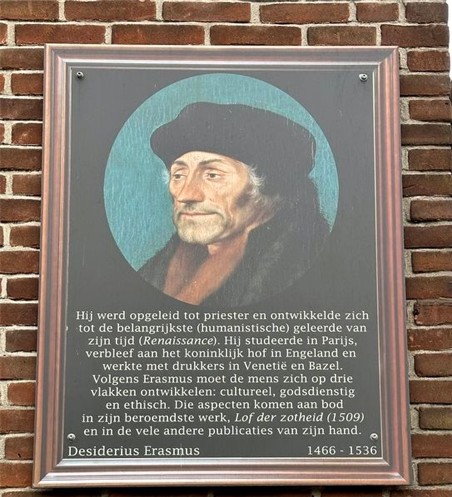
He was trained as a priest and developed into the most important (humanist) scholar of his time (Renaissance). He studied in Paris, stayed at the royal court in England and worked with printers in Venice and Basel. According to Erasmus, man must develop in three areas: cultural, religious and ethical. These aspects are discussed in his most famous work, Lof der zotheid (“In Praise of Folly” – original Latin title Stultitiae laus, 1509) and in many other publications by him.
♦ _____ ♦
The life and legacy of Desiderius Erasmus stand among the most influential in the intellectual and religious history of Europe. Born around 1466 in Rotterdam, Erasmus rose from modest beginnings to become one of the foremost scholars of the Renaissance Humanism. His work helped shape the course of education, biblical scholarship, and religious thought during a period of great change.
Orphaned at a young age, Erasmus was educated in monastic schools and eventually entered religious life, though he never felt entirely at home within the confines of the monastery. His intellectual gifts soon became apparent, and he devoted himself to the study of classical literature, especially the works of ancient Greek and Roman authors. Like other humanists, Erasmus believed that a return to the original sources—ad fontes—was essential for both learning and faith. This conviction led him to study the Bible in its original languages, rather than relying solely on the Latin translations that had long been standard in Western Europe.
Erasmus is perhaps best known for his groundbreaking edition of the Greek New Testament, first published in 1516. This work, often called the Novum Instrumentum Omne, provided scholars with a more accurate text of the Scriptures and included his own Latin translation alongside the Greek. It became a foundational text for later translators, including those who produced vernacular Bibles that would reach a broader audience. In this way, Erasmus contributed significantly to the spread of biblical literacy and the reform of Christian thought.
In addition to his scholarly work, Erasmus was a gifted writer with a sharp wit and a keen sense of moral concern. His most famous literary work, The Praise of Folly, published in 1509, offered a satirical critique of the abuses and excesses he observed within society and the Church. Through humor and irony, Erasmus exposed the vanity, superstition, and corruption of his age, while calling for a return to genuine Christian piety grounded in humility and charity.
Although Erasmus lived during the time of the Protestant Reformation, he occupied a unique and often misunderstood position. He shared many of the reformers’ concerns about the need for renewal within the Church, yet he sought reform through education, dialogue, and moral example rather than division. His emphasis on inner devotion and ethical living reflected what has often been called a “philosophy of Christ,” a practical and heartfelt approach to faith.
Erasmus maintained friendships with leading figures of his day, including Thomas More, and his correspondence reveals a man deeply engaged with the intellectual currents of Europe. Despite criticism from both reformers and traditionalists, he remained committed to moderation and unity.
When Erasmus died in 1536 in Basel, he left behind a legacy that would endure far beyond his lifetime. His devotion to learning, his insistence on returning to foundational texts, and his call for sincere Christian living helped shape the course of Western thought. In an age often marked by conflict, Erasmus stands as a voice for wisdom, balance, and the enduring value of thoughtful reform.
_____
Image Source/Credit:
• Photographed by Andrew Ruppenstein, March 17, 2024 HMDB.org
Related
Sorry, no records were found. Please adjust your search criteria and try again.
Sorry, unable to load the Maps API.