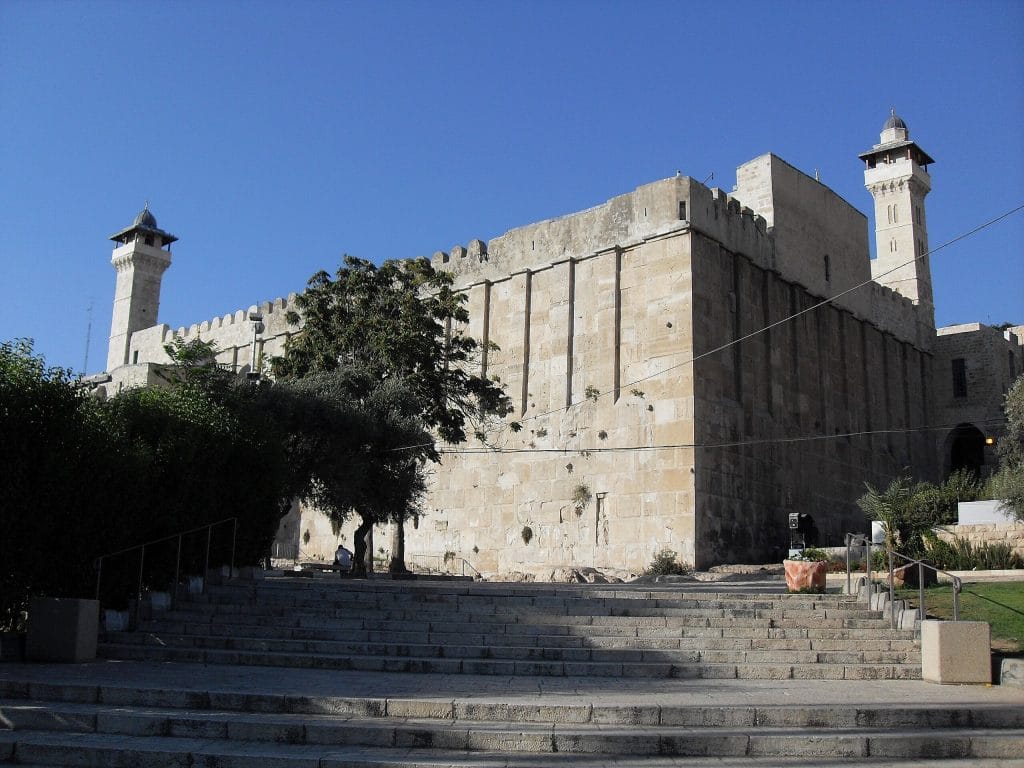
The building is from the time of Herod – but the Cave was visited much earlier.
The Cave of Machpelah stands among the most ancient and revered sites in the biblical world. Located in the historic city of Hebron, it is traditionally recognized as the burial place of the patriarchs and matriarchs of Israel—Abraham, Isaac, and Jacob, along with their wives. For the Jewish people, this site is second in holiness only to the Temple Mount in Jerusalem, and it carries deep historical, spiritual, and cultural meaning.
The origins of the Cave of Machpelah are recorded in the Book of Genesis. According to the biblical account, Abraham purchased the cave and the surrounding field from a Hittite named Ephron as a burial place for his wife Sarah. This transaction is notable as one of the earliest recorded land purchases in Scripture, emphasizing both its legal significance and its enduring importance. Abraham himself was later buried there, followed by Isaac and Rebekah, and Jacob and Leah. In Jewish tradition, this makes the cave the resting place of the founding family of the nation.
The structure that stands over the cave today is an impressive rectangular enclosure built during the reign of Herod the Great in the first century BCE. Massive stone walls, some of which remain intact, reflect the distinctive architectural style associated with Herod’s other building projects. Over the centuries, the site has been modified and used by various religious communities, including Jews, Christians, and Muslims, each of whom reveres the patriarchs.
Despite these changes, the Jewish connection to the Cave of Machpelah has remained constant. For centuries, access for Jewish worshippers was restricted under different rulers, particularly during periods of Islamic control when Jews were often permitted only limited entry. It was not until modern times that fuller access was restored, allowing Jewish prayer within the complex itself. Today, the site functions as a shared holy place, with designated areas for Jewish and Muslim worship.
The cave itself lies beneath the surface and is not fully accessible to the public. What visitors see today are cenotaphs—memorial markers—within the structure above, representing the traditional burial locations of the patriarchs and matriarchs. These markers are treated with great reverence, and the atmosphere within the building reflects centuries of prayer and devotion.
For Jewish pilgrims, visiting the Cave of Machpelah is an act of deep spiritual connection. It is a place where the past feels close at hand, where the stories of Genesis are not distant narratives but living traditions tied to a physical location. Prayers offered there often focus on continuity—linking present generations with their ancient ancestors—and on the enduring covenant between God and the people of Israel.
The significance of the site extends beyond its religious importance. It is also a symbol of heritage and identity, representing the deep historical roots of the Jewish people in the land. At the same time, its shared status has made it a focal point of tension as well as cooperation, reflecting the broader complexities of the region.
In sum, the Cave of Machpelah is far more than an ancient burial site. It is a cornerstone of biblical history, a testament to faith, and a place where tradition and memory are preserved across millennia. Its enduring presence in Hebron continues to draw those who seek a connection to the earliest chapters of the Jewish story.
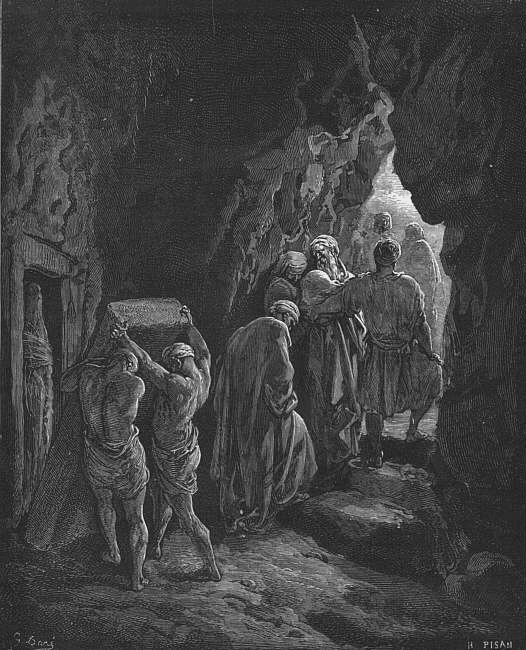
Sarah’s Burial | Pitts Digital Image Archive | Emory University (dia.pitts.emory.edu/image_details.cfm?ID=17052)
_____
Image Source/Credit:
• Internet Archive Book Images, No restrictions, via Wikimedia Commons