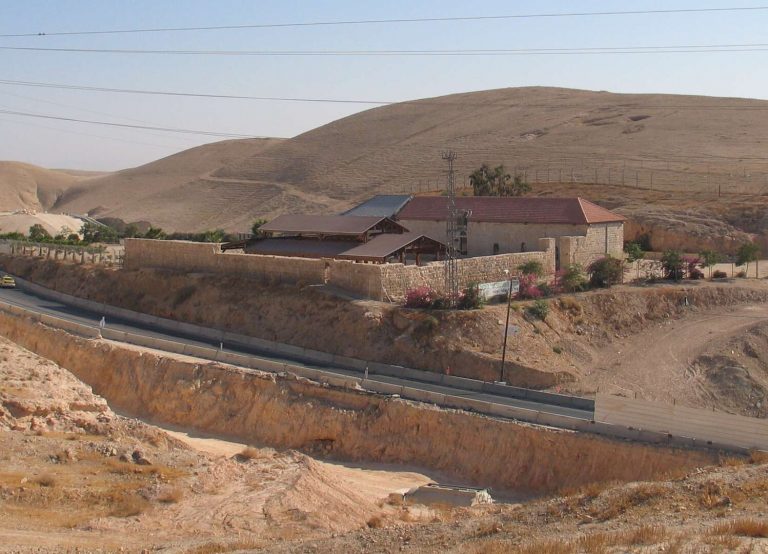
The Inn of the Good Samaritan is a traditional site associated with one of the most well-known parables of Jesus Christ, found in the Gospel of Luke. Located along the ancient road between Jerusalem and Jericho, the site has long been linked to the story of the Good Samaritan, a teaching that has profoundly shaped Christian understanding of compassion and neighborly love.
The parable itself, recorded in Luke 10:25–37, tells of a man traveling from Jerusalem to Jericho who is attacked by robbers, beaten, and left for dead. Several passersby, including a priest and a Levite, ignore the injured man. It is a Samaritan—belonging to a group often despised by Jews of the time—who stops to help. He tends the man’s wounds, places him on his own animal, and brings him to an inn, where he pays for his care and promises to cover any additional expense. The story was told by Jesus in response to a question about who qualifies as one’s neighbor, and it emphasizes mercy, humility, and practical kindness.
The road from Jerusalem to Jericho, descending steeply through rocky and desolate terrain, has long been known for its dangers. In ancient times, it was notorious for banditry, making it a fitting setting for the parable. Over the centuries, travelers and pilgrims identified certain locations along this route as possible settings for the events described in the Gospel. The Inn of the Good Samaritan emerged from this tradition as a place where the wounded man might have been taken.
Historically, the site developed as a stopping point for travelers. During the Byzantine period, a church and hostel were established there to serve pilgrims journeying between Jerusalem and the Jordan Valley. Archaeological remains from this period suggest that the area was indeed used as a place of rest and refuge. In later centuries, particularly under Ottoman rule, the site continued to function as a roadside inn, reinforcing its association with the biblical story.
Today, the location is preserved as a historical and cultural site. Visitors can explore the remains of ancient structures, including mosaics from the Byzantine era, which reflect the long-standing Christian presence in the region. The site also serves as a museum, offering insight into the history of the area and the development of the Good Samaritan tradition.
The legacy of the Inn of the Good Samaritan extends far beyond its physical location. Whether or not it can be identified with certainty as the exact setting of the parable, it stands as a powerful symbol of the values the story conveys. The figure of the Samaritan, who shows compassion across social and cultural boundaries, has become a universal example of selfless care for others.
In Christian teaching, the parable has been interpreted not only as a moral lesson but also as a reflection of divine mercy. The inn, in this sense, has sometimes been seen as a symbol of refuge and healing—a place where the wounded are cared for and restored.
In its history and tradition, the Inn of the Good Samaritan continues to remind visitors of the enduring call to compassion. It invites reflection on the simple yet profound question posed by the parable: how one responds to the needs of others. Through its association with this timeless teaching, the site remains a meaningful point of connection between the biblical narrative and the lived experience of faith.
♦ _____ ♦
Wikipedia:
The Inn of the Good Samaritan is a national park, museum, ancient archaeological site and former inn administered by the Israel Nature and Parks Authority located near Ma’ale Adumim, halfway between Jerusalem and Jericho, at an elevation of 298 meters above sea level.[2]
The Inn is named after the New Testament‘s Parable of the Good Samaritan, and houses a museum of ancient mosaics and other archaeological findings mostly dating from the 4th-7th centuries that were collected from churches and Jewish and Samaritan synagogues from the West Bank and from the ancient Gaza synagogue.
Beginning in biblical times, Jewish pilgrims from the Galilee took the nearby Jerusalem-Jericho road to worship at the Temple in Jerusalem. In later times, Christian pilgrims used the road to reach the baptismal site of Jesus on the Jordan River, near Jericho. The area of the Inn of the Good Samaritan was repeatedly fortified, and traveller-inns were built a little below the hilltop. This is reflected in the presence of two distinct, if related, archaeological sites in close proximity to each other, the other site being the ruins of a castle believed to have been built by King Herod although today they are separated by the modern Jerusalem–Jericho highway.
_____
Image Source/Credit:
• Photo By Bukvoed – Own work, CC BY 3.0
Related
Sorry, no records were found. Please adjust your search criteria and try again.
Sorry, unable to load the Maps API.