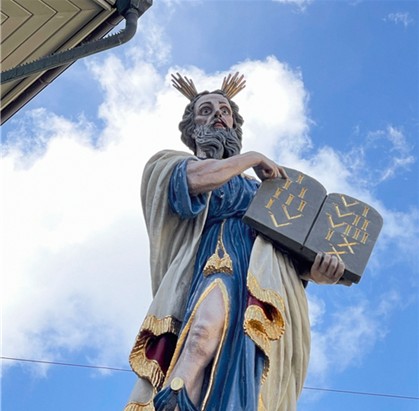
Beautiful statue of Moses holding the Ten Commandments above the Water Fountain.
Mosesbrunnen is one of the most striking and symbolically rich fountains in the historic city of Bern. Located in the old town, which is recognized as a UNESCO World Heritage site, the fountain reflects both the artistic traditions of the Renaissance and the enduring influence of biblical imagery in Swiss civic life.
The Moses Fountain, or Mosesbrunnen, was originally constructed in 1544 during a period when Bern was flourishing as a center of political and cultural importance. Like many of the city’s famous fountains, it was designed not only to provide water but also to convey moral and religious messages to the public. The figure atop the column represents Moses, the Old Testament lawgiver, holding the tablets of the Ten Commandments.
The statue itself was created by the sculptor Hans Gieng, who was responsible for several of Bern’s iconic fountains. His work is characterized by vivid color, expressive detail, and strong symbolic content. In the Mosesbrunnen, Moses is depicted pointing to the commandments, emphasizing the importance of divine law and moral order.
During the sixteenth century, Bern underwent significant religious transformation as it embraced the principles of the Protestant Reformation. The inclusion of a biblical figure like Moses in a public monument reflects the city’s emphasis on Scripture and its role in shaping both personal conduct and public governance. The fountain thus served as a daily reminder to citizens of the moral foundations upon which society was believed to rest.
Over the centuries, the Mosesbrunnen has been carefully preserved and restored, maintaining its original artistic character while adapting to the needs of a modern city. Its bright colors and detailed craftsmanship continue to attract visitors from around the world.
Today, the Mosesbrunnen stands as both a functional fountain and a historical monument. It represents the blending of art, faith, and civic identity that defined Renaissance Bern. As part of the city’s celebrated series of fountains, it remains a vivid reminder of a time when public art was intended not only to beautify urban spaces but also to instruct and inspire those who passed by.
_____
From Wikipedia – regarding the Horns of Moses:
Depictions of a horned Moses stem from the description of Moses’ face as “cornuta” (“horned”) in the Latin Vulgate translation of the passage found at Exodus chapter 34, specifically verses 29, 30 and 35, in which Moses returns to the people after receiving the commandments for the second time.[2] The Catholic Douay–Rheims Bible (1609) translates the Vulgate as, “And when Moses came down from the Mount Sinai, he held the two tables of the testimony, and he knew not that his face was horned from the conversation of the Lord.”[3] This was Jerome‘s effort to faithfully translate the difficult, original Hebrew text, which uses the term קָרַן, qāran (based on the root, קֶרֶן qeren, which often means “horn”); the term is now interpreted to mean “shining” or “emitting rays” (somewhat like horns).[4][5] The Anglican King James or Authorised Version of only a few years later has no horns, but a shining face “… when he came down from the mount, that Moses wist not that the skin of his face shone while he talked with him.”[6]
_____
Image Source/Credit:
• Conceptuel, CC0, via Wikimedia Commons
Related
Sorry, no records were found. Please adjust your search criteria and try again.
Sorry, unable to load the Maps API.