The John Calvin’s House in Geneva stands as an important historical site connected to one of the central figures of the Protestant Reformation, John Calvin. Though modest in appearance, the residence reflects both the personal character of Calvin and the far-reaching influence of his work during the sixteenth century.
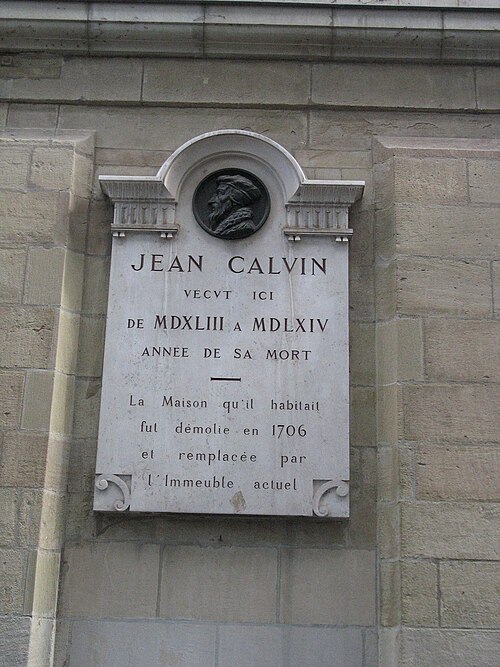
John Calvin settled in Geneva permanently in 1541 after an earlier period of exile. Upon his return, he was provided a residence by the city authorities at what is now known as the Rue de Calvin, near Saint Pierre Cathedral. This house became his home for the remainder of his life, until his death in 1564. Unlike the grand homes of political leaders, Calvin’s dwelling was simple and functional, in keeping with his emphasis on discipline, humility, and devotion to study.
Within this residence, Calvin carried out an extraordinary volume of work. It was here that he wrote and revised his most influential theological treatise, Institutes of the Christian Religion, a work that helped to define Reformed theology and continues to be studied to this day. From his study, he also composed commentaries on much of the Bible, countless letters to leaders across Europe, and sermons that were often delivered at nearby churches such as Saint Pierre Cathedral.
The house served not only as a private residence but also as a center of activity for the Reformation in Geneva. Students, pastors, and political figures regularly visited Calvin there, seeking counsel and instruction. In many respects, the home functioned as an extension of his public ministry, a place where ideas were developed and relationships were forged that would shape the course of Protestantism far beyond the city’s walls.
Geneva during this period became a hub for religious refugees, particularly from France, who fled persecution for their Protestant beliefs. Calvin’s house thus stood within a broader network of hospitality and support that characterized the city. While the house itself was not large, it symbolized the openness of Geneva to those seeking refuge and the determination of its leaders to promote reform.
After Calvin’s death, the house continued to be associated with his memory, though the original structure underwent changes over the centuries. Today, the site is marked and preserved as a place of historical significance, even if the exact interior no longer reflects its sixteenth-century condition. Visitors who come to the location do so not for architectural grandeur but for its connection to a man whose ideas profoundly shaped the religious landscape of the Western world.
The legacy of John Calvin’s House lies less in the building itself and more in what it represents. It is a reminder that much of the Reformation’s intellectual and spiritual labor took place in quiet settings—studies, meeting rooms, and homes where careful thought and disciplined writing could flourish. From this modest residence came ideas that influenced churches, governments, and societies across continents.
In the end, the house stands as a symbol of Calvin’s life and work: orderly, purposeful, and deeply committed to the authority of Scripture. It invites reflection on the power of ideas developed in private and carried into the public sphere. As such, it remains an enduring part of Geneva’s Reformation heritage and a testament to the lasting impact of one man’s dedication to faith and scholarship.
♦ _____ ♦
From Wikipedia:
During his ministry in Geneva, Calvin preached over two thousand sermons. Initially he preached twice on Sunday and three times during the week. This proved to be too heavy a burden and late in 1542 the council allowed him to preach only once on Sunday. In October 1549, he was again required to preach twice on Sundays and, in addition, every weekday of alternate weeks. His sermons lasted more than an hour and he did not use notes. An occasional secretary tried to record his sermons, but very little of his preaching was preserved before 1549. In that year, professional scribe Denis Raguenier, who had learned or developed a system of shorthand, was assigned to record all of Calvin’s sermons. An analysis of his sermons by T. H. L. Parker suggests that Calvin was a consistent preacher and his style changed very little over the years.[41][42] John Calvin was also known for his thorough manner of working his way through the Bible in consecutive sermons. From March 1555 to July 1556, Calvin delivered two hundred sermons on Deuteronomy.[43]
Very little is known about Calvin’s personal life in Geneva. His house and furniture were owned by the council. The house was big enough to accommodate his family as well as Antoine’s family and some servants. On 28 July 1542, Idelette gave birth to a son, Jacques, but he was born prematurely and survived only briefly. Idelette fell ill in 1545 and died on 29 March 1549. Calvin never married again. He expressed his sorrow in a letter to Viret:
I have been bereaved of the best friend of my life, of one who, if it has been so ordained, would willingly have shared not only my poverty but also my death. During her life she was the faithful helper of my ministry. From her I never experienced the slightest hindrance.[45]
_____
Image Source/Credit (in order):
• Rokus Cornelis, CC BY 3.0 (creativecommons.org/licenses/by/3.0), via Wikimedia Commons
Related
Sorry, no records were found. Please adjust your search criteria and try again.
Sorry, unable to load the Maps API.