From Wikipedia:
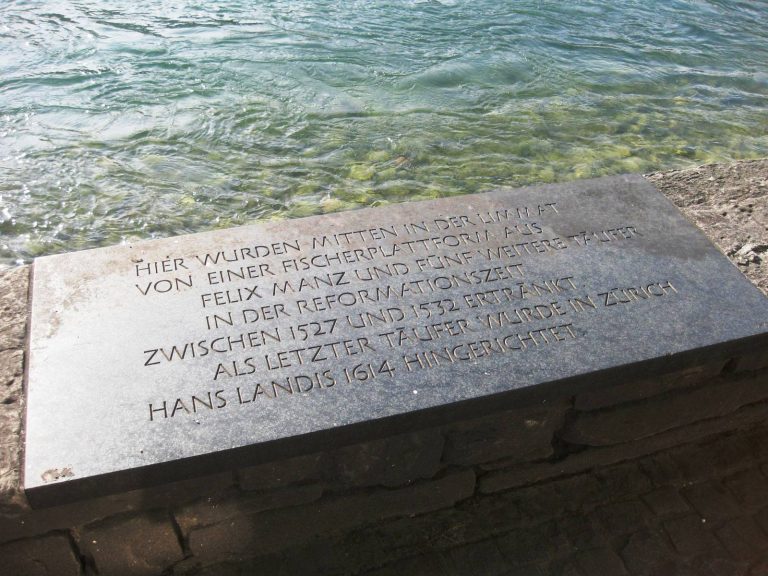
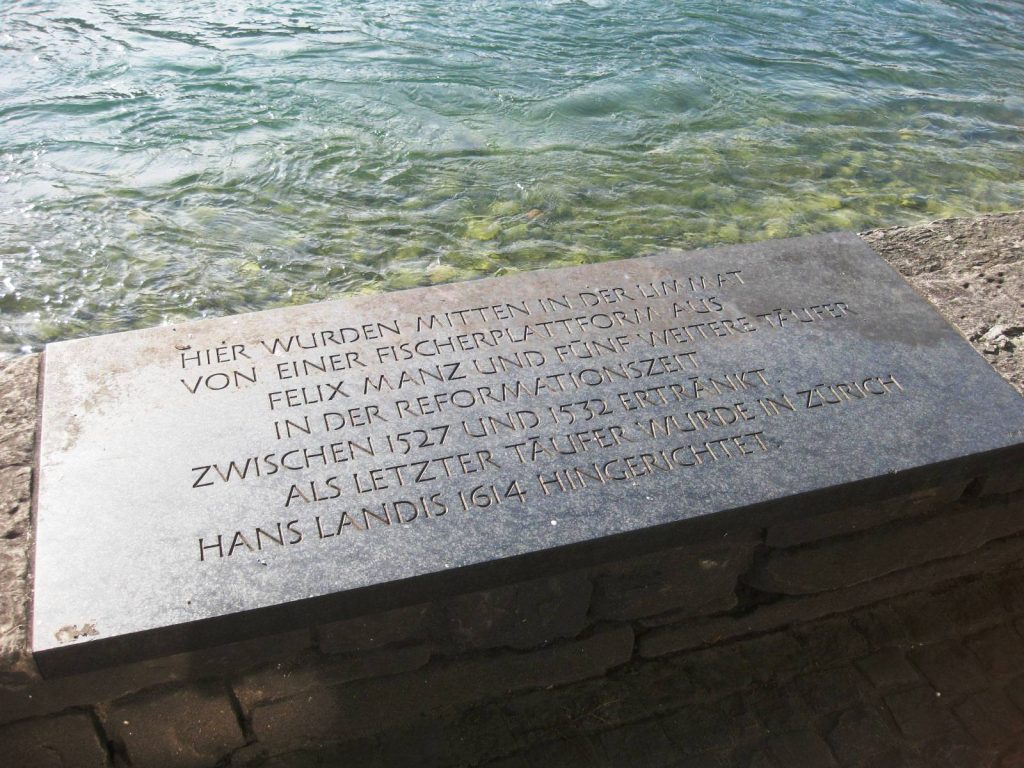
On 7 March 1526, the Zürich council had passed an edict that made adult re-baptism punishable by drowning. On 5 January 1527, Felix Manz became the first casualty of the edict, and the first Swiss Anabaptist to be martyred at the hands of magisterial Protestants. While Manz stated that he wished “to bring together those who were willing to accept Christ, obey the Word, and follow in His footsteps, to unite with these by baptism, and to purchase the rest in their present conviction”, Zwingli and the council accused him of obstinately refusing “to recede from his error and caprice”. At 3:00 p.m., as he was led from the Wellenburg to a boat, he praised God and preached to the people. A Reformed minister went along, seeking to silence him, and hoping to give him an opportunity to recant. Manz’s brother and mother encouraged him to stand firm and suffer for Jesus’ sake. He was taken by boat onto the River Limmat. His hands were bound and pulled behind his knees and a pole was placed between them. He was executed by drowning in Lake Zürich on the Limmat. His alleged last words were, “Into thy hands, O God, I commend my spirit.” His property was confiscated by government of Zürich, and he was buried in the St. Jakobs cemetery. Manz’s execution predates the Münster Rebellion which officially began in 1534.
♦ _____ ♦
The martyrdom of Felix Manz stands as one of the earliest and most poignant episodes in the history of the Radical Reformation. His death in 1527 marked a decisive moment in the conflict between emerging Protestant authorities and those who sought a more thorough reformation of the church according to Scripture.
Felix Manz was born in Zurich around 1498, the son of a Catholic canon. Well educated in classical languages, including Hebrew, Greek, and Latin, he became part of a circle of reform-minded scholars influenced by the teachings of Huldrych Zwingli. At first, Manz and his companions supported Zwingli’s efforts to reform the church in Zurich. However, disagreements soon arose, particularly over the pace and extent of reform.
The central issue that separated Manz from Zwingli was the practice of infant baptism. Manz and others came to believe that baptism should be reserved for those who consciously profess faith in Christ, rejecting the long-standing tradition of baptizing infants. This conviction led to the formation of the Anabaptist movement in 1525, when a group of believers performed what they considered the first “believer’s baptism” in Zurich. Their insistence on voluntary church membership and separation from state control challenged both religious and civil authorities.
The Zurich council, working in concert with Zwingli, quickly moved to suppress the movement. Anabaptists were seen as a threat not only to religious unity but also to social order, as their teachings undermined the close alliance between church and state. Manz became one of the most visible leaders of the movement, preaching, teaching, and encouraging others to follow the New Testament pattern of discipleship.
After repeated warnings, arrests, and imprisonments, Manz was finally condemned to death. On January 5, 1527, he was executed by drowning in the Limmat River in Zurich. This method of execution, sometimes grimly referred to as the “third baptism,” was intended as a direct punishment for his rejection of infant baptism. As he was led to his death, Manz is said to have praised God and remained steadfast in his faith, while his mother and brother encouraged him from the riverbank.
The martyrdom of Felix Manz had a lasting impact on the Anabaptist movement. Rather than extinguishing it, his death strengthened the resolve of his followers and drew attention to their cause. In the years that followed, many others would suffer persecution and death across Europe, but their commitment to believer’s baptism, religious liberty, and a church composed of voluntary believers endured.
Today, Manz is remembered as a symbol of conviction and courage. His martyrdom highlights the complexities of the Reformation, revealing that persecution was not limited to one side but occurred even among those who sought to reform the church. The site of his execution in Zurich is now marked by a memorial, serving as a reminder of the cost of conscience.
The legacy of Felix Manz continues in the traditions that trace their roots to the Anabaptists, including Mennonites, Amish, and other free church movements. His life and death call attention to the enduring importance of religious freedom and the principle that faith must be a matter of personal conviction rather than coercion.
_____
Image Source/Credit (in order):
• Manz, Felix (Ca. 1498-1527) – GAMEO (gameo.org/index.php?title=Manz,_Felix_(ca._1498-1527)
• Brad Beaman: Image (bradbeaman.wordpress.com/wp-content/uploads/2012/05/zurch-0431.jpg)
Related
Sorry, no records were found. Please adjust your search criteria and try again.
Sorry, unable to load the Maps API.