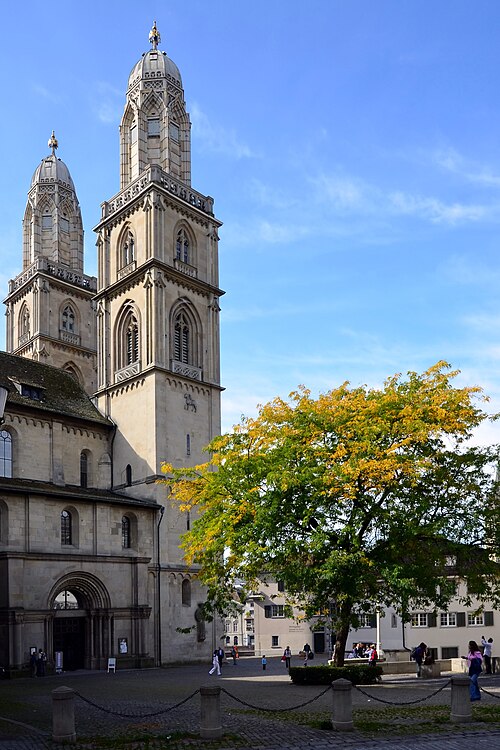
The Grossmünster is one of the most important historic churches in Zurich, closely tied to the origins and development of the Swiss Reformation. With its distinctive twin towers rising above the Limmat River, the Grossmünster has long served not only as a place of worship but also as a symbol of profound religious change in Europe.
According to tradition, the church was founded by Charlemagne in the early ninth century. Legend holds that he discovered the graves of the city’s patron saints, Felix and Regula, and established a church on the site in their honor. While the historical accuracy of this story is uncertain, archaeological evidence confirms that a religious structure existed there from an early date. The present Romanesque building was begun around 1100 and largely completed by the early thirteenth century, giving it the solid and imposing character it retains today.
During the medieval period, the Grossmünster functioned as a collegiate church, served by a community of canons. It held considerable influence within Zurich, both religiously and politically, as the church was closely connected with the governance of the city. Its clergy were among the leading figures in shaping the spiritual life of the region, and the building itself became a focal point for worship and instruction.
The greatest turning point in the history of the Grossmünster came in the early sixteenth century with the arrival of Huldrych Zwingli. In 1519, Zwingli was appointed as the people’s priest at the church, and from its pulpit he began to preach a series of sermons based directly on the New Testament. Rejecting long-standing traditions that lacked clear biblical support, he called for a return to the authority of Scripture and a simplification of Christian worship.
Under Zwingli’s leadership, the Grossmünster became the center of the Swiss Reformation. Images, relics, and the elaborate rituals of the medieval church were removed, and services were reoriented around preaching, prayer, and congregational participation. Music, which had been an important part of worship, was initially eliminated, reflecting the reformers’ concern for clarity and reverence. These changes marked a decisive break with the past and set a pattern that would influence Reformed churches throughout Europe.
In the centuries that followed, the Grossmünster remained a central institution in Zurich’s religious life. While its interior has undergone various modifications, including the reintroduction of music and later artistic elements, the church has preserved much of its historic character. Its towers, rebuilt in a neo-Gothic style in the eighteenth century, continue to define the city’s skyline and serve as a recognizable landmark.
The legacy of the Grossmünster is inseparable from the broader story of the Reformation. It stands as a testament to the power of preaching, the importance of Scripture, and the enduring impact of reform movements on church and society. At the same time, it reflects the complexities of that era, when deep convictions often led to division as well as renewal.
Today, the Grossmünster functions as an active Protestant church and a site of historical interest. Visitors from around the world come to explore its architecture and to learn about its role in shaping the course of Christian history. In its stones and its story, the Grossmünster continues to bear witness to a transformative period that helped define the modern religious landscape.
♦ _____ ♦
From Wikipedia:
Huldrych Zwingli initiated the Swiss-German Reformation in Switzerland from his pastoral office at the Grossmünster, starting in 1520. Zwingli won a series of debates presided over by the magistrate in 1523 which ultimately led local civil authorities to sanction the severance of the church from the papacy. The reforms initiated by Zwingli and continued by his successor, Heinrich Bullinger, account for the plain interior of the church. The iconoclastic reformers removed the organ and religious statuary in 1524. These changes, accompanied by abandonment of Lent, replacement of the Mass, disavowal of celibacy, eating meat on fast days, replacement of the lectionary with a seven-year New Testament cycle, a ban on church music, and other significant reforms make this church one of the most important sites in the history of the reformation and the birthplace of the Swiss-German reformation.[2][3][4]
_____
Image Source/Credit (in order):
• © Roland Fischer, Zürich (Switzerland) – Mail notification to: roland_zh(at)hispeed(dot)ch / Wikimedia Commons
Related
Sorry, no records were found. Please adjust your search criteria and try again.
Sorry, unable to load the Maps API.