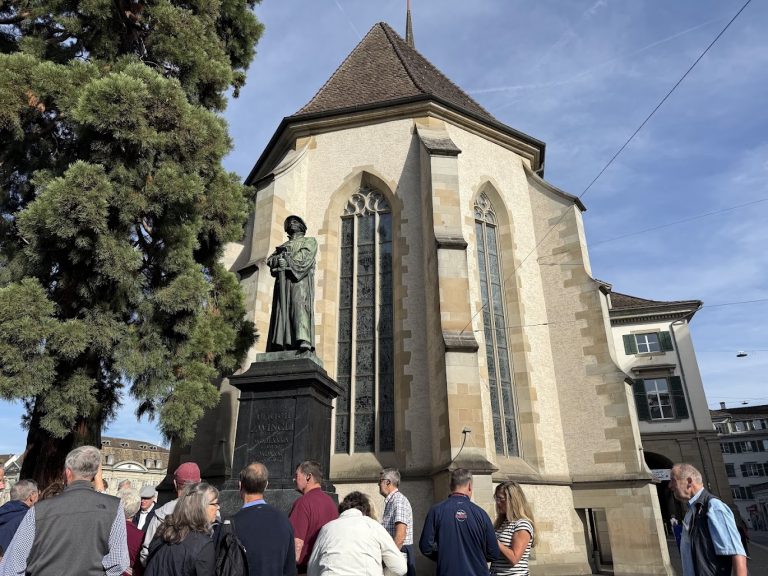
The Wasserkirche, or “Water Church,” is one of the most historic and symbolically rich landmarks in Zurich. Situated on a small island in the Limmat River, the church has witnessed centuries of religious development, political change, and spiritual reflection, making it a key site in the story of Swiss Christianity.
The origins of the Wasserkirche reach back to early medieval times, though the site itself was considered sacred even earlier. According to tradition, it was associated with the martyrdom of the city’s patron saints, Felix and Regula, who were said to have been executed there during the Roman era. By the ninth century, a church had been established on the spot, and over the centuries it was rebuilt and expanded, eventually taking on its present Gothic form in the late Middle Ages.
During the medieval period, the Wasserkirche functioned as an important place of pilgrimage. Its location—literally surrounded by water—gave it a unique and somewhat isolated character, setting it apart from other churches in the city. Pilgrims came to venerate relics and to reflect on the testimony of early Christian martyrs. This role, however, would change dramatically in the sixteenth century with the arrival of the Protestant Reformation.
Under the leadership of Huldrych Zwingli, Zurich became a center of reform beginning in 1519. Zwingli’s emphasis on the authority of Scripture and his rejection of practices not grounded in the Bible led to sweeping changes throughout the city. The Wasserkirche, like many other religious institutions, was stripped of its images, relics, and traditional functions. Pilgrimage was abolished, and the church’s role was redefined in accordance with Reformed principles.
For a time, the building even lost its strictly religious function. In the centuries following the Reformation, the Wasserkirche was used for a variety of secular purposes, including as a storage facility and later as a public library. This transformation reflected the broader shift in Zurich society, where former ecclesiastical spaces were often repurposed to serve civic needs.
Despite these changes, the historical and spiritual significance of the Wasserkirche was never entirely forgotten. In the nineteenth and early twentieth centuries, there was a renewed interest in preserving historic landmarks and reconnecting with the past. The church was restored and eventually returned to religious use, though in a form shaped by modern sensibilities and ecumenical openness.
One of the most notable aspects of the Wasserkirche’s legacy is its association with the martyrdom of Felix Manz, a leader of the early Anabaptist movement. Although he was executed nearby in the Limmat River rather than inside the church itself, the proximity of the site has made the Wasserkirche an important place of remembrance for those who reflect on the cost of religious conviction during the Reformation era.
Today, the Wasserkirche stands as both a historical monument and an active place of worship. Its long history—from medieval pilgrimage site to Reformation-era transformation and modern restoration—illustrates the changing character of Christian life in Zurich. At the same time, its enduring presence by the river serves as a quiet reminder of the past, inviting visitors to consider the faith, struggles, and convictions of those who came before.
In its architecture and legacy, the Wasserkirche embodies continuity amid change. It remains a testament to the enduring importance of faith, memory, and the careful preservation of history.
♦ _____ ♦
From Wikipedia:
In 1885, the memorial was inaugurated outside the Wasserkirche in the extension of the choir; the 400th anniversary of Zwingli’s birth had been narrowly missed due to delayed funding. The necessary funds came from nationwide collections, from concerts in the Grossmünster and Fraumünster, as well as from international contributions from the predominantly Protestant countries of Germany, Holland, and America. [ 10 ] Zwingli is depicted larger than life as a warrior and reformer, holding a sword and a Bible in his hands, which also commemorates his death in the war. [ 11 ] In addition to the memorial, which only gave his name and dates of birth and death, an information panel was installed in 2005 with some further information about the Zurich reformer and his significance for the city. [ 12 ]
_____
Image Source/Credit (in order):
• Photo from Our Christian Heritage
Related
Sorry, no records were found. Please adjust your search criteria and try again.
Sorry, unable to load the Maps API.