Hymn History: Thou Didst Leave Thy Throne
Author: Emily Elizabeth Steele Elliott
Thou didst leave Thy throne and Thy kingly crown,
When Thou camest to earth for me;
But in Bethlehem’s home was there found no room
For Thy holy nativity.
(Emily Elizabeth Steele Elliott)
The Origin of the Hymn “Thou Didst Leave Thy Throne”
The hymn “Thou Didst Leave Thy Throne” is a cherished Christmas carol that reflects on the humility of Christ’s incarnation and the believer’s response of devotion. Written in the nineteenth century, the hymn has endured as a meaningful expression of reverence, particularly during the Advent and Christmas seasons.
The text was written by Emily Elizabeth Steele Elliott (1836–1897), a devoted Christian and member of a family deeply engaged in church work and charitable ministry. Elliott composed the hymn around 1864 while living in England. The story behind its creation reflects a personal and pastoral concern: she sought to write something that would explain the meaning of Christ’s coming in a way that was both simple and heartfelt.
According to tradition, Elliott wrote “Thou Didst Leave Thy Throne” for a Sunday school class, responding to a question about what one could give to Jesus at Christmas. Her answer was expressed through the hymn’s recurring refrain: “O come to my heart, Lord Jesus, there is room in my heart for Thee.” This line captures the central theme of the hymn—Christ, who found no room in the inn at Bethlehem, is now welcomed into the believer’s heart.
The hymn’s verses trace key moments in the life of Christ, beginning with His birth in humble circumstances. It then moves through His earthly ministry, noting that He had “no place to lay His head,” and continues to His suffering and crucifixion. The final verse looks ahead to His return in glory, contrasting the humility of His first coming with the majesty of His second. This sweeping narrative gives the hymn a theological depth that extends beyond a simple Christmas carol.
The music most commonly associated with the hymn was composed by Timothy Richard Matthews, a respected Anglican minister and musician. His tune, often called “Margaret,” provides a gentle and contemplative setting that complements the reflective nature of Elliott’s text.
“Thou Didst Leave Thy Throne” quickly gained popularity and was included in a number of influential hymnals in the late nineteenth and early twentieth centuries. Its clear message and singable melody made it especially suitable for congregational singing, as well as for use in children’s services and Christmas programs.
The legacy of the hymn lies in its ability to present profound theological truths in a simple and accessible form. It emphasizes the humility of Christ, who left the glory of heaven to enter a world that largely rejected Him. At the same time, it invites a personal response, encouraging each listener to make room for Christ in their own life.
Over the years, the hymn has remained a staple in many churches, particularly within Protestant traditions. It continues to be sung during Advent and Christmas services, often serving as a moment of quiet reflection amid more celebratory carols. Its enduring appeal rests in its balance of doctrine and devotion, offering both a retelling of the gospel story and a call to personal faith.
In an age that often emphasizes outward celebration, “Thou Didst Leave Thy Throne” gently redirects attention to the deeper meaning of Christmas. Through its thoughtful words and reverent tone, it continues to inspire worshipers to reflect on the significance of Christ’s coming and to respond with hearts open to Him.
♦ _____ ♦
The author of “Thou Didst Leave Thy Throne” – commonly considered a Christmas carol, and yet it follows the whole life of Jesus from His birth thru the Second Coming (albeit in a much less upbeat tune than J. Wilbur Chapman’s “One Day.”)
Thou didst leave Thy throne and Thy kingly crown,
When Thou camest to earth for me;
But in Bethlehem’s home was there found no room
For Thy holy nativity.
O come to my heart, Lord Jesus,
There is room in my heart for Thee.
Heaven’s arches rang when the angels sang,
Proclaiming Thy royal degree;
But of lowly birth didst Thou come to earth,
And in great humility.
O come to my heart, Lord Jesus,
There is room in my heart for Thee.
The foxes found rest, and the birds their nest
In the shade of the forest tree;
But Thy couch was the sod, O Thou Son of God,
In the deserts of Galilee.
O come to my heart, Lord Jesus,
There is room in my heart for Thee.
Thou camest, O Lord, with the living word
That should set Thy people free;
But with mocking scorn, and with crown of thorn,
They bore Thee to Calvary.
O come to my heart, Lord Jesus,
There is room in my heart for Thee.
When the heavens shall ring, and the angels sing,
At Thy coming to victory,
Let Thy voice call me home, saying “Yet there is room,
There is room at My side for thee.”
My heart shall rejoice, Lord Jesus,
When Thou comest and callest for me.
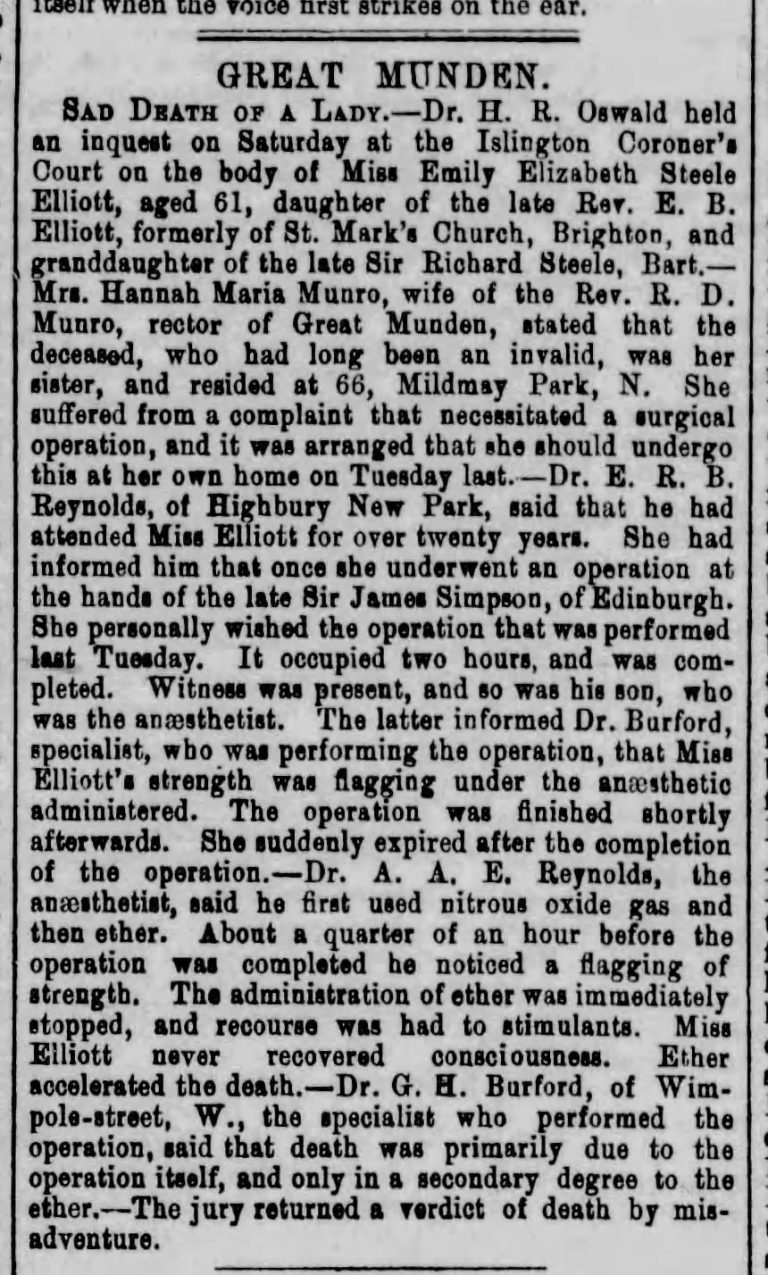
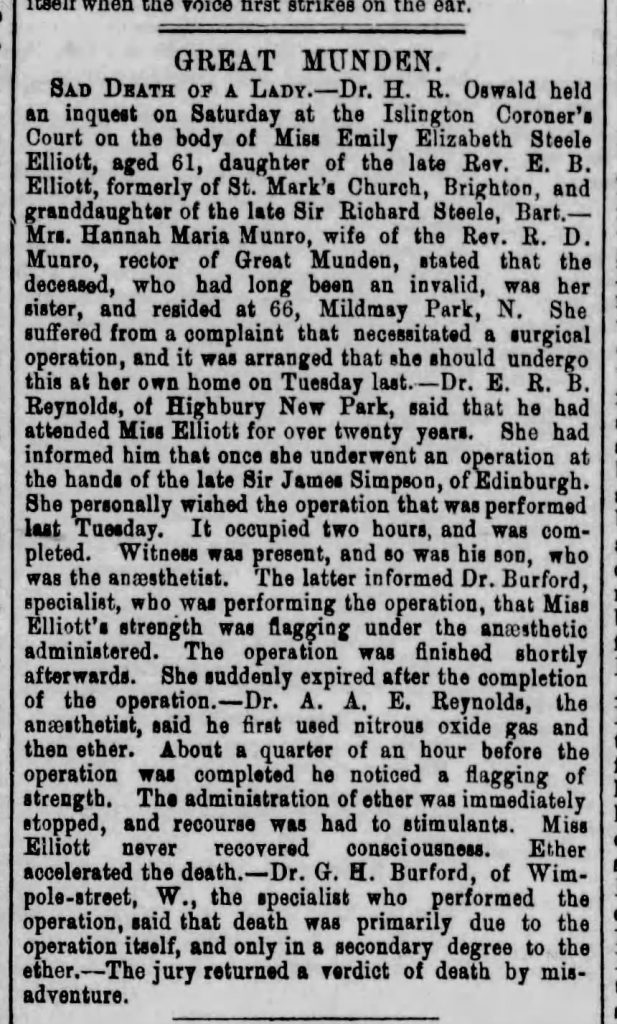
Emily Elizabeth Steele Elliott died from complications from surgery, but because she accepted the risk, the inquest ruled it death by misadventure.
_____
Image Source/Credit:
• Newspapers.com, Hertfordshire Mercury, August 14, 1897, https://www.newspapers.com/article/hertfordshire-mercury/194034152/
Related
Sorry, no records were found. Please adjust your search criteria and try again.
Sorry, unable to load the Maps API.