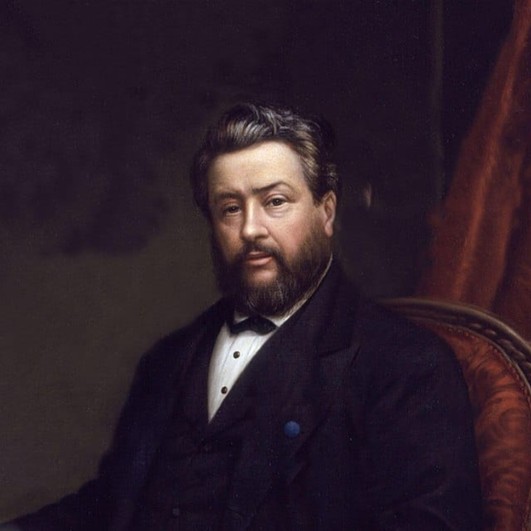
The great Victorian ‘Prince of Preachers’, Charles Haddon Spurgeon, began his ministry here at the Baptist church in Waterbeach. Every great venture of faith has to begin somewhere, and we are seeking to rekindle the passion and impact of Spurgeon’s ministry in our present-day community some 170 years later. Spurgeon always had a fond love and appreciation for the place where his ministry began, laying the foundation stone of the new chapel in 1863. We still possess at Spurgeon’s Chapel his heartfelt sentiments in the form of personal messages in hymn books and a Pulpit Bible, signed prints of himself, communion silver, and handwritten sermon notes. We believe Spurgeon’s Chapel is historically significant and stands to remind us of a time when God moved powerfully through the preaching of His Word in our nation.
♦ _____ ♦
Charles Haddon Spurgeon is widely regarded as one of the greatest preachers in Christian history, yet his remarkable ministry began in a humble village setting. His first pastorate at Waterbeach Baptist Church, near Cambridge, marked the starting point of a career that would eventually influence thousands.
In 1851, at just seventeen years of age, Spurgeon accepted the call to serve as pastor of the small congregation in Waterbeach. Though young and relatively unknown, he had already demonstrated an unusual gift for preaching. His conversion had occurred only a year earlier, yet his deep conviction and natural ability to communicate Scripture quickly became evident. The people of Waterbeach, recognizing his sincerity and promise, welcomed him into their community.
Waterbeach at the time was a modest rural village, and the Baptist church there reflected its surroundings—simple, close-knit, and rooted in traditional faith. Spurgeon’s arrival brought new energy. His preaching was direct, earnest, and grounded in Scripture. Unlike more formal or academic ministers, he spoke plainly, making his message accessible to ordinary people. This approach resonated strongly with the villagers, many of whom found in his sermons both clarity and encouragement.
During his time at Waterbeach, Spurgeon devoted himself not only to preaching but also to pastoral care. He visited parishioners in their homes, offered counsel, and became a familiar presence in the daily life of the village. His commitment to personal ministry helped build trust and strengthened the congregation. Under his leadership, the church began to grow, both in numbers and in spiritual vitality.
One of the most notable aspects of Spurgeon’s ministry at Waterbeach was the revival that took place during his pastorate. Attendance increased significantly, and many individuals professed faith. The church, once small and somewhat quiet, became a lively center of worship and community life. Spurgeon’s sermons, marked by vivid illustration and heartfelt appeal, drew listeners from surrounding areas as well.
Despite his youth, Spurgeon displayed a maturity beyond his years. He possessed a strong sense of calling and a disciplined approach to his work. He spent time in study and prayer, ensuring that his preaching remained grounded in biblical truth. At the same time, his natural warmth and sense of humor made him approachable, allowing him to connect with people from all walks of life.
The success of his ministry at Waterbeach did not go unnoticed. Word of the young preacher’s effectiveness spread, eventually leading to his call to a larger congregation in London. In 1854, after just a few years in Waterbeach, Spurgeon accepted an invitation to preach at New Park Street Chapel, a move that would launch him onto the national stage. From there, his influence would continue to expand, culminating in his long pastorate at the Metropolitan Tabernacle.
Though his later achievements were far greater in scale, Spurgeon himself never forgot his beginnings in Waterbeach. The lessons he learned there—the importance of faithful preaching, personal connection, and reliance on Scripture—remained central to his ministry throughout his life. The village church provided him with the opportunity to develop his gifts and to prove his calling in a practical setting.
Today, Spurgeon’s first pastorate at Waterbeach Baptist Church is remembered as a foundational chapter in his life. It serves as a reminder that great influence often begins in small places. In that quiet English village, a young preacher found his voice, and in doing so, began a ministry that would leave a lasting mark on the Christian world.
_____
Image Source/Credit:
• Alexander Melville, Public domain, via Wikimedia Commons
Related
Sorry, no records were found. Please adjust your search criteria and try again.
Sorry, unable to load the Maps API.