
The Southampton Civic Centre stands as one of the most prominent architectural and cultural landmarks in Southampton. Serving as a hub for municipal administration, education, and the arts, the Civic Centre reflects the city’s growth in the twentieth century and its commitment to public life.
The origins of the Civic Centre date to the interwar period, when Southampton sought to establish a unified complex for its civic institutions. Prior to this, municipal services were scattered across various locations, creating inefficiencies and limiting the city’s ability to function cohesively. In response, plans were developed to construct a central site that would house the city council offices, law courts, library, and art gallery in one coordinated design.
Construction began in 1934, during a time of economic difficulty but also of civic ambition. The project was designed by architect E. Berry Webber, whose vision combined classical symmetry with modern elements, creating a structure that conveyed both dignity and practicality. The Civic Centre was officially opened in 1939, just as Europe stood on the brink of the Second World War.
Despite its recent completion, the building quickly became involved in wartime activity. Southampton was heavily bombed during the Blitz, and the Civic Centre itself sustained damage, though it remained standing. Its continued use during and after the war symbolized the resilience of the city and its institutions in the face of adversity.
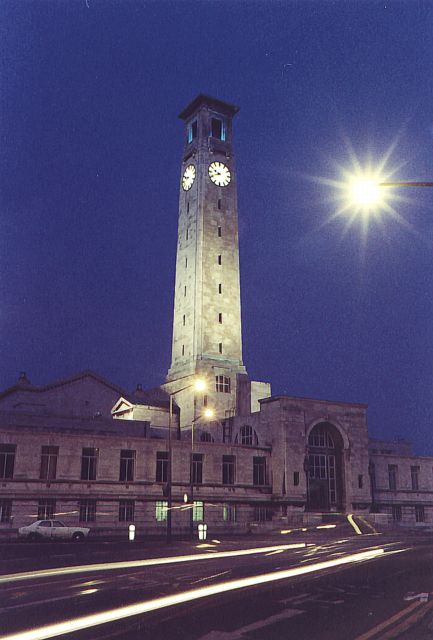
Architecturally, the Civic Centre is notable for its imposing façade and central clock tower, which rises prominently above the surrounding streets. The design incorporates Portland stone and balanced proportions, giving the complex a sense of permanence and order. Within its walls, different sections were dedicated to specific functions, including council chambers, administrative offices, and cultural spaces.
One of the most important components of the Civic Centre is the Southampton City Art Gallery, which opened alongside the main complex. The gallery houses an impressive collection of art, ranging from Renaissance works to modern pieces, and has become one of the leading municipal art galleries in England. Its presence within the Civic Centre highlights the city’s commitment not only to governance but also to cultural enrichment.
The complex also includes the central library, which has served generations of residents as a place of learning and community engagement. Over the decades, the Civic Centre has hosted countless civic events, public meetings, and cultural activities, reinforcing its role as the heart of Southampton’s public life.
In more recent years, the Civic Centre has undergone various renovations and adaptations to meet the changing needs of the city. While some administrative functions have been relocated, the building continues to play a vital role in cultural and civic activities. Its preservation reflects an ongoing recognition of its historical and architectural importance.
The legacy of the Southampton Civic Centre lies in its embodiment of civic unity and public service. It represents a moment in the city’s history when there was a clear vision to bring together governance, education, and culture in one central location. This vision has had a lasting impact, shaping how residents interact with their local institutions.
Today, the Civic Centre remains a symbol of Southampton’s identity. Its clock tower continues to mark the passage of time, while its halls bear witness to decades of civic life. As both a historical monument and a living institution, it stands as a testament to the enduring importance of community, culture, and public service.
♦ _____ ♦
Isaac Watts is one of Southampton’s most famous sons. He was famous as an author, educator, philosopher and hymn writer. Born in 1674, he lived at 41 French Street and was educated at the nearby King Edward VI grammar school. Isaac Watts was one of the leading nonconformists in the town and is mainly remembered for his hymns which include ‘Our God, Our Help in Ages Past’ which is chimed on the Civic Centre clock at 8:00am, noon and 4:00pm.
_____
Image Source/Credit (in order):
• Photo By Stephen Elwyn RODDICK, CC BY-SA 2.0, https://commons.wikimedia.org/w/index.php?curid=9221946
Related
Sorry, no records were found. Please adjust your search criteria and try again.
Sorry, unable to load the Maps API.