
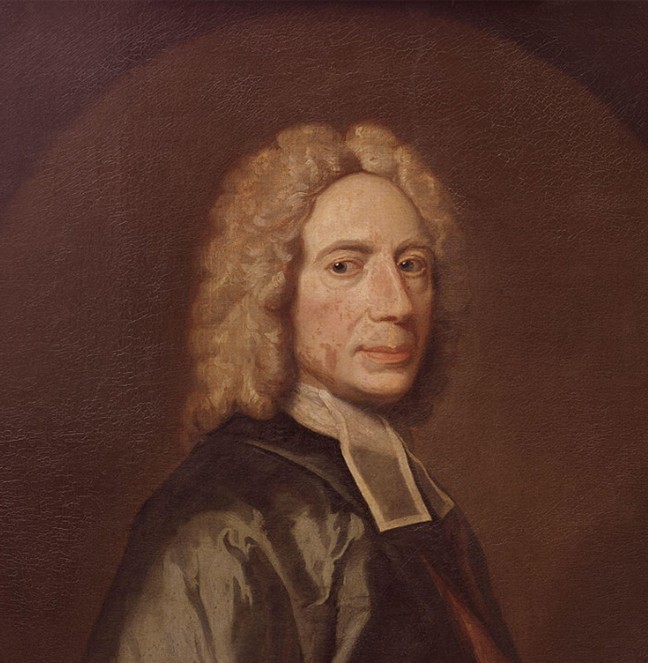
Isaac Watts (1674–1748) is widely regarded as one of the most influential hymn writers in the English-speaking world. Often called the “Father of English Hymnody,” Watts transformed congregational singing and left a lasting legacy through his poetry, theology, and educational writings.
Born in Southampton, Watts grew up in a devout Nonconformist family at a time when those outside the established Church of England faced restrictions and social disadvantages. His father, also named Isaac, was a schoolmaster and a committed Dissenter who was imprisoned for his religious convictions. These early experiences helped shape Watts’s deep commitment to faith and his independence of thought.
From a young age, Watts showed remarkable intellectual ability, particularly in languages and poetry. He was offered the opportunity to attend one of the leading universities, but because of his Nonconformist beliefs, he instead studied at a dissenting academy in London. There he received a thorough education in theology, philosophy, and classical literature, preparing him for a life of ministry and writing.
Watts became a pastor in London, serving the Mark Lane Congregational Church. Although his health was often fragile, he maintained an active ministry and gained a reputation as a thoughtful and compassionate preacher. However, it was his contribution to hymn writing that would secure his place in history.
At the time, English congregations primarily sang metrical psalms—strict poetic versions of biblical psalms that were often limited in expression and difficult to sing. Watts believed that Christian worship should reflect the full range of New Testament truth and experience. In response, he began writing hymns that were more personal, expressive, and centered on the life and work of Christ.
His hymns marked a turning point in English worship. Collections such as Hymns and Spiritual Songs (1707) introduced texts that spoke directly to the heart, combining doctrinal depth with poetic beauty. Among his most famous hymns are “When I Survey the Wondrous Cross,” “Joy to the World,” and “O God, Our Help in Ages Past.” These hymns have endured for centuries and continue to be sung in churches around the world.
In addition to his hymnody, Watts was a prolific writer in other fields. He authored works on theology, logic, and education, including The Improvement of the Mind, which became a widely used textbook. His writings demonstrated a commitment to clarity, discipline, and the practical application of knowledge, reflecting his belief that intellectual growth should support moral and spiritual development.
Watts spent much of his later life in the home of Sir Thomas Abney, a wealthy supporter who provided him with care and hospitality during his long illness. It was there that he continued to write and reflect, producing many of his later works in a quiet and supportive environment.
The legacy of Isaac Watts is profound and far-reaching. He reshaped the practice of congregational singing, moving it beyond the exclusive use of psalms and opening the door for a rich tradition of hymn writing. His emphasis on heartfelt expression and theological clarity set a standard that has influenced generations of hymn writers.
Today, Watts is remembered not only for his literary achievements but also for his devotion to the life of the church. His hymns continue to give voice to the faith of countless believers, bridging the centuries with words that remain both meaningful and enduring. In this way, Isaac Watts’s contribution to Christian worship and thought continues to resonate, securing his place as one of the great figures in the history of English hymnody.
_____
Image Source/Credit:
• National Portrait Gallery, Public domain, via Wikimedia Commons
Related
Sorry, no records were found. Please adjust your search criteria and try again.
Sorry, unable to load the Maps API.