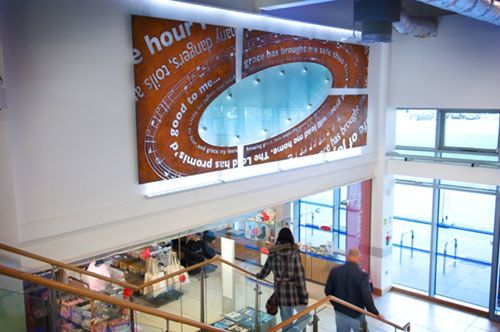
The memorial sculpture at the Mersey Ferry Terminal Pier Head stands as a thoughtful and reflective tribute inspired by the life of John Newton. Positioned along Liverpool’s historic waterfront, the work connects the city’s maritime heritage with a deeper moral narrative—one that acknowledges both the darkness of the past and the possibility of transformation.
John Newton (1725–1807) is a figure whose life embodies stark contrast. In his early years, he was involved in the transatlantic slave trade, serving as a captain of slave ships. Liverpool, as one of Britain’s principal ports during that era, was deeply tied to this trade. Newton’s connection to the sea and to the port city situates his story firmly within the broader history of the Mersey. Yet his life did not remain defined by that early chapter. Following a profound spiritual awakening, Newton renounced the slave trade, became an Anglican clergyman, and later joined the growing movement to abolish slavery. He is perhaps best remembered as the author of the hymn “Amazing Grace,” a text that reflects repentance and redemption.
The memorial sculpture draws upon this dual legacy. Rather than presenting a conventional likeness, the design is symbolic, inviting reflection rather than simple admiration. Elements of the sculpture often evoke the sea—flowing forms, weathered textures, or wave-like structures—reminding viewers of Liverpool’s maritime identity and Newton’s life upon the water. At the same time, the work incorporates imagery that suggests struggle and release, perhaps through broken chains, rising forms, or contrasting materials. These features point to the moral journey that defined Newton’s later years.
Set against the backdrop of the River Mersey, the sculpture benefits from a powerful sense of place. The Pier Head has long been a focal point of Liverpool’s global connections, where ships once departed for distant shores. Today, it is a place where history is both remembered and reexamined. The presence of a memorial inspired by Newton encourages visitors to consider not only the achievements associated with maritime trade, but also the human cost that accompanied it.
Importantly, the sculpture does not attempt to simplify Newton’s life into a single narrative of heroism. Instead, it acknowledges complexity. By referencing both his role in the slave trade and his later repentance, the memorial reflects a more honest engagement with history. It recognizes that individuals—and societies—are capable of change, but that such change does not erase responsibility. In this way, the sculpture aligns with broader efforts in Liverpool to confront its past with clarity and humility.
The choice to place such a memorial at the ferry terminal is particularly fitting. Ferries continue to connect communities across the Mersey, just as ships once connected Liverpool to the wider world. The constant movement of vessels serves as a reminder of continuity, while the sculpture invites pause and reflection. Passengers passing through the terminal encounter not only a point of transit but also a moment of contemplation.
In its quiet way, the memorial contributes to an ongoing conversation about memory, responsibility, and hope. It encourages viewers to consider how the past shapes the present and how acknowledgment can lead to deeper understanding. By drawing on the life of John Newton, the sculpture offers a message that is both sobering and hopeful: that even within a history marked by injustice, there remains the possibility of repentance, change, and a more humane future.
_____
Image Source/Credit:
• “Amazing Grace — Broadbent Studio.” Broadbent Studio, broadbent.studio/amazing-grace.
Related
Sorry, no records were found. Please adjust your search criteria and try again.
Sorry, unable to load the Maps API.