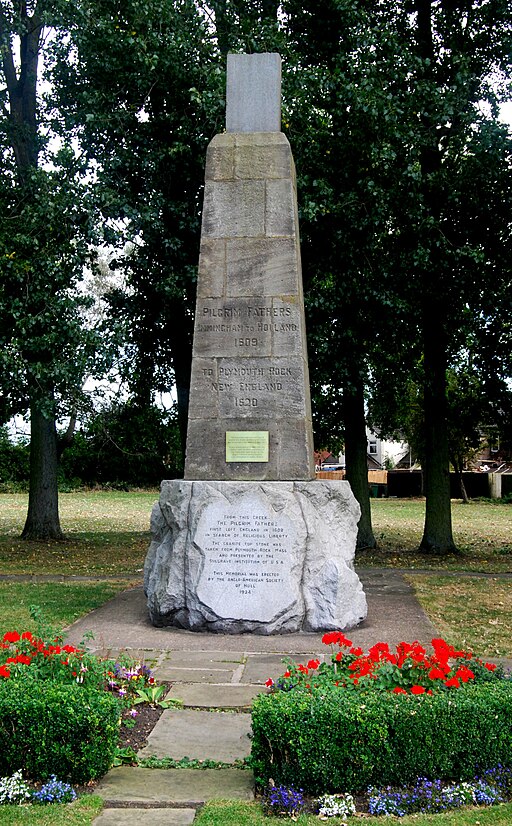
The Pilgrim Fathers Departure Monument stands as a quiet but meaningful tribute to one of the most consequential journeys in early modern history. Located in the historic city of Leiden, the monument commemorates the departure of the English Separatists—later known as the Pilgrim Fathers—who left the Netherlands in 1620 to seek a new life in the New World.
The Pilgrims had lived in Leiden for over a decade before their departure. Fleeing religious persecution in England, they had found relative tolerance in the Dutch Republic. Under the leadership of John Robinson, the group established a close-knit community grounded in faith, discipline, and mutual support. Yet despite the freedom they experienced, they faced challenges, including economic hardship and concern over the loss of their English identity in a foreign land. These factors contributed to their decision to leave Europe and establish a new settlement across the Atlantic.
The Pilgrim Fathers Departure Monument marks the place where many of these men, women, and children began their journey. Though the famous voyage is most often associated with the Mayflower, the Pilgrims actually first departed from the nearby port of Delfshaven aboard a smaller vessel. From there, they traveled to England before setting sail for America. The monument, therefore, represents not just a single moment, but the beginning of a carefully planned and deeply significant migration.
Modest in size and design, the monument reflects the character of the Pilgrims themselves. It does not overwhelm the viewer with grandeur but instead invites quiet reflection. Its inscription honors the courage and faith of those who undertook the uncertain journey. Standing before it, one is reminded that the Pilgrims were ordinary people—families and individuals—who made an extraordinary decision in pursuit of religious freedom and a better future.
The setting of the monument in Leiden adds to its significance. The city played an important role in shaping the Pilgrims’ identity. It was here that they developed many of the values that would later influence life in Plymouth Colony. Their time in Leiden strengthened their commitment to self-governance, community cooperation, and religious devotion—principles that would become hallmarks of their new settlement in America.
Visitors to the monument today often include both locals and international travelers, particularly those interested in early American history. For many, it serves as a tangible link between Europe and the United States, illustrating how events in one part of the world can shape the course of history in another. The monument also highlights the international dimension of the Pilgrim story, reminding us that their journey was not simply an English or American tale, but one that also belongs to the Netherlands.
In a broader sense, the Pilgrim Fathers Departure Monument symbolizes the enduring human desire for freedom and self-determination. The Pilgrims’ decision to leave Leiden was not made lightly; it involved risk, sacrifice, and uncertainty. Yet their willingness to act on their convictions has left a lasting legacy.
Today, as one stands before the monument, it is possible to reflect not only on the past but also on the values that continue to resonate across generations. The Pilgrim Fathers Departure Monument remains a simple yet powerful reminder of a journey that helped shape the modern world.
_____
Image Source/Credit:
• Syncopator, CC BY-SA 4.0 <https://creativecommons.org/licenses/by-sa/4.0>, via Wikimedia Commons
Related
Sorry, no records were found. Please adjust your search criteria and try again.
Sorry, unable to load the Maps API.