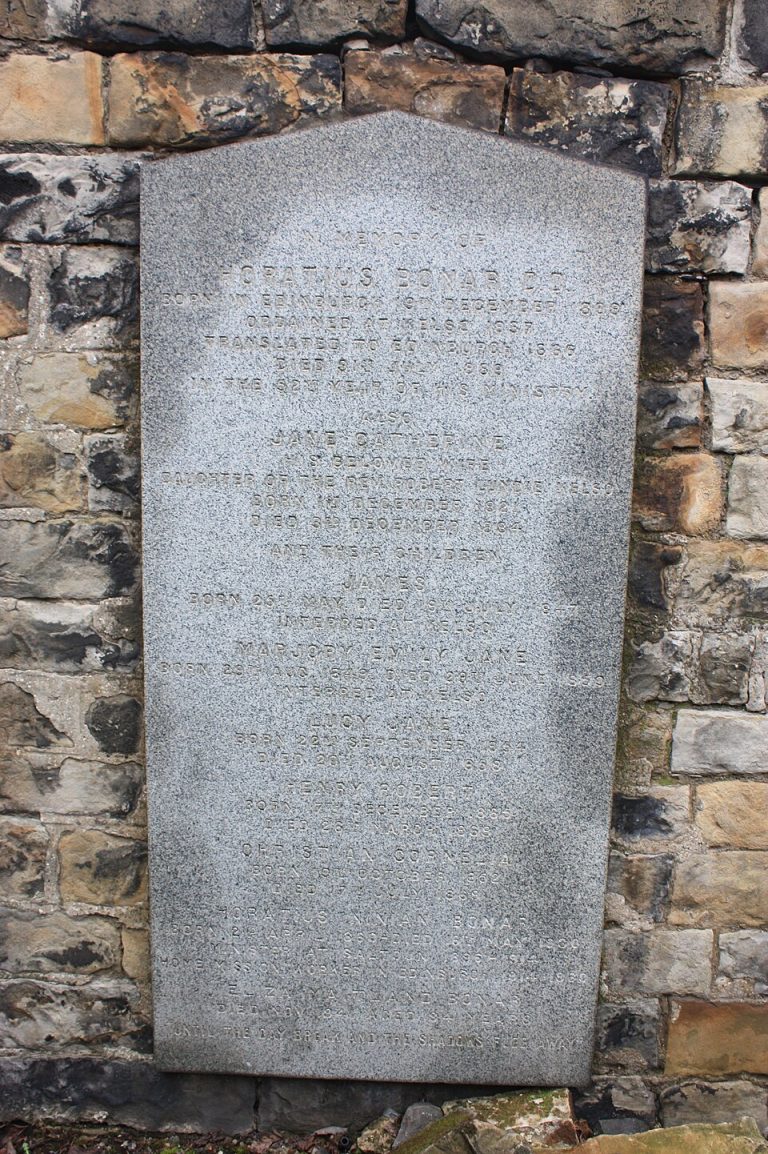
Horatius Bonar (1808–1889) stands among the most influential figures in nineteenth-century Scottish religious life, remembered both for his pastoral ministry and his prolific hymnody. A minister of the Free Church of Scotland, Bonar devoted his life to preaching, writing, and shaping Christian devotion through music and literature, leaving a legacy that continues to inspire believers today.
Born in Edinburgh in 1808, Bonar was the eldest son of James Bonar, a lawyer, and a family deeply committed to the Scottish Reformed tradition. From an early age, he showed a marked interest in spiritual matters, leading him to pursue theological studies at Edinburgh University. His education equipped him with a profound knowledge of Scripture and the Reformed faith, preparing him for a lifetime of ministry devoted to preaching the Gospel and nurturing the spiritual lives of his congregants.
Bonar was ordained in 1837 as a minister in the Church of Scotland, serving congregations in various towns before joining the Free Church of Scotland following the Disruption of 1843—a split prompted by disputes over the spiritual independence of the church from state interference. Throughout his ministry, he became known for his fervent preaching style, marked by clarity, doctrinal depth, and heartfelt appeals to repentance and faith. His sermons often emphasized the practical outworking of Christian principles in daily life, combining pastoral care with rigorous theological insight.
Beyond his pulpit work, Bonar made his most enduring contribution through hymn writing. He penned hundreds of hymns that conveyed both the beauty of God’s character and the experience of the believer’s life of faith. Hymns such as “I Heard the Voice of Jesus Say” and “Blessing and Honor and Glory and Power” reflect his deep understanding of Scripture and his gift for expressing spiritual truths in memorable, singable form. His hymns quickly became widely known, crossing denominational boundaries and appearing in hymnals throughout Scotland, England, and eventually North America. They continue to be sung in churches around the world, a testament to their enduring spiritual resonance.
Bonar was also a prolific writer of devotional literature. His books and pamphlets, including commentaries, biographies, and collections of meditations, were intended to guide readers toward greater intimacy with God. Works such as God’s Way of Holiness and Songs of Faith and Hope combined theological insight with pastoral sensitivity, making complex doctrinal truths accessible to ordinary believers. Through his writings, Bonar extended the reach of his ministry far beyond the walls of his churches.
The legacy of Horatius Bonar is multifaceted. As a preacher, he shaped generations of Scottish Christians through his sermons. As a hymn writer, he enriched congregational worship with songs that continue to stir hearts and express timeless truths. And as a devotional author, he offered guidance for personal spiritual growth that remains relevant today. His life exemplified the integration of rigorous theological conviction with compassionate pastoral care, showing that doctrine and devotion can go hand in hand.
Bonar passed away in 1889, but his influence has endured. Churches continue to include his hymns in worship, his writings are studied for their devotional depth, and his example of faithful service continues to inspire ministers and laypeople alike. Horatius Bonar’s life reminds us that steadfast dedication to the Word of God, expressed through preaching, writing, and song, can leave a legacy that resonates far beyond one’s own generation.
♦ _____ ♦
Wikipedia:
Horatius Bonar (19 December 1808 – 31 July 1889) was a Scottish churchman and poet who was a contemporary and acquaintance of Robert Murray M’cheyne. He is principally remembered as a prodigious hymnodist. Friends knew him as Horace Bonar. Licensed as a preacher, he did mission work in Leith for a time, and in November 1837 he settled at Kelso as minister of the new North Church founded in connection with Thomas Chalmers’s scheme of church extension. He became exceedingly popular as a preacher, and was soon well known throughout Scotland.[3]
_____
Image Source/Credit:
• Photo By Stephencdickson CC BY-SA 4.0,
Related
Sorry, no records were found. Please adjust your search criteria and try again.
Sorry, unable to load the Maps API.