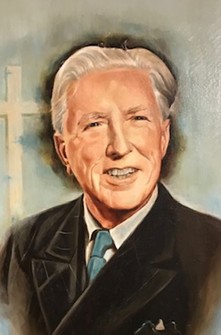
John Elward Brown Sr.
“The future has for each of us greater privilege, greater opportunity, greater responsibility and greater challenge.”
(John Elward Brown Sr.)
Early Life and Conversion
John Elward Brown Sr. was born on April 2, 1879, near Center Point, Iowa, into a modest family whose father, John Franklin Brown—a Civil War veteran—struggled with health issues and financial constraints. The fifth of nine children, young Brown left formal schooling at age eleven to help the family make ends meet. When he was seventeen, he moved with his older brother to Rogers, Benton County, Arkansas, in search of work. It was there, in 1897, that he attended a revival meeting with the Salvation Army and experienced a deep conversion to Christ. Enlisting shortly thereafter in the Salvation Army, Brown began his ministry by helping to establish an outpost in Siloam Springs, Arkansas. Within two years he left the Salvation Army and launched into full-time evangelistic work.
Evangelistic Ministry and Media Innovation
By 1910, Brown had emerged as a leading evangelist in the American Southwest, especially active in California and Texas, where he conducted large-scale revival campaigns. He is credited with bringing over 400,000 people to Christ through his crusades, personal evangelism, and teaching.
Brown was ahead of his time in embracing mass-media. In 1928 he purchased his first radio station (KPFW) and in 1935 secured KUOA in Fayetteville, Arkansas—moving it to Siloam Springs to serve as a voice for his ministry and the institution he was building. Through radio, his daily program “God’s Half-Hour” reached thousands of listeners, extending his evangelistic impact far beyond revival tents.
Founding of John Brown University
In August 1919, Brown transformed his 300-acre farm in Siloam Springs into the Southwestern Collegiate Institute, a low-cost vocational and Christian education institution aimed at ambitious students who could not afford typical college fees. Subsequently, the institution was renamed John Brown University (JBU) in honor of its founder, and it continues today as a private Christian university in Arkansas. Brown’s vision extended beyond evangelism—he saw Christian education, vocational training, and broadcasting as intertwined components of advancing the Gospel in a changing world.
Social and Civic Engagement
Beyond church and campus, Brown engaged in public moral reform. Notably, he led a campaign in 1947 in Benton County to maintain prohibition of alcohol sales; 61 % of voters supported his initiative, and the county remained “dry” into the 21st century. His involvement in civic issues reflects his belief that faith must engage society, not retreat from it.
Philosophy, Character and Ministry Approach
Brown’s ministry was marked by several key convictions and stylistic traits:
- Evangelistic urgency: He believed the Gospel must reach the unreached and made decisions for Christ the central aim of his campaigns.
- Integration of work and witness: Brown insisted Christian education, vocational training, and media outreach were not optional extras but essential for a holistic Gospel mission.
- Media-savvy leadership: He recognized early that radio—and later broadcasting—would amplify the Gospel reach and invested accordingly.
- Practical faith: His own humble beginnings shaped his commitment to affordability, accessibility and real-world application of Christian truth.
- Long-term vision: He built institutions meant to outlast him: a university, radio stations, published works—all undergirded by Gospel fidelity.
While his strengths are many, it is fair to note that Brown’s ministry also stands in the context of his era—some elements of his social and cultural outlook reflect the early 20th-century evangelical milieu with its strengths and limitations.
Legacy and Enduring Impact
John Elward Brown Sr. passed away on February 12, 1957, after suffering complications from a broken hip and a subsequent blood clot. His funeral and memorials recognized the breadth of his influence across evangelism, education and media.
His legacy can be summarized in several key areas:
- Evangelistic monument: Brown’s hundreds of thousands of conversions testify to a life devoted to gospel proclamation.
- Educational institution: John Brown University remains a living institution rooted in his vision of Christian education, vocational training and service.
- Media innovation: Through radio stations KUOA and others, Brown pioneered evangelical broadcasting in the South, setting patterns followed by later ministries.
- Moral engagement: His civic involvement, especially in the prohibition movement, underscores his belief that faith interacts with social life and public policy.
- Model of integration: Brown shows how ministry can weave evangelism, education, media and social reform—not as separate silos but as a unified Gospel enterprise.
Practical Lessons for Today
For contemporary Christian leaders and ministry practitioners, Brown’s life offers several significant lessons:
- Think beyond the pulpit: Brown moved from revival tents to radio studios to college campuses; ministries today should similarly adapt to changing cultural platforms.
- Affordability matters: His founding of a low-cost Christian institution reminds us that mission must consider access and means, not just message.
- Media reaches broadly: Radio was his platform; for us it might be digital media, podcasts or online education—but the principle remains: use the means available.
- Social responsibility is part of mission: Brown did not separate evangelism from social concerns; likewise, modern ministry should engage with justice, public policy and culture.
- Legacy through structures: By founding an institution, buying media outlets and building enduring infrastructure, Brown achieved a ministry that outlived his physical life—an important reminder for leaders about vision beyond their lifetime.
Conclusion
John Elward Brown Sr. stands as a significant figure in 20th-century American evangelicalism—a man who began humbly, preached broadly, innovated boldly and invested long-term. His story brings together revivalist zeal, educational entrepreneurship and media pioneering in a way that remains instructive today.
Though decades have passed since his leadership, the institutions he founded, the lives he touched and the media he launched continue to echo his passion for Christ and his belief that the Gospel must be heard, taught and lived. For anyone exploring Christian leadership, evangelical education or the history of ministry in the American South, Brown’s life remains a rich example of what one person’s vision, combined with faithfulness and innovation, can accomplish.
_____
Image Source/Credit:
• Admin. “John Edward Brown.” Christian Hall of Fame, 29 Aug. 2020 (christianhof.org/brown)
Related
Sorry, no records were found. Please adjust your search criteria and try again.
Sorry, unable to load the Maps API.