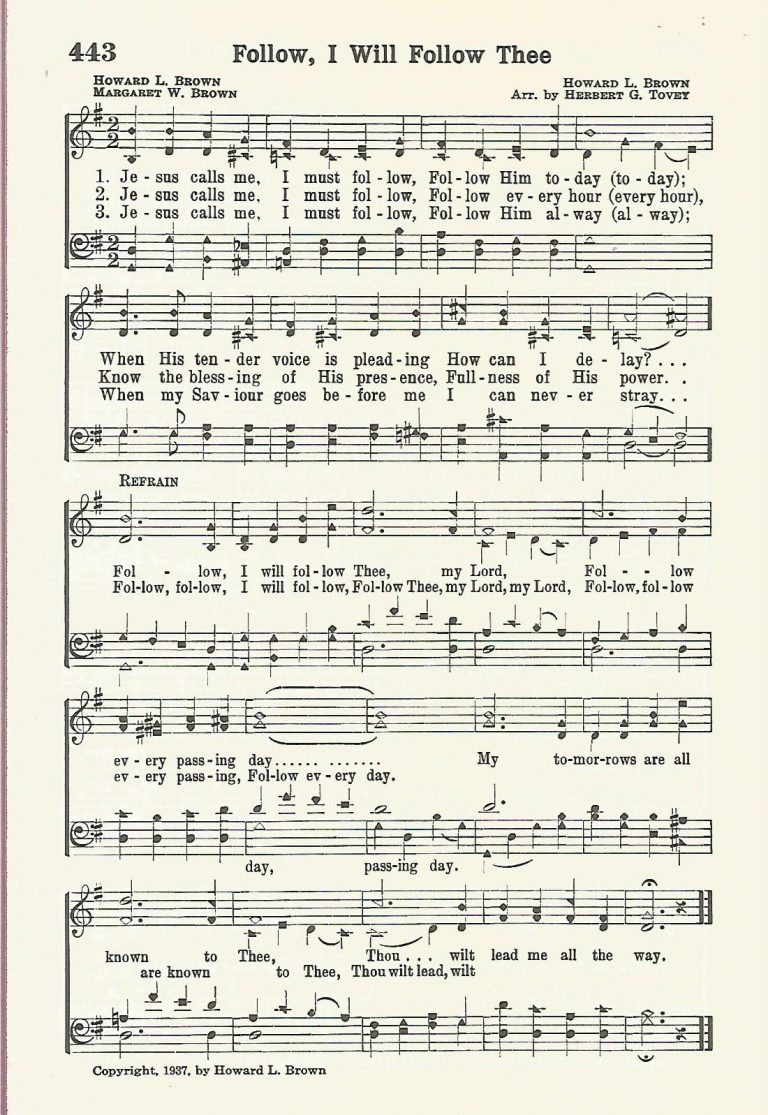
Hymn History: Follow, I Will Follow Thee
Author: Howard Longsdon Brown
I will follow Thee, my Savior,
Where’er the pathway may go.
(Howard Longsdon Brown)
The Origin of the Hymn “Follow, I Will Follow Thee”
The hymn “Follow, I Will Follow Thee” emerged from the earnest devotional climate of early twentieth-century American evangelicalism, a period when personal commitment and practical Christian living were emphasized in churches, youth societies, and revival meetings. Its author, Howard L. Brown, was part of that tradition. Though not as widely known as some earlier gospel songwriters, Brown contributed hymns that reflected the steady, decision-oriented faith that characterized many congregations of his day.
Howard L. Brown was active in Christian Endeavor and other evangelical circles during the 1930s. His name appears in several gospel song collections, often alongside that of his wife, Margaret W. Brown, indicating that hymn writing was both a personal and shared ministry. In 1935, “Follow, I Will Follow Thee” was copyrighted and published, finding its place in church songbooks that were used for youth rallies, evangelistic services, and congregational worship.
The era in which Brown wrote was marked by transition. The emotional revivalism of the late nineteenth century had matured into organized church programs, youth movements, and missionary efforts. Christian Endeavor societies in particular encouraged young believers to make public pledges of faithfulness, service, and moral integrity. A hymn built around the repeated affirmation “I will follow” fit naturally into that setting.
The text of “Follow, I Will Follow Thee” is direct and personal. Like many gospel songs of the period, it speaks in the first person. Rather than recounting a biblical narrative or exploring doctrinal themes at length, the hymn centers on the believer’s response to Christ’s call. Its refrain underscores this commitment:
I will follow Thee, my Savior,
Where’er the pathway may go.
The language echoes the words of Christ in the Gospels — “Follow me” — spoken to fishermen by the Sea of Galilee and later to others who would become His disciples. In Scripture, that call required leaving familiar routines and trusting Christ’s leadership. Brown’s hymn distills that same principle into a simple, memorable declaration suited to congregational singing.
The stanzas acknowledge that the path of discipleship is not always easy. References to storms, valleys, or trials remind singers that following Christ involves perseverance. Such imagery would have resonated deeply during the 1930s, a decade overshadowed by the Great Depression. Economic hardship and uncertainty touched many church families. A hymn affirming steadfast loyalty in difficult circumstances offered encouragement grounded in faith rather than in outward prosperity.
Musically, the hymn follows the gospel song pattern common to its time. The melody is straightforward, accessible, and structured around a recurring chorus. This design made it effective for group singing in a variety of settings — Sunday services, midweek meetings, and youth gatherings. Gospel songs were meant to be sung by ordinary believers, not trained choirs alone, and Brown’s composition reflects that practical approach.
Theologically, “Follow, I Will Follow Thee” reflects a balanced evangelical emphasis. It assumes a personal relationship with Christ — He is addressed as “my Savior” — yet it also points toward obedience and daily faithfulness. The hymn does not dwell on abstract theology but expresses lived discipleship. In this way, it stands in continuity with earlier gospel writers such as Philip P. Bliss and Fanny Crosby, who similarly combined simple language with earnest conviction.
One of the strengths of Brown’s hymn is its clarity. There is no ambiguity about its message. The singer pledges to follow Christ wherever He leads. That straightforwardness suited churches that valued plain preaching and practical Christianity. In many congregations, hymns served not only as praise but also as testimony. Singing “I will follow” was both an act of worship and a reaffirmation of personal resolve.
Over time, musical tastes in churches have shifted, and some gospel songs of the early twentieth century are heard less frequently. Yet “Follow, I Will Follow Thee” represents an important chapter in American hymnody. It captures the spirit of a generation that believed faith should be visible in conduct and steadfast in adversity. The hymn reflects an understanding of Christianity as a life to be lived with consistency and courage.
Howard L. Brown may not be as widely remembered as some of his predecessors, but his contribution illustrates how many faithful writers enriched the church’s song. Their names may appear quietly in hymnals, yet their words have strengthened countless believers. In composing “Follow, I Will Follow Thee,” Brown gave voice to a central Christian conviction: that discipleship involves willing obedience, not merely admiration from a distance.
The hymn’s enduring value lies in its simplicity. It reminds worshipers that the call of Christ has not changed. To follow Him — through calm days and troubled seasons alike — remains the essence of Christian devotion. In that steady pledge, Brown’s hymn continues to echo a timeless truth: faithfulness is measured not by grand gestures, but by daily resolve to walk in the Savior’s steps.
_____
Image Source/Credit (in order):
• Homeschoolbookreviewblog. “Follow, I Will Follow Thee.” Hymnstudiesblog, 23 Mar. 2024 (hymnstudiesblog.wordpress.com/2024/03/23/follow-i-will-follow-thee)
Related
Sorry, no records were found. Please adjust your search criteria and try again.
Sorry, unable to load the Maps API.