
The Wesley Oak on St. Simons Island, Georgia, is a historic and symbolic landmark associated with the early ministry of John Wesley during his time in colonial America. Though less widely known than other sites connected to Wesley’s life, this venerable tree represents an important chapter in his spiritual development and in the beginnings of Methodism’s connection to the New World.
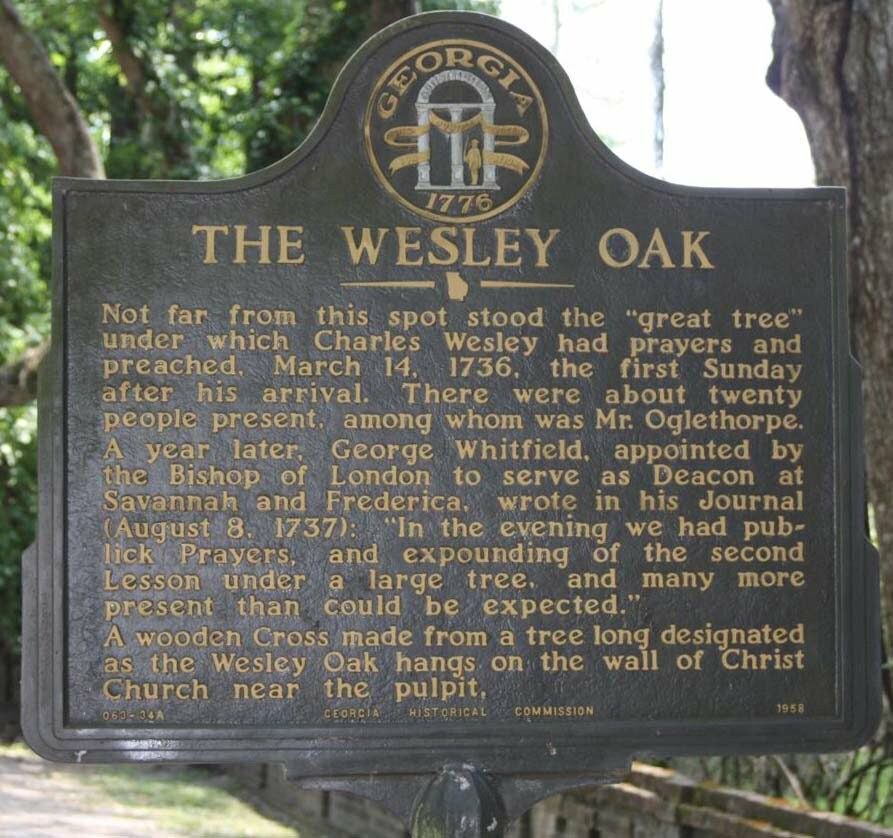
John Wesley arrived in the colony of Georgia in 1736 as an Anglican missionary. His journey was part of a broader effort by the Church of England to establish a religious presence in the American colonies. Wesley’s primary responsibility was to serve as a minister in Savannah, but his work also took him to surrounding areas, including St. Simons Island. It was here, beneath what is now known as the Wesley Oak, that he is traditionally believed to have preached to settlers and Native Americans.
The tree itself, a massive live oak draped in Spanish moss, is estimated to be several centuries old. Its wide, spreading branches create a natural canopy, making it an ideal gathering place for outdoor preaching. In the eighteenth century, when church buildings were limited and communities were dispersed, such natural settings often served as meeting places for worship and instruction.
Wesley’s time in Georgia was both formative and challenging. Though he was earnest in his efforts, his ministry in the colony met with mixed results. Cultural differences, personal struggles, and conflicts within the community made his mission difficult. Despite these challenges, his experiences in Georgia played a crucial role in shaping his later ministry. The difficulties he encountered contributed to a period of reflection that eventually led to his spiritual awakening in 1738, often associated with his Aldersgate experience in London.
The Wesley Oak stands as a reminder of this earlier phase in his life—a time when he was still searching for clarity and assurance in his faith. His preaching beneath the tree represents his commitment to his calling, even before his later transformation. It also reflects a pattern that would become central to his ministry: the willingness to preach outside traditional church settings and to reach people wherever they could be found.
Today, the Wesley Oak is preserved as a historical site and is located on the grounds of Christ Church on St. Simons Island. Visitors to the site can view the tree and reflect on its connection to Wesley’s ministry. The surrounding area, with its historic church and peaceful landscape, provides a fitting setting for contemplation and remembrance.
The significance of the Wesley Oak extends beyond its association with a single individual. It represents the early roots of Methodism in America and the broader effort to bring Christian teaching to the colonies. It also serves as a symbol of perseverance, illustrating how even periods of difficulty can contribute to future growth and impact.
In addition, the tree has become a point of interest for those interested in American religious history. It offers a tangible link to the past, connecting visitors with the experiences of an influential figure in a formative stage of his life. The preservation of the site ensures that this connection can be appreciated by future generations.
In conclusion, the Wesley Oak in Georgia stands as a quiet yet meaningful landmark in the story of John Wesley and the development of Methodism. Though his time in the colony was marked by challenge, it laid important groundwork for his later ministry. The tree remains as a symbol of those early efforts, reminding visitors of the enduring significance of faith, perseverance, and the willingness to serve in unfamiliar and difficult circumstances.
_____
Image Source/Credit:
• Bubba73 (Jud McCranie), CC BY-SA 4.0 <https://creativecommons.org/licenses/by-sa/4.0>, via Wikimedia Commons
Related
Sorry, no records were found. Please adjust your search criteria and try again.
Sorry, unable to load the Maps API.