
Billy Sunday remains one of the most colorful and influential figures in early twentieth-century American religious life, and his formative years at Northwestern Academy—often referred to historically as Evanston Academy—played a meaningful role in shaping the man he would become.
Born in 1862 in rural Iowa, Billy Sunday’s early life was marked by hardship. His father, a Union soldier, died during the American Civil War, leaving the family in poverty. As a boy, Sunday spent time in an orphanage, developing resilience and discipline that would later define both his athletic and religious careers. His natural athletic ability eventually brought him recognition, and he rose to prominence as a professional baseball player in the 1880s, known for his speed and energy on the field.
Despite his success in baseball, Sunday experienced a religious conversion that changed the course of his life. Leaving behind professional sports, he committed himself to Christian ministry, eventually becoming one of the most well-known evangelists of his era. His preaching style was anything but reserved. He was energetic, theatrical, and direct, often pacing the stage, using vivid language, and appealing strongly to emotion and moral conviction. His messages emphasized personal responsibility, repentance, and a return to traditional values—qualities that resonated with large audiences across the United States.
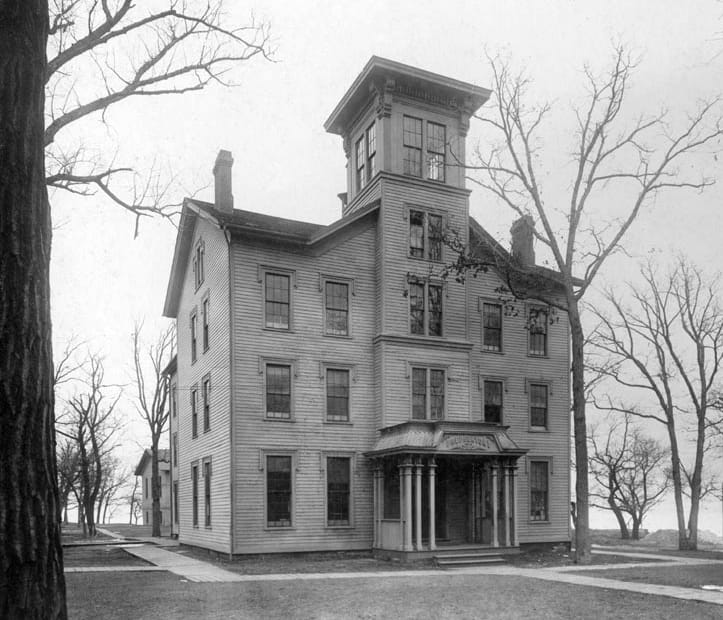
Before his rise to national fame, however, Sunday’s education at Northwestern Academy in Evanston provided an important foundation. The academy, affiliated with Northwestern University, was known for its emphasis on moral instruction, classical education, and character development. It aimed to prepare young men for higher education and responsible citizenship, blending academic rigor with spiritual guidance.
At Evanston Academy, Sunday was exposed to a structured environment that valued discipline and self-improvement. Though he was not known as a particularly distinguished student academically, the experience helped refine his sense of purpose and direction. The academy’s emphasis on Christian principles likely reinforced the moral framework that would later become central to his preaching.
Evanston itself, a community with strong ties to religious and educational institutions, also contributed to Sunday’s development. The town had a reputation for temperance and moral reform, values that aligned closely with Sunday’s later campaigns against alcohol and vice. His exposure to such an environment during his formative years cannot be overlooked. It offered him a model of community life grounded in shared ethical standards and faith-based ideals.
Sunday’s later ministry reflected many of these influences. He became a leading voice in the temperance movement, strongly supporting prohibition and urging Americans to reject alcohol as a destructive force. His sermons often combined personal anecdotes, moral instruction, and a call to action, encouraging listeners to live upright and disciplined lives. In many ways, his approach mirrored the values instilled in institutions like Northwestern Academy—hard work, moral clarity, and personal accountability.
His impact was considerable. At the height of his career, Sunday drew massive crowds, filling large tabernacles built specifically for his revival meetings. It is estimated that he preached to millions of people and inspired countless individuals to make religious commitments. While some critics viewed his style as overly dramatic, supporters saw him as a powerful force for moral renewal in a rapidly changing society.
Billy Sunday’s connection to Evanston Academy may not be the most widely discussed aspect of his life, but it represents an important chapter in his personal development. The academy provided structure and exposure to ideas that would later define his public ministry. It stands as a reminder that even figures known for their larger-than-life presence are shaped by the institutions and communities that influence them in their youth.
In the end, Sunday’s legacy is one of transformation—both personal and societal. From a boy facing hardship, to a professional athlete, to a nationally recognized evangelist, his life reflects a journey shaped by discipline, faith, and opportunity. His time at Evanston Academy, though only one part of that journey, contributed to the foundation upon which his remarkable career was built.
♦ _____ ♦
During the winter of 1887-88, Sunday made arrangements to take courses in elocution and rhetoric at Evanston Academy, part of Northwestern University. In exchange for the courses, he agreed to coach the university’s baseball team during their winter practice sessions. On the night of January 1, 1888, Sunday proposed to Nell Thompson.
_____
Image Source/Credit:
• Public domain, via Wikimedia Commons
Related
Sorry, no records were found. Please adjust your search criteria and try again.
Sorry, unable to load the Maps API.