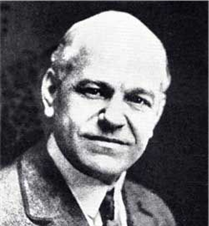
William Edward Biederwolf
“His scholarship was broad; his use of the English language was concise, accurate, and powerful; his sympathies were deep; his heart was warm …”
(Hannah S. Bowers)
The Life and Legacy of William Biederwolf
William Edward Biederwolf stands among the notable evangelists of the early twentieth century, remembered for his clear gospel preaching, his patriotic spirit, and his steady commitment to doctrinal fidelity during a time of shifting spiritual currents. Like many revivalists of his era, he lived with deep conviction that God’s Word was the ultimate authority for faith and practice, and that the church’s hope rested not in novelty but in a return to the plain teaching of Scripture. His ministry, which stretched across decades and touched thousands of lives, testified to the enduring value of faithful evangelism grounded in traditional Christian truth.
Biederwolf was born on September 29, 1867, in Montgomery County, Indiana, into a hardworking rural family of German heritage. The values of discipline, reverence for God, and respect for the local church were woven into his upbringing. Though he did not immediately sense a calling to ministry, the spiritual habits formed in his youth prepared him for the path that would later unfold. As a young man he pursued education at Wabash College, where he began to display leadership, intellectual sharpness, and an ability to speak clearly—traits that would become central to his evangelistic work.
After his conversion and subsequent call to preach, Biederwolf continued his studies at Princeton Theological Seminary, an institution then known for its strong commitment to biblical orthodoxy. Under the leadership of men such as B. B. Warfield and Charles Hodge’s successors, he received a robust theological foundation. He also pursued further training in Germany, giving him a broad perspective that proved helpful throughout his career. These years shaped his convictions deeply. He came to believe that the preacher’s task was not to impress but to proclaim, not to speculate but to declare plainly the message God had already given.
Though trained for pastoral ministry, Biederwolf soon felt a strong tug toward evangelistic work. He recognized the spiritual need of communities across America—families struggling morally, churches losing influence, and young people drifting from the faith of their parents. Out of that concern, he stepped into the demanding life of an itinerant evangelist, traveling from city to city and conducting revival campaigns that often lasted weeks at a time. His preaching style was clear, direct, and thoroughly biblical, marked by earnest appeals to conscience rather than sensationalism. He believed that the gospel carried its own power when presented plainly.
Biederwolf’s meetings were characterized by thorough preparation, reasoned messages, and a respectful atmosphere. He did not rely on emotional manipulation, but rather on the steady unfolding of Scripture and the convicting work of the Holy Spirit. Many who attended his campaigns later remarked on his balance—seriousness without severity, warmth without compromise. He preached the old truths without apology: sin, repentance, salvation through Christ alone, and the call to holy living. Churches in many communities credited his meetings with renewed prayer, restored families, and increased membership.
During World War I, Biederwolf served as a chaplain, demonstrating a patriotism that meshed naturally with his faith. He believed that love of country was strengthened, not weakened, by devotion to Christ, and he offered spiritual support to soldiers facing hardship and uncertainty. His time as a chaplain broadened his ministry and deepened his compassion. After the war, he continued preaching with even greater urgency, convinced that the moral challenges facing the nation required spiritual awakening.
One of Biederwolf’s most enduring contributions was his leadership in the broader movement of early American fundamentalism. Although not as publicly prominent as some of his contemporaries, he played a vital role in defending biblical authority and calling churches back to doctrinal stability. He recognized the growing influence of modernism in schools, seminaries, and pulpits, and he urged believers to stand firm on the historic truths of the faith. For him, the answer to theological drift was not novelty but a renewed commitment to Scripture.
He also served as a strong proponent of religious education. From 1924 to 1930 he served as director of the Winona Lake Bible Conference, one of the most influential Bible gatherings of its time. Under his guidance, the conference brought together pastors, missionaries, and laypeople for preaching, teaching, and practical Christian training. Biederwolf saw such efforts as essential, believing that Christians needed deeper biblical understanding if they were to stand firm in their convictions and effectively reach others.
In his later years, Biederwolf continued preaching, writing, and leading conferences until declining health slowed his pace. He never embraced the theatrics or extremes that marked some parts of the evangelistic world. Instead, he maintained a steady, balanced ministry rooted in Scripture and practical Christian living. He had a keen sense of responsibility—to God, to the church, to the nation, and to the generations who would follow. When he passed away on September 3, 1939, many Christian leaders recognized him as a man who had labored faithfully without seeking personal fame.
The legacy of William Biederwolf rests on several key pillars:
- First, his unwavering dedication to evangelism demonstrated the continuing need for clear gospel preaching, regardless of cultural changes. He believed that no generation advances beyond its need for Christ, repentance, and new birth.
- Second, his defense of doctrinal orthodoxy helped strengthen the fundamentalist movement during its formative years. He provided a steady voice of clarity and conviction without the contentious spirit that sometimes marked that era.
- Third, his work with Bible conferences and training programs set an example for how Christians can be equipped in practical, accessible ways.
Biederwolf’s life offers a reminder that genuine influence does not require spectacle. It requires fidelity—to Scripture, to the work God gives, and to the people He calls us to serve. His ministry, grounded in the old paths and carried out with sincerity, continues to encourage those who believe that the timeless truths of Scripture remain the church’s surest foundation.
_____
Image Source/Credit (in order):
• Public domain, via Wikimedia Commons
Related
Sorry, no records were found. Please adjust your search criteria and try again.
Sorry, unable to load the Maps API.