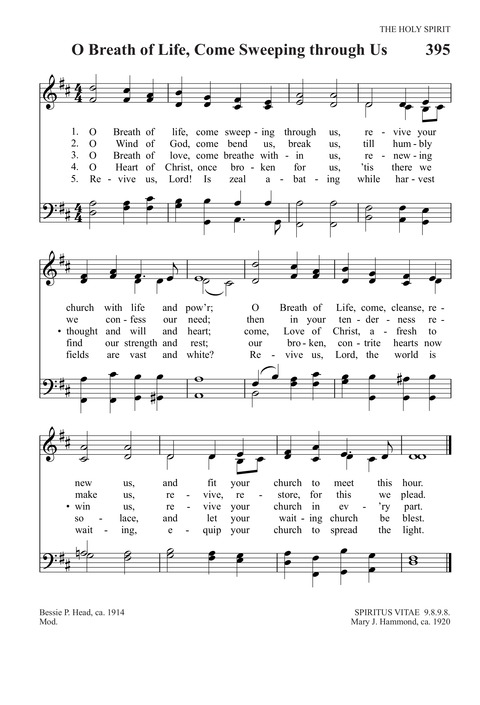
Hymn History: O, Breath of Life
Tune Composer: Norman E. Johnson
Author: Bessie Porter Head
“Norman Johnson’s genius has shaped some of today’s best church music.”
(Christianity Today)
Norman E. Johnson (1928–2017) was a devoted Christian musician, educator, and hymn writer whose quiet faith and steady service left a meaningful mark on congregational singing in the United States. Though not as widely known as some of the great nineteenth-century hymnists, Johnson’s work has been cherished in churches that value clear doctrine, singable melodies, and lyrics rooted firmly in Scripture.
Born in 1928 in the American Midwest, Johnson grew up in a home where church life was central. Like many of his generation, he was shaped by the steady rhythms of Sunday worship, evening hymn sings, and the strong musical traditions of Protestant congregations. From an early age he showed an aptitude for music. He studied piano and voice and quickly developed a love for the hymns that had sustained believers for generations—works by writers such as Isaac Watts and Fanny Crosby. These early influences would remain evident throughout his own writing.
Johnson pursued formal musical training in college, preparing not only as a performer but as a teacher and church musician. Over the years he served in a variety of roles, including choir director, music educator, and church organist. Those who worked with him often noted his patient manner and his belief that church music should first and foremost support the congregation’s voice. He held firmly to the idea that hymns were not performance pieces but shared confessions of faith, meant to be sung by ordinary believers.
His hymn writing grew naturally out of his work in the local church. Johnson was attentive to the needs of pastors and congregations. When a particular theme required clearer expression—whether the assurance of salvation, the call to discipleship, or the comfort of God’s providence—he would often set about crafting a text that addressed it plainly and biblically. His language was straightforward, avoiding trends or sentimental excess. Instead, he favored balanced stanzas, regular meter, and rhymes that made his hymns easy to learn and remember.
One of Johnson’s best-known contributions is the hymn “Now I Belong to Jesus,” a piece that has been included in numerous evangelical hymnals. Its message centers on the believer’s union with Christ and the security found in His saving grace. The refrain, simple and memorable, reflects Johnson’s gift for expressing theological truth in words accessible to all ages. Churches across denominational lines have adopted the hymn for both regular worship and special services, including baptisms and revival meetings.
In addition to writing texts, Johnson was deeply involved in the practical work of church music. He trained choirs, organized music programs, and encouraged young musicians to use their talents in service to the Lord. He believed that discipline and reverence were essential in worship. Rehearsals under his direction were orderly and purposeful, yet marked by warmth. He expected preparation and excellence, not for applause, but out of respect for the sacred task at hand.
Johnson’s hymns reflect a distinctly evangelical theology, emphasizing personal faith in Christ, the authority of Scripture, and the hope of eternal life. At the same time, his work avoided narrowness. He wrote with a broad Christian audience in mind, focusing on themes common to believers everywhere: repentance, redemption, gratitude, and trust. This balance helped his hymns endure beyond the particular settings in which they were first introduced.
Though he lived during a period of significant change in church music—especially the rise of contemporary praise styles—Johnson remained committed to the traditional hymn form. He did not oppose new expressions outright, but he consistently advocated for the preservation of doctrinally rich congregational singing. He believed that hymns served as a kind of sung theology, shaping the faith of future generations. In this, he stood in continuity with earlier hymn writers who saw their work as an extension of pastoral ministry.
Even in later years, Johnson continued to encourage church musicians and hymn writers. He understood that his own role was part of a larger chain, linking past and future. The hymns he loved as a boy had strengthened him through life’s trials, and he hoped his own texts would do the same for others.
Norman E. Johnson passed away in 2017, leaving behind a legacy measured not in fame but in faithfulness. His hymns continue to be sung in churches that prize clarity, reverence, and heartfelt praise. In an era often marked by rapid change, Johnson’s work stands as a reminder that enduring truths, simply and sincerely expressed, never lose their power.
~~~~~
ChristianityToday:
One of his great concerns is the need for integrity in music ministry. He considers the greatest needs to be: (1) a return to a succinct, quality gospel message—too much contemporary material is so individualistic that it doesn’t relate to the congregation; (2) more variety in the church program, with more music actually addressed to God; and (3) worship with less spectatorism. “The audience still must be God, not man,” he says.
_____
Image Source/Credit (in order):
• Trinity Psalter Hymnal 395. O Breath of Life, Come Sweeping Through Us | Hymnary.org (hymnary.org/hymn/TPH2018/395)
Related
Sorry, no records were found. Please adjust your search criteria and try again.
Sorry, unable to load the Maps API.