Hymn History: The Nail Scarred Hand
Author: Baylus Benjamin McKinney
“The radiant and gentle life of B. B. McKinney exemplified his Christianity… always so modest, never wanting any credit.”
(Robert Cottrill)
The life and legacy of Baylus Benjamin McKinney reflect the deep musical and spiritual traditions of early twentieth-century American Christianity. A gifted composer, pastor, and educator, McKinney made a lasting contribution to gospel music through his hymns, many of which continue to be sung in churches today. Among his most cherished works is “The Nail Scarred Hand,” a hymn that captures both the comfort and conviction found in the Christian life.
Born in 1886 in Texas, McKinney grew up in a musical family that encouraged his early interest in both music and ministry. He pursued formal training at several institutions, including the Southwestern Baptist Theological Seminary and the Kansas City Conservatory of Music. This combination of theological and musical education shaped his future work, equipping him to serve both as a pastor and as a leader in church music. McKinney’s ministry took him to several Baptist churches, where he became known not only for his preaching but also for his ability to lead congregational singing.
In addition to his pastoral work, McKinney served as a music editor for denominational publishing houses. In this role, he contributed to the development of hymnals and gospel song collections that were widely used across the United States. His editorial work gave him a broad influence, as he helped shape the musical selections that would guide worship in countless congregations. Through both his own compositions and his editorial oversight, McKinney played a key role in preserving and promoting the gospel song tradition.
“The Nail Scarred Hand” stands as one of McKinney’s most enduring hymns. The song centers on the image of Christ’s wounded hands, a powerful symbol drawn from the crucifixion narratives in the Gospels. These “nail-scarred hands” represent both the suffering of Christ and the assurance of salvation for believers. McKinney’s text uses this imagery to emphasize trust in Christ, even amid life’s uncertainties.
The hymn opens with a personal declaration of faith, affirming confidence in Christ’s guidance:
If I falter in the way, or if I faint,
If I fail to see the light,
I will cling unto the hand
That was wounded for me.
This theme of reliance continues throughout the hymn. The “nail-scarred hand” becomes a metaphor for divine guidance, protection, and comfort. McKinney’s language is simple yet deeply expressive, allowing worshipers to connect emotionally with the message. The hymn speaks to those who face doubt, difficulty, or discouragement, reminding them that Christ’s sacrifice provides both forgiveness and ongoing support.
Musically, “The Nail Scarred Hand” reflects the characteristics of early twentieth-century gospel songs. Its melody is straightforward and memorable, designed for congregational singing. The structure typically includes a refrain that reinforces the central image, making the message easy to remember and internalize. This accessibility helped the hymn gain widespread popularity, particularly in revival meetings and traditional church services.
McKinney’s broader body of work includes many other well-known hymns, such as “Have Faith in God” and “Speak to My Heart.” These songs share a common emphasis on personal trust in God and the sustaining power of faith. His writing consistently reflects a pastoral concern for the needs of ordinary believers. Rather than focusing on abstract theology, McKinney addressed the practical realities of Christian living, offering encouragement and reassurance through song.
The legacy of Baylus Benjamin McKinney extends beyond his individual compositions. As a teacher, editor, and leader in church music, he helped shape the sound of worship for an entire generation. His hymns were included in widely distributed hymnals, ensuring their use across a variety of denominations and settings. Even today, his songs remain part of the repertoire of churches that value traditional gospel music.
“The Nail Scarred Hand” continues to resonate because of its timeless message. The image at its center speaks across generations, reminding believers of the cost of their redemption and the constancy of Christ’s care. In a world often marked by uncertainty, the hymn offers a steady assurance: the same hands that bore the nails now guide and sustain those who trust in Him.
McKinney passed away in 1952, but his influence endures through his music. His hymns remain a testament to the power of simple, heartfelt expression grounded in biblical truth. Through “The Nail Scarred Hand,” he gave the church a song that not only proclaims the gospel but also invites believers to rest in its promises. His life’s work stands as a lasting contribution to Christian worship, reflecting both his musical skill and his deep faith.
♦ _____ ♦
Inscription:
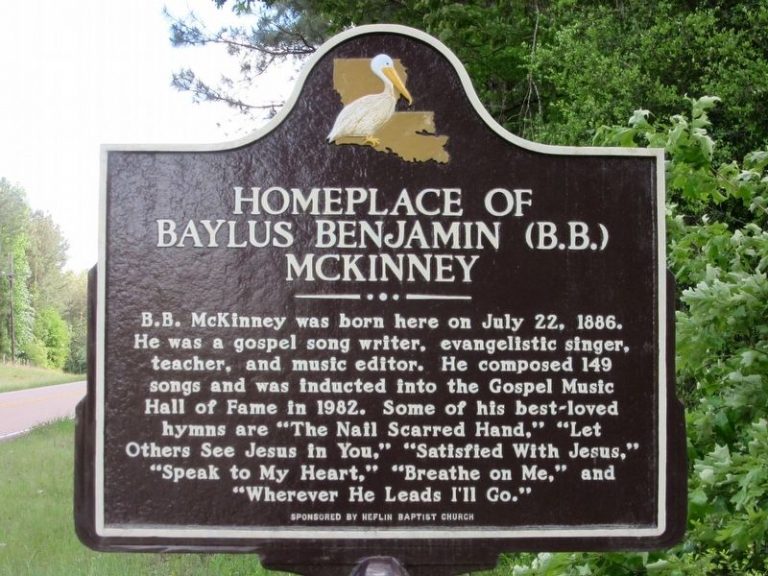
B.B. McKinney was born here on July 22, 1886. He was a gospel song writer, evangelistic singer, teacher, and music editor. He composed 149 songs and was inducted into the Gospel Music Hall of Fame in 1982. Some of his best-loved hymns are “The Nail Scarred Hand,” “Let Others See Jesus in You,” “Satisfied With Jesus,” “Speak to My Heart,” “Breathe on Me,” and “Wherever He Leads I’ll Go.”
_____
Image Source/Credit (in order):
• Photographed by Jason Armstrong, April 24, 2021 HMDB.org
• Baylus Benjamin McKinney (www.hymntime.com/tch/bio/m/c/k/i/mckinney_bb.htm)
Related

Sorry, no records were found. Please adjust your search criteria and try again.
Sorry, unable to load the Maps API.