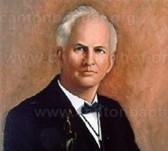
Thomas Theodore “T. T.” Martin
“We have fallen upon an evil day. … We have trusted in material wealth … and all have failed to give us the bliss for which we yearn. … The principles of the great Teacher … will bring us to real prosperity.”
(Thomas Theodore “T. T.” Martin)
The Life and Legacy of Thomas Theodore “T. T.” Martin
Thomas Theodore “T. T.” Martin stands among the noteworthy voices of early twentieth-century American evangelism, remembered for his unwavering defense of biblical authority and his earnest evangelistic zeal. While some of his contemporaries garnered wider fame, Martin’s labors helped shape the convictions of many Christians during a time of growing theological uncertainty. He built his ministry on the old paths—simple gospel preaching, a firm belief in the inspiration of Scripture, and a practical commitment to calling souls to repentance. His influence stretched across churches, revival campaigns, and the wider fundamentalist movement that rose during his lifetime.
T. Martin was born on April 28, 1862, in Smith County, Mississippi, a rural region where hard work and plain living were everyday realities. He grew up in a family that valued the Scriptures and encouraged him in spiritual things. His early conversion set the direction for his life, and before long he felt the call to preach. From youth, Martin showed determination and discipline. To prepare for ministry, he pursued education at Mississippi College and later at the Southern Baptist Theological Seminary in Louisville, Kentucky. These years grounded him in the Scriptures and gave him the tools that he would later use in both preaching and writing.
Martin began pastoring while still a young man, serving congregations in Mississippi and Texas. His preaching was marked by clarity, urgency, and a direct appeal to the conscience—qualities that would later distinguish him as an evangelist. Though he enjoyed pastoral work, he sensed a growing call toward full-time evangelistic labors. The needs of the lost, and the conviction that revival preaching could awaken hearts, led him to resign his pulpit and step out in faith as an itinerant evangelist.
From the late 1880s onward, Martin traveled widely across the South, conducting revival meetings in churches, auditoriums, and open-air gatherings. His style was plainspoken and forceful, yet grounded in Scripture. Reports from the time describe him as earnest, fearless, and deeply burdened for souls. People responded to his straightforward preaching, and many churches experienced renewed spiritual life during his meetings. Martin believed that revival came not through emotional excess but through repentance, prayer, and obedience to the Word of God. His approach appealed to those who valued tradition, stability, and doctrinal conviction.
As theological liberalism began spreading through denominational institutions and schools in the early twentieth century, Martin became increasingly concerned. He recognized that modernism threatened not only doctrinal teaching but also the evangelistic heart of the church. Believing that the authority of Scripture was the foundation of Christian life, he stepped into the growing conflict as a defender of the faith. He spoke plainly, sometimes sharply, but always from a conviction that the spiritual welfare of the church was at stake.
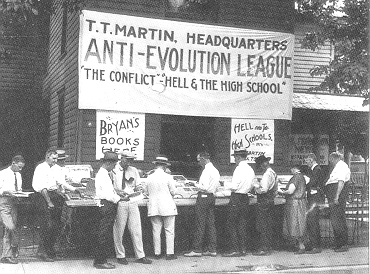
His best-known book, Hell and the High Schools (1923), was a forceful critique of evolutionary teaching in public schools. Martin argued that evolution undermined biblical authority and weakened moral foundations. While some viewed his stance as confrontational, many Christians of his day welcomed his defense of the traditional reading of Genesis and the historic Christian worldview. The book circulated widely, reinforcing Martin’s place among the leading voices of early fundamentalism.
Martin’s contribution to the famous 1920s anti-modernist campaign was particularly noteworthy. During the Scopes Trial in Dayton, Tennessee, in 1925, he conducted street-corner preaching and distributed literature defending biblical creation and calling people to repentance. Though not a central figure in the courtroom proceedings, his presence in Dayton symbolized the earnest convictions of many ordinary believers who felt that cultural and educational trends were drifting away from the faith of their fathers. Martin never tired of reminding the public that Scripture—not science, philosophy, or shifting societal currents—must remain the final authority.
In addition to his evangelistic preaching and apologetic writing, Martin produced several devotional works emphasizing practical Christian living. Books such as God’s Plan with Men and Winning Souls encouraged believers to embrace personal holiness and take part in evangelism. He wrote plainly, using stories from his ministry to illustrate timeless spiritual lessons. Churches often distributed his pamphlets, appreciating their simplicity and usefulness.
Martin continued holding revival meetings into the 1930s, even as age and health placed greater strain on him. Throughout his ministry, he had no interest in building an earthly empire or promoting himself. Instead, he poured his energy into calling men and women to repentance, strengthening the faith of church members, and urging pastors to stand firm on the authority of Scripture. His life reflected a steadfast commitment to the older ways—prayer, Scripture reading, personal evangelism, and faithful church involvement. These were the tools he trusted, and they proved effective.
He passed away on May 23, 1939, leaving behind a legacy shaped not by institutions but by the thousands who heard him preach and the Christians who found renewed conviction through his writings. While later generations may not know his name as readily as some other evangelists, those familiar with the history of American fundamentalism recognize his important role. He helped solidify a movement rooted in Scripture, practical evangelism, and a willingness to stand firm even when cultural tides shifted in other directions.
The legacy of T. T. Martin endures in several ways.
- First, his defense of biblical authority strengthened believers during a time of widespread doctrinal uncertainty. His warnings against abandoning the Scriptures proved prescient as theological drift continued in many circles.
- Second, his evangelistic work showed the enduring value of clear gospel preaching. He believed that no generation—no matter how modern—outgrew its need for repentance and faith.
- Third, his example encouraged ordinary Christians to stand firm in their convictions, even when doing so brought criticism.
In remembering Thomas Theodore Martin, one sees the portrait of a man who held fast to the old truths, labored faithfully without seeking applause, and left a mark on American religious life through steadfast devotion. His life remains a reminder that earnest gospel preaching, grounded in Scripture and accompanied by personal integrity, continues to bear fruit long after the preacher’s voice has fallen silent.
_____
Image Source/Credit (in order):
• Admin. “T.T. Martin.” Christian Hall of Fame, 30 June 2020 (christianhof.org/martin
• User, Super. “Hell and the High Schools by T. T. Martin.” Famous Trials (famous-trials.com/scopesmonkey/2140-hellandhighschools)
Related
Sorry, no records were found. Please adjust your search criteria and try again.
Sorry, unable to load the Maps API.