
Wikipedia:
He composed many tunes, including those for “He Leadeth Me”; “Just As I Am“; “Sweet Hour of Prayer” (attributed to William W. Walford, 1772–1850);[4] “Savior, Like a Shepherd Lead Us” and “My Hope Is Built on Nothing Less“, all of which can still be found in hynmbooks and songbooks today.
The Life and Legacy of William Batchelder Bradbury
William Batchelder Bradbury (1816–1868) occupies a central place in the development of American church music during the nineteenth century. A gifted composer, educator, and publisher, Bradbury helped shape the sound of Protestant worship in an era when congregational singing was becoming more organized, widespread, and musically refined. His tunes, many of which remain in use today, reveal a man deeply committed to strengthening the church through song.
Born in York, Maine, Bradbury grew up during a time when singing schools and community choirs played an important role in musical education. Recognizing his talent early, he pursued formal study in Boston and later in Europe, where he encountered the musical traditions of Germany. These studies broadened his musical understanding and enriched his compositional style. Unlike some of his contemporaries whose training was limited, Bradbury combined American practicality with a disciplined musical foundation.
Upon returning to the United States, Bradbury became active as a choir director, music teacher, and composer. He was particularly influential in New York City, where he led church choirs and conducted large singing conventions. His passion for teaching helped raise the standard of congregational and choral singing. At a time when church music could be uneven and poorly led, Bradbury worked to bring order, skill, and enthusiasm to the task.
Bradbury is perhaps best remembered for his hymn tunes that have endured in countless hymnals. Among the most beloved is the tune “Sweet Hour,” written for the text “Sweet Hour of Prayer.” The melody’s gentle rise and fall perfectly complement the devotional character of the hymn, inviting quiet reflection. Another widely known tune is “Woodworth,” paired with the hymn “Just As I Am,” written by Charlotte Elliott. Bradbury’s tune gives strength and simplicity to Elliott’s text, supporting its message of humble approach to Christ.
His work with children’s hymnody was equally significant. Bradbury recognized the importance of teaching sacred truths to the young through music that was clear and memorable. He composed the tune for “Jesus Loves Me,” with text by Anna Bartlett Warner. Few hymns have reached as many hearts as this simple song. Its direct statement of Christian assurance—paired with Bradbury’s uncomplicated melody—has made it a cornerstone of children’s ministry for generations.
Bradbury also collaborated with prominent hymn writers such as Fanny Crosby. Their partnership produced numerous hymns that strengthened the growing Sunday school movement. Bradbury understood how to craft melodies that congregations could learn quickly yet continue to sing with conviction over time. His music avoided unnecessary ornamentation, favoring clear phrasing and strong harmonic structure.
In addition to composing, Bradbury was a successful music publisher. He compiled and edited hymn collections that circulated widely, helping standardize and disseminate quality church music. His publishing ventures ensured that congregations across the country had access to carefully arranged hymnals suitable for worship and instruction. Through these collections, his influence extended far beyond the churches he personally served.
Bradbury’s musical style reflects a transition in American sacred music. Earlier traditions often relied on rugged, folk-like tunes or complex fuging pieces. Bradbury’s compositions, while grounded in solid harmony, embraced smoother melodic lines and a more polished character. They retained accessibility while benefiting from his formal training. In this way, he helped move American hymnody toward a more unified and disciplined sound without losing its congregational vitality.
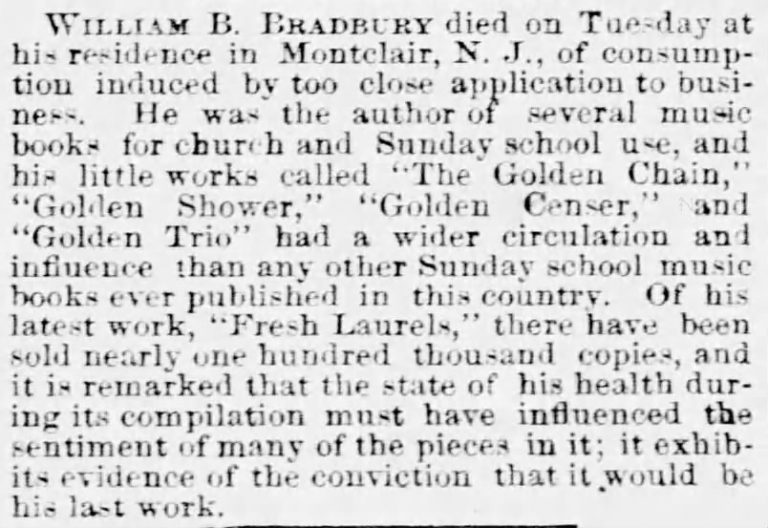
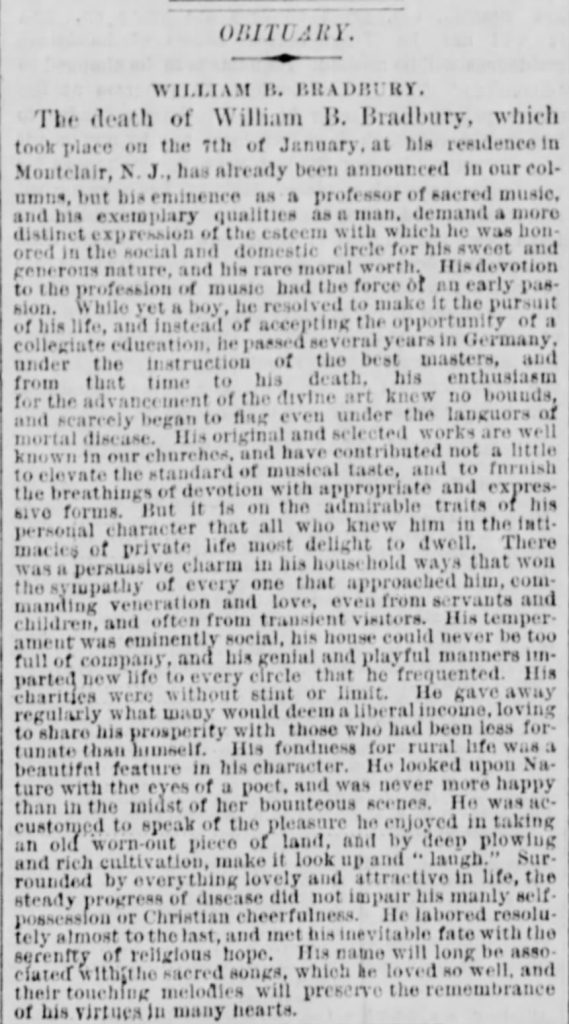
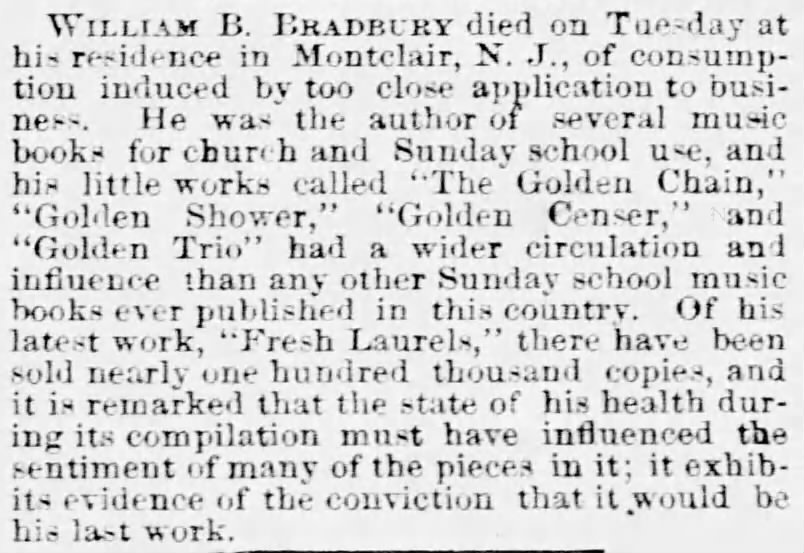
Though he died relatively young in 1868, Bradbury’s legacy proved enduring. His tunes became firmly embedded in Baptist, Methodist, Presbyterian, and other Protestant hymnals. They crossed denominational lines because they served the shared purpose of Christian worship. The strength of his music lies in its balance: reverent but warm, structured yet singable, dignified without being distant.
William Batchelder Bradbury’s contribution to sacred music reminds us that church song thrives when guided by both devotion and craftsmanship. He valued musical excellence, but always in service to the congregation. His melodies were not written for performance alone, but for participation—for voices lifted together in prayer and praise.
More than a century and a half after his death, congregations still sing his tunes. Children continue to learn “Jesus Loves Me,” worshippers bow in reflection during “Sweet Hour of Prayer,” and penitents find comfort in “Just As I Am.” Through these enduring hymns, Bradbury’s work remains woven into the life of the church, carrying forward a tradition of faithful and heartfelt song.
_____
Image Source/Credit (in order):
• William Batchelder Bradbury (www.hymntime.com/tch/bio/b/r/a/d/bradbury_wb.htm)
• Newspapers.com, New York Tribune, January 21, 1868 (www.newspapers.com/article/new-york-tribune/191755573/)
• Newspapers.com, Boston Evening Transcript, January 10, 1868 (www.newspapers.com/article/boston-evening-transcript/191755942/)
• Newspapers.com, The Brooklyn Union, January 9, 1868 (www.newspapers.com/article/the-brooklyn-union/191756178/)
Related


Sorry, no records were found. Please adjust your search criteria and try again.
Sorry, unable to load the Maps API.