Hymn History: Blessed Be The Name
Author: William Henry Clark
“All praise to Him who reigns above,
In majesty supreme…
Who gave His Son for man to die,
That He might man redeem.”
(William Henry Clark)
William Henry Clark (1854–1925) was a faithful minister of the gospel and a hymn writer whose words have endured in Christian worship long after his voice fell silent. Though not as widely known as some of his contemporaries, Clark’s contribution to congregational song—particularly through the beloved hymn “Blessed Be the Name”—has secured him a lasting place in evangelical hymnody.
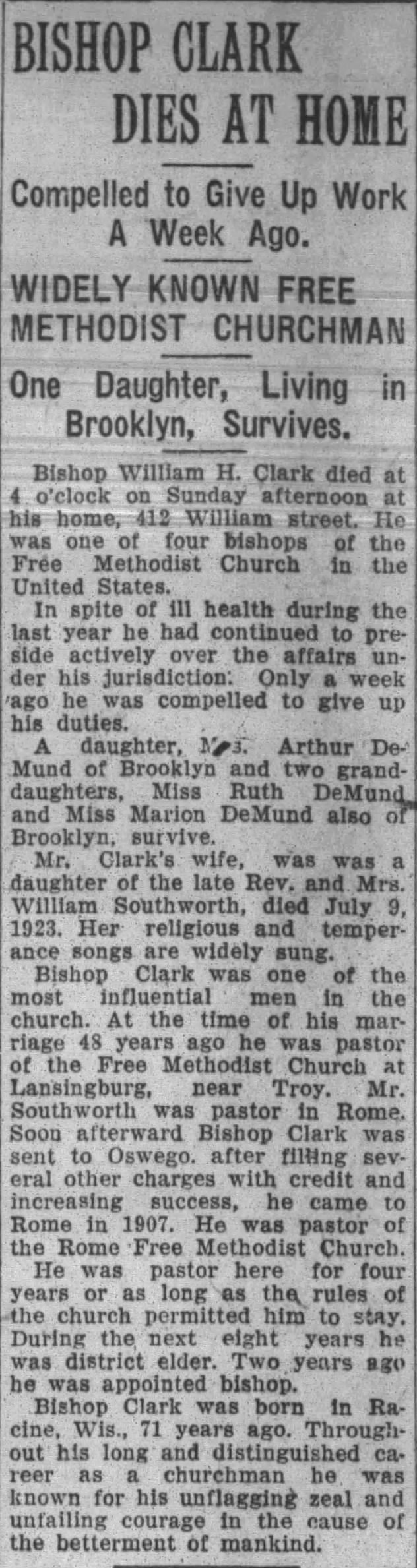
Born in the mid–nineteenth century, Clark came of age during a period of energetic revivalism and expanding denominational work in America. He became associated with the Free Methodist movement, a branch of Methodism that emphasized holiness of heart and life, plain living, and earnest evangelism. Clark did not seek prominence for himself; rather, he devoted his strength to preaching Christ, shepherding congregations, and building up the church. Over the years he served as a pastor, district leader, and eventually as a bishop within the Free Methodist Church. His leadership was marked not by spectacle, but by steady faithfulness.
Clark’s greatest and most enduring legacy rests in his hymn writing. In 1888 he penned the text “Blessed Be the Name,” a hymn that exalts the person and work of Christ in simple yet profound language. The tune most commonly associated with the text was composed by Ralph E. Hudson, and the partnership of Clark’s words with Hudson’s melody gave the church a song that has been sung for generations.
The hymn begins with a declaration of praise: “All praise to Him who reigns above, in majesty supreme.” In these opening lines, Clark sets the tone for the entire piece—Christ is sovereign, exalted, and worthy of adoration. Yet the hymn does not remain in lofty abstraction. It quickly moves to the heart of the gospel: “Who gave His Son for man to die, that He might man redeem.” Here Clark expresses the central truth of evangelical faith—redemption through the sacrificial death of Christ. The hymn continues stanza by stanza to recount Christ’s saving love, His gracious provision, and His unchanging character. The repeated refrain, “Blessed be the name, blessed be the name, blessed be the name of the Lord,” invites the congregation to respond together in heartfelt praise.
What makes Clark’s writing so enduring is its clarity. He did not write for choirs alone or for trained musicians; he wrote for congregations. His language is direct, scriptural, and accessible. The theology is sound and centered squarely on Christ. In an era when many hymns were composed for revival meetings and camp gatherings, Clark’s text combined warmth of devotion with doctrinal substance. It is the kind of hymn that can be sung in a small country church or a large city congregation with equal sincerity.
Clark’s life also reflected the humility found in his hymns. It is recorded that he requested no elaborate tribute at his funeral, preferring that attention remain on the Lord rather than on himself. Such a request speaks volumes. In a time when public recognition could easily accompany ecclesiastical office, Clark chose the quieter path. He saw himself as a servant. This spirit of self-effacement is consistent with the refrain he wrote—“Blessed be the name of the Lord”—not blessed be the name of the writer.
His ministry extended beyond hymn writing. As a bishop in the Free Methodist Church, Clark helped guide a denomination committed to holiness teaching, missionary work, and moral earnestness. He lived during years when the American church faced rapid social and industrial change. Through it all, Clark’s steady preaching and pastoral care provided spiritual anchorage for many. The hymns he composed were not detached literary exercises; they grew out of the same convictions he proclaimed from the pulpit.
Today, more than a century after its publication, “Blessed Be the Name” continues to appear in hymnals across denominational lines. It has been translated, arranged, and recorded in various musical styles, yet its essential character remains unchanged. Congregations still rise to sing its refrain, joining voices in a tradition that links present worshippers with those of earlier generations.
In remembering William Henry Clark, we see a pattern worth honoring: faithful service, doctrinal clarity, and humble devotion. He did not seek to innovate for novelty’s sake, nor to draw attention to himself. Instead, he used his gifts to magnify Christ and to strengthen the church’s song. His legacy endures wherever believers gather and lift their voices in praise, blessing the name of the Lord.
_____
Image Source/Credit:
• Newspapers.com, Daily Sentinel, November 9, 1925 (www.newspapers.com/article/daily-sentinel/191739941/)
Related
Sorry, no records were found. Please adjust your search criteria and try again.
Sorry, unable to load the Maps API.