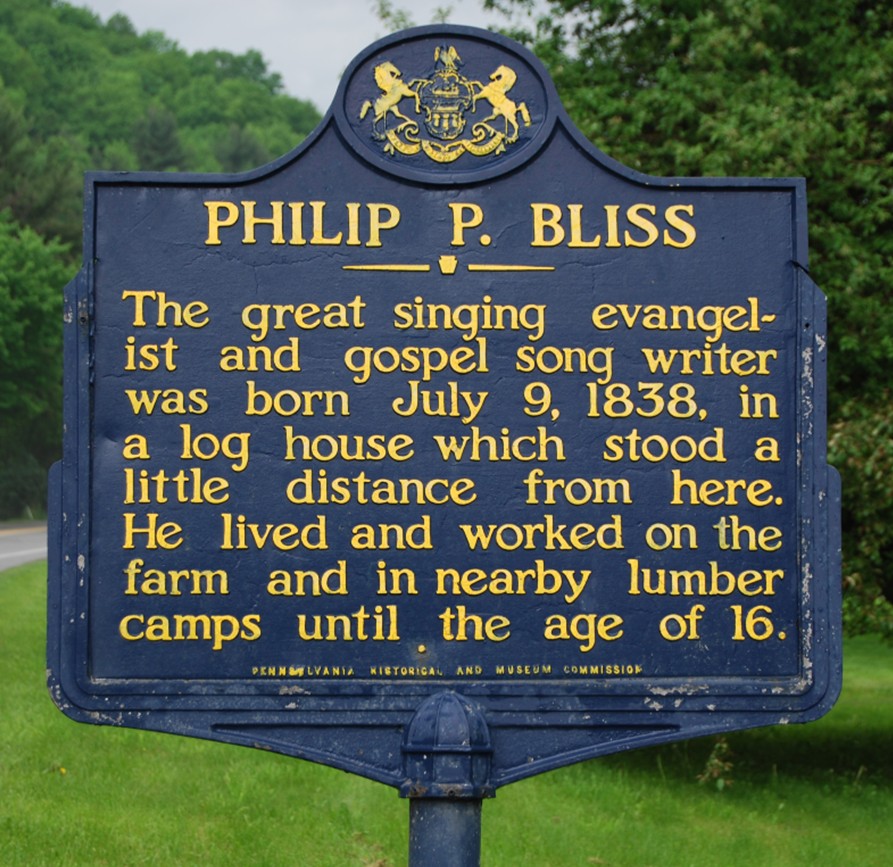
Image Credit: Photo: Philip P. Bliss Marker. www.hmdb.org/PhotoFullSize.asp?PhotoID=155306.
The marker reads:
The great singing evangelist and gospel song writer was born July 9, 1838, in a log house which stood a little distance from here. He lived and worked on the farm and in nearby lumber camps until the age of 16.
Hymn History: Hallelujah, What a Savior!
Author: Philip Paul Bliss
“In my estimate, he was the most highly honored of God, of any man of his time, as a writer and singer of Gospel Songs, and with all his gifts he was the most humble man I ever knew. I loved him as a brother, and shall cherish his memory….”
(Dwight L. Moody)
The Origin of the Hymn “Hallelujah, What a Savior!”
The hymn “Hallelujah, What a Savior!” stands as one of the most direct and powerful declarations of Christ’s redemptive work in the gospel hymn tradition. Strong in doctrine and exultant in tone, it centers squarely on the person and work of Jesus Christ. Its author, Philip Paul Bliss, wrote it in the midst of an active evangelistic ministry that shaped much of American Protestant worship in the late nineteenth century.
Philip P. Bliss (1838–1876) was a key figure in the revival movement associated with evangelists such as Dwight L. Moody. Born into humble circumstances in Pennsylvania, Bliss showed musical promise at an early age but received little formal education in childhood. Through determination and opportunity, he developed his musical abilities and eventually became one of the leading gospel songwriters of his generation. His hymns combined strong biblical themes with melodies designed for congregational singing.
“Hallelujah, What a Savior!” was written in 1875. Unlike many gospel songs of the period, which often emphasized personal testimony or invitation, this hymn is rich in doctrinal content. Each stanza focuses on a different aspect of Christ’s redemptive work, tracing the arc from incarnation and suffering to resurrection and exaltation.
The opening stanza sets the tone:
Man of Sorrows! what a name
For the Son of God, who came
Ruined sinners to reclaim!
Hallelujah! what a Savior!
The phrase “Man of Sorrows” comes directly from Isaiah 53, a prophetic passage long understood by Christians to refer to Christ’s suffering. Bliss immediately identifies Jesus as both divine—“the Son of God”—and compassionate toward fallen humanity. The hymn’s central exclamation, “Hallelujah! what a Savior!” serves as a refrain of praise that follows each stanza.
The second stanza turns to the crucifixion:
Bearing shame and scoffing rude,
In my place condemned He stood;
Sealed my pardon with His blood:
Hallelujah! what a Savior!
Here the doctrine of substitutionary atonement is plainly expressed. Bliss does not speak in vague terms. He writes, “In my place condemned He stood.” This personal appropriation of Christ’s sacrifice was a hallmark of revival preaching in the nineteenth century. The cross was not merely a historical event but a saving act applied individually to the believer.
The third and fourth stanzas continue the progression, speaking of Christ’s sacrifice and resurrection. Bliss carefully structures the hymn so that it follows the gospel narrative: suffering, death, resurrection, and exaltation. The final stanza looks forward to Christ’s return:
When He comes, our glorious King,
All His ransomed home to bring,
Then anew this song we’ll sing:
Hallelujah! what a Savior!
Thus, the hymn encompasses not only the past work of Christ but also future hope. It presents a full sweep of redemptive history in five concise stanzas.
Musically, the hymn is typically sung to the tune Bliss himself composed. Unlike some lighter gospel melodies, this tune carries a sense of solemn strength. It supports congregational singing while maintaining a reverent tone appropriate to the subject. The repetition of “Hallelujah! what a Savior!” gives the congregation a unified and triumphant response.
The hymn was written during a fruitful period in Bliss’s ministry. He traveled extensively, singing and leading music for evangelistic meetings. His collaboration with Moody brought his songs before large audiences in both America and Britain. Though Bliss’s life was tragically cut short in a train accident in 1876, his hymns continued to circulate widely after his death.
In many churches, “Hallelujah, What a Savior!” became associated with communion services and observances of the Lord’s Supper. Its focus on Christ’s atoning sacrifice makes it particularly fitting for occasions that call believers to remember His death. At the same time, its forward-looking final stanza keeps the note of hope alive.
What sets this hymn apart from some of its contemporaries is its theological density. It does not rely primarily on emotional appeal or narrative storytelling. Instead, it presents core Christian doctrines in straightforward language. Sin, substitution, blood atonement, resurrection, and second coming—all are present. Yet the tone is not heavy. The repeated “Hallelujah” lifts the text from solemn reflection to joyful praise.
Over the decades, the hymn has been included in a wide range of hymnals, from revival songbooks to more formal denominational collections. Its endurance suggests that congregations continue to value clear, Christ-centered proclamation in song.
“Hallelujah, What a Savior!” reflects the best of the gospel hymn tradition: doctrinal clarity, heartfelt gratitude, and congregational strength. Written by Philip Paul Bliss in a time of active evangelistic fervor, it remains a stirring reminder of who Christ is and what He has accomplished. By combining biblical truth with exultant praise, the hymn continues to give voice to the church’s enduring confession—truly, what a Savior.
_____
Hymns by Philip Bliss found in Great Hymns of the Faith:
#127 – Hallelujah, What a Savior!
#197 – Hallelujah, ‘Tis Done!
#203 – Whosoever Will
#205 – Once for All!
#213 – The Light of the World Is Jesus
#234 – Wonderful Words of Life
#251 – Almost Persuaded
#362 – More Holiness Give Me
#363 – Dare to Be a Daniel
#371 – Let the Lower Lights Be Burning
#409 – Hold the Fort
#488 – My Redeemer
#492 – Jesus Loves Even Me
_____
Image Source/Credit:
• A. Burt Music, Books, & Stationery, Public domain, via Wikimedia Commons