
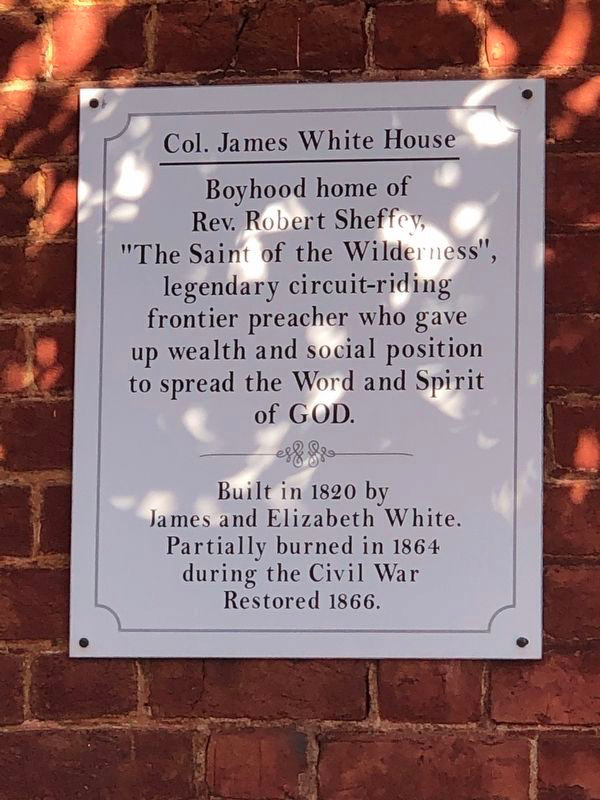
Boyhood home of Rev. Robert Sheffey, “The Saint of the Wilderness”, legendary circuit-riding frontier preacher who gave up wealth and social position to spread the Word and Spirit of God.
Built in 1820 by James and Elizabeth White. Partially burned in 1864 during the Civil War. Restored 1866.
♦ _____ ♦
The story of the Colonel James White House and the life of Robert Sheffey offer a compelling glimpse into the spiritual and cultural heritage of early America, particularly in the Appalachian and frontier regions where faith, perseverance, and community life were deeply intertwined.
Located in Knoxville, the Colonel James White House stands as the oldest surviving structure in the city. Built in 1786 by James White, a Revolutionary War officer and the founder of Knoxville, the house originally served as both a residence and a fortified frontier station. Constructed of hand-hewn logs, its sturdy design reflects the uncertainties of life on the early American frontier, where settlers faced not only the challenges of wilderness survival but also the constant threat of conflict.
The house functioned as more than just a family dwelling; it became a center of early community life. Religious gatherings, civic discussions, and social events were often held within its walls. In this way, the Colonel James White House represents more than architecture—it embodies the spirit of early American settlement, where faith and fellowship were essential to daily existence. Today, it is preserved as a museum, offering visitors insight into 18th-century frontier life and the roots of East Tennessee’s development.
Not far removed in spirit from this frontier heritage is the life and ministry of Robert Sheffey, one of the most beloved circuit-riding preachers of the 19th century. Born in 1820 in Wythe County, Sheffey became known for his deep piety, fervent prayers, and tireless travels across the Appalachian Mountains. As a minister in the Methodist Episcopal Church South, he followed the long-established tradition of circuit riders—clergy who journeyed from community to community, often on horseback, to preach the Gospel in remote and underserved areas.
Sheffey’s ministry was marked by a remarkable simplicity and sincerity. He was known to pray earnestly for individuals by name, often in unexpected places such as along mountain trails or in humble cabins. Stories abound of his compassionate heart and unwavering faith, earning him the affectionate title of “God’s odd man.” Unlike the more formal religious leaders of established towns, Sheffey’s work took place among the rural poor, where his message of grace and redemption found receptive hearts.
The connection between the Colonel James White House and Robert Sheffey lies in the broader narrative of American frontier Christianity. Both represent different generations of the same enduring tradition: the establishment of faith in new and often difficult environments. The White House symbolizes the earliest stages of settlement, where homes doubled as places of worship and community gathering. Sheffey, in turn, represents the continuation of that spiritual legacy, carrying the message of the Gospel into the mountains long after the frontier had been established.
Together, these two historical touchstones highlight the vital role of faith in shaping early American life. Whether within the sturdy walls of a frontier homestead or along the winding paths of the Appalachian hills, the influence of Christian devotion helped form communities, sustain families, and inspire generations. The preserved home in Knoxville and the enduring stories of Robert Sheffey both serve as reminders of a time when faith was not merely practiced—it was lived daily, often under the most challenging circumstances.
_____
Image Source/Credit:
• Photographed by Duane and Tracy Marsteller, October 23, 2022, HMDB.org
Related
Sorry, no records were found. Please adjust your search criteria and try again.
Sorry, unable to load the Maps API.