
The Dissenter’s Glebe of Samuel Davies occupies an important place in the religious history of colonial Virginia. Closely associated with Samuel Davies, one of the most influential early American Presbyterian ministers, the glebe represents both the challenges and the gradual expansion of religious freedom in the eighteenth-century South.
In colonial Virginia, the Church of England was the established church, supported by law and public funds. Those who worshiped outside its structure—known as “Dissenters”—often faced restrictions, including limitations on preaching, gathering, and owning property for religious use. Within this context, Samuel Davies emerged as a leading figure advocating for the rights of non-Anglican Protestants. Arriving in Virginia in the 1740s, Davies worked tirelessly to secure legal permission to preach and organize Presbyterian congregations.
The term “glebe” traditionally referred to land set aside to support a parish minister. In the case of Davies, the Dissenter’s Glebe represented a significant development. It was land granted or acquired for the support of a Presbyterian minister—something not commonly permitted in a colony where Anglicanism held legal privilege. This property became both a practical resource and a symbol of growing tolerance.
Located in Hanover County, the glebe served as a base for Davies’s extensive ministry. From this location, he traveled widely, preaching to scattered communities across central Virginia. His sermons drew large audiences and were known for their clarity, earnestness, and evangelical zeal. Davies emphasized personal conversion, the authority of Scripture, and the importance of heartfelt religion—hallmarks of the broader Great Awakening.
The glebe also functioned as a center of organization for Presbyterian life in the region. Davies helped establish multiple meetinghouses and congregations, laying the foundation for the growth of Presbyterianism in Virginia. His influence extended beyond the pulpit; he was also an advocate for education and played a key role in supporting what would become the College of New Jersey, where he later served as president.
The existence of the Dissenter’s Glebe illustrates the gradual shift toward greater religious liberty in colonial America. Davies successfully petitioned the colonial authorities for licenses to preach in several locations, a remarkable achievement at a time when dissenting ministers were often viewed with suspicion. His efforts helped pave the way for broader acceptance of religious diversity, a principle that would later be enshrined in American law.
Though the original structures associated with the glebe have not all survived, the site remains historically significant. It represents a turning point in the relationship between church and state in Virginia. Where once dissenters struggled for recognition, the presence of a glebe for a Presbyterian minister signaled a measure of acceptance and stability.
Today, the Dissenter’s Glebe of Samuel Davies is remembered as a place where conviction met perseverance. It reflects the determination of early American Christians who sought the freedom to worship according to conscience. The legacy of Samuel Davies, rooted in this place, continues to influence both religious and educational institutions.
In the broader sweep of history, the glebe stands as more than a tract of land. It is a symbol of the struggle for religious liberty and the role of faith in shaping American identity. Through his work at this site, Samuel Davies helped lay the groundwork for a society in which diverse religious traditions could flourish.
♦ _____ ♦
Samuel Davies was Patrick Henry’s pastor growing up.
Marker:
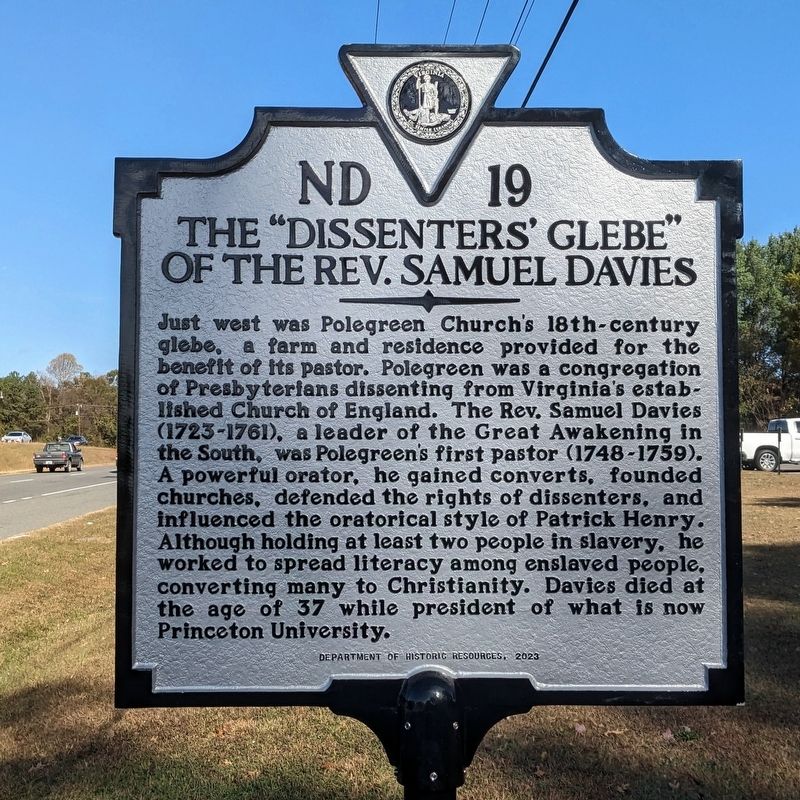
Just west was Polegreen Church’s 18th-century glebe, a farm and residence provided for the benefit of its pastor. Polegreen was a congregation of Presbyterians dissenting from Virginia’s established Church of England. The Rev. Samuel Davies (1723-1761), a leader of the Great Awakening in the South, was Polegreen’s first pastor (1748-1759). A powerful orator, he gained converts, founded churches, defended the rights of dissenters, and influenced the oratorical style of Patrick Henry. Although holding at least two people in slavery, he worked to spread literacy among enslaved people, converting many to Christianity. Davies died at the age of 37 while president of what is now Princeton University.
_____
Image Source/Credit:
• Photo HMDB.org Photographed by Bernard Fisher, November 6, 2024
Related
Sorry, no records were found. Please adjust your search criteria and try again.
Sorry, unable to load the Maps API.