
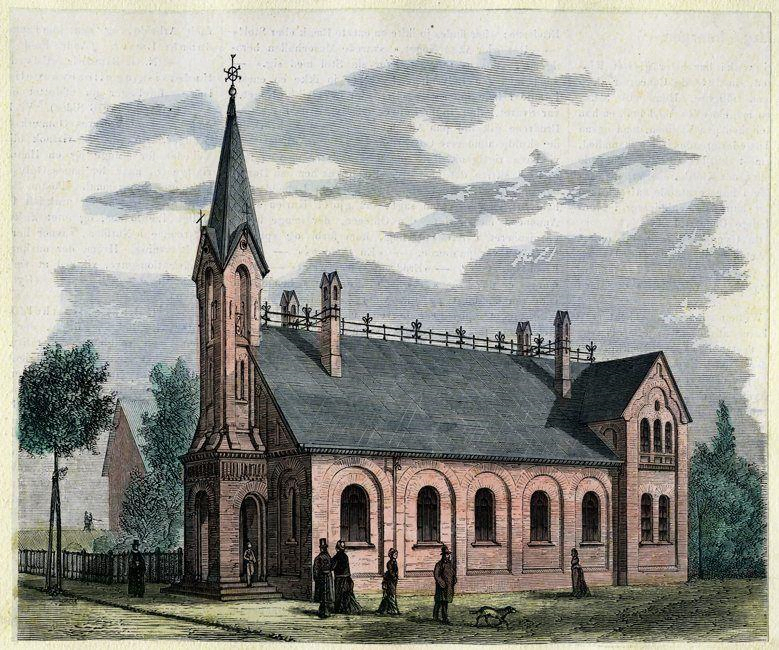
The only Free Lutheran Church in Copenhagen, started by Niels Pedersen Grunnet (1827-1897)
♦ _____ ♦
Martinskirken, located in Copenhagen, Denmark, is a notable Lutheran church with a rich history tied to both local religious life and the broader development of urban Christianity in the Danish capital. Though not as internationally renowned as some of Europe’s grand cathedrals, Martinskirken holds a meaningful place within the spiritual and cultural fabric of the city, reflecting the traditions of Danish Lutheranism and the evolving needs of its congregation over time.
The church was established in the late nineteenth century, during a period when Copenhagen was expanding rapidly due to industrialization and population growth. As new neighborhoods developed, there arose a need for additional parish churches to serve the growing urban population. Martinskirken was founded to meet this need, providing a place of worship and community for residents in its district.
Architecturally, Martinskirken reflects the ecclesiastical design sensibilities of its era. Like many churches built in Scandinavia during the nineteenth century, it combines elements of traditional Lutheran simplicity with modest decorative features. The structure typically emphasizes clean lines, a functional layout, and a focus on the altar and pulpit, underscoring the importance of preaching and the sacraments in Lutheran worship. While not overly ornate, the church’s design conveys a sense of dignity and reverence.
Inside, Martinskirken offers a welcoming and contemplative atmosphere. The interior is arranged to support congregational participation, with seating oriented toward the central liturgical elements. Natural light often plays a significant role in the space, contributing to a sense of openness and tranquility. Such features are characteristic of Danish church design, where the emphasis is placed on clarity, accessibility, and communal worship rather than grandeur.
Martinskirken has long served as more than just a place for Sunday services. It has functioned as a center for community life, hosting a variety of activities that reflect the church’s role in Danish society. These may include educational programs, musical events, and social outreach initiatives aimed at supporting those in need. In this way, the church embodies the Lutheran tradition of integrating faith with everyday life and social responsibility.
Over the years, Martinskirken has adapted to changing cultural and religious conditions. Like many churches in Europe, it has faced the challenges of secularization and shifting patterns of religious participation. Nevertheless, it has continued to maintain its presence by engaging with the community and offering relevant programs that address contemporary concerns. This adaptability has helped sustain its role as a meaningful institution within its neighborhood.
The church is also part of the broader structure of the Church of Denmark, the national church to which the majority of Danes historically belong. As such, Martinskirken participates in the traditions and practices that define Danish Lutheranism, including liturgical worship, baptism, confirmation, and the observance of the Christian calendar. Its connection to the national church underscores its place within a long-standing religious heritage.
In addition to its religious functions, Martinskirken contributes to Copenhagen’s cultural landscape. Churches in Denmark often serve as venues for concerts and artistic events, taking advantage of their acoustics and historic ambiance. Martinskirken is no exception, providing a space where music and art can be experienced in a setting that enhances their impact.
Today, Martinskirken remains a symbol of continuity amid change. It reflects both the historical development of Copenhagen and the enduring role of the church in Danish society. While its scale and visibility may be modest compared to more famous landmarks, its significance lies in its faithful service to generations of worshippers and its ongoing commitment to community life.
In sum, Martinskirken stands as a testament to the enduring values of Lutheran tradition—simplicity, community, and devotion—while also adapting to the needs of a modern urban environment. Its presence continues to offer a place of reflection, connection, and spiritual support in the heart of Copenhagen.
_____
Image Source/Credit:
• https://kbhbilleder.dk/frb-arkiv/7768, Public domain, via Wikimedia Commons
Related
Sorry, no records were found. Please adjust your search criteria and try again.
Sorry, unable to load the Maps API.