
2 Kings 25:27-30
And it came to pass in the seven and thirtieth year of the captivity of Jehoiachin king of Judah, in the twelfth month, on the seven and twentieth day of the month, that Evilmerodach king of Babylon in the year that he began to reign did lift up the head of Jehoiachin king of Judah out of prison; And he spake kindly to him, and set his throne above the throne of the kings that were with him in Babylon; And changed his prison garments: and he did eat bread continually before him all the days of his life. And his allowance was a continual allowance given him of the king, a daily rate for every day, all the days of his life.
♦ _____ ♦
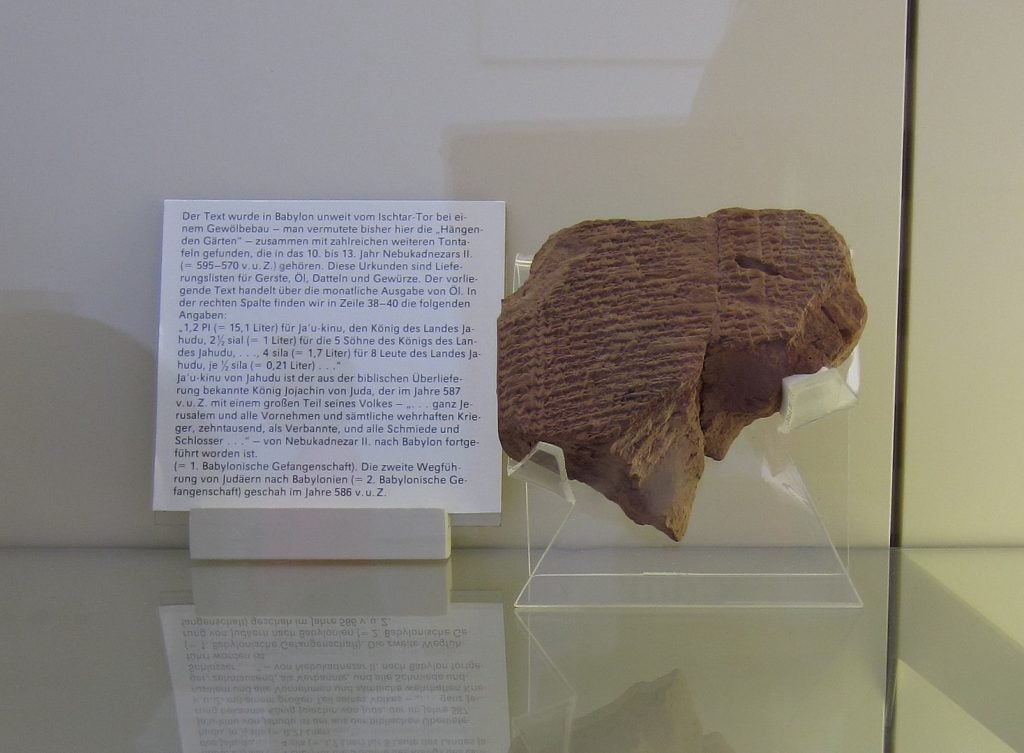
The Jehoiachin’s Rations Tablets are among the most intriguing archaeological discoveries relating to the Old Testament period, offering a rare glimpse into the lives of Judean exiles in ancient Babylon. These clay tablets, written in cuneiform script, date to the early sixth century B.C. and provide historical evidence connected to the biblical account of the Babylonian captivity.
The tablets were discovered in the late nineteenth and early twentieth centuries during excavations of ancient Babylon, in present-day Iraq. They form part of a larger collection of administrative records from the reign of Nebuchadnezzar II, one of the most powerful rulers of the Neo-Babylonian Empire. These records were primarily concerned with the distribution of food and supplies to individuals living under Babylonian authority.
What makes the Jehoiachin Tablets especially significant is their reference to Jehoiachin, the Judean king who was taken into captivity by Nebuchadnezzar in 597 B.C. According to the biblical narrative in the Books of Kings and Chronicles, Jehoiachin was exiled to Babylon after a brief reign in Jerusalem. The tablets confirm his presence there, referring to him as “Ya’u-kīnu, king of the land of Judah,” and listing provisions allocated to him and his household.
The records detail daily or monthly rations of oil, barley, and other goods given to Jehoiachin and his sons. These provisions suggest that, although he was a captive, he was treated with a certain degree of respect, likely due to his royal status. This aligns with the account in the Bible, particularly in 2 Kings 25, which describes how Jehoiachin was eventually released from prison and given a place of honor at the Babylonian court.
The tablets are written in Akkadian, the administrative language of Babylon, using cuneiform—a system of wedge-shaped impressions pressed into clay. After being inscribed, the tablets were baked or dried, preserving them for millennia. Today, many of these tablets are housed in major museums, including the Pergamon Museum in Berlin, where they continue to be studied by scholars.
From a historical standpoint, the Jehoiachin Tablets are valuable because they provide independent, non-biblical confirmation of a specific individual mentioned in Scripture. In the field of archaeology, such corroboration is relatively rare, especially for figures from the ancient Near East. The tablets therefore serve as an important link between the biblical narrative and the broader historical record.
Beyond their connection to Jehoiachin himself, the tablets also shed light on the conditions of exile. They indicate that at least some deported peoples were integrated into the administrative system of the empire and received regular provisions. This challenges earlier assumptions that all exiles lived in harsh or oppressive conditions, suggesting instead a more complex picture of life in Babylon.
The discovery of these tablets has contributed to a deeper understanding of the Babylonian exile, a pivotal event in the history of ancient Israel. This period not only marked the loss of the kingdom of Judah but also led to significant religious and cultural developments, including the preservation and compilation of many biblical texts.
In summary, the Jehoiachin’s Rations Tablets are a remarkable example of how archaeology can illuminate ancient history. Through a simple record of food distribution, they provide insight into the life of a captive king, the workings of the Babylonian administration, and the historical reality behind a key biblical event. Their enduring significance lies in their ability to connect the written record of Scripture with the physical evidence of the ancient world.
_____
Image Source/Credit:
• Scallaham, CC BY-SA 4.0 <https://creativecommons.org/licenses/by-sa/4.0>, via Wikimedia Commons
Related
Sorry, no records were found. Please adjust your search criteria and try again.
Sorry, unable to load the Maps API.