
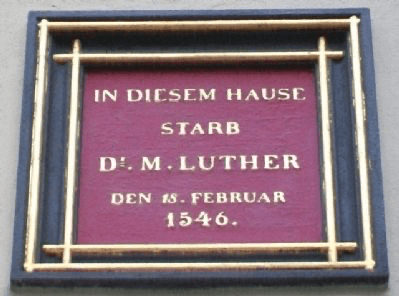
The Martin Luther’s Death House stands as a place of solemn remembrance, marking the final chapter in the life of Martin Luther. Located in Eisleben, the same town where Luther was born, this historic building commemorates his death on February 18, 1546. Together with his birthplace, it forms part of a larger heritage that reflects the profound influence of the Protestant Reformation.
Luther had returned to Eisleben late in his life to mediate a dispute among the Counts of Mansfeld, a noble family connected to his early years. Despite declining health, he undertook the journey out of a sense of duty and concern for peace. While there, he took lodging in a house that would later become known as his death house. It was within these walls that he spent his final days, continuing to counsel, write, and pray.
On the night of February 17 into the early hours of February 18, Luther died after a period of illness. His passing was marked by those around him as peaceful and steadfast, consistent with the convictions he had long proclaimed. Accounts from the time describe him expressing confidence in his faith, affirming the teachings that had defined his life and work.
The building associated with Luther’s death has undergone changes over the centuries, yet it has been preserved and adapted as a memorial site. Today, it functions as a museum, offering visitors insight into Luther’s final days as well as his broader legacy. The interior includes exhibits that explore the circumstances of his death, the reactions of his contemporaries, and the immediate impact of his passing on the Reformation movement.
Among the most notable features of the museum are displays of historical documents, portraits, and artifacts connected to Luther and his time. These exhibits provide context for understanding not only the end of his life but also the enduring significance of his work. While the exact room of his death cannot be preserved in its original state with complete certainty, the museum carefully reconstructs the atmosphere of the period, allowing visitors to reflect on the moment when one of history’s most influential figures came to rest.
The legacy of Martin Luther’s Death House lies in its role as a place of conclusion and reflection. It reminds visitors that Luther’s work, though transformative, was carried out within the limits of a human life. His efforts to reform the Church, emphasize the authority of Scripture, and proclaim justification by faith alone had already spread widely by the time of his death. Yet his passing marked a transition, as others took up the task of continuing and shaping the movement he had begun.
In the years following his death, Luther’s influence only grew. His writings were preserved, his ideas debated and expanded, and his example remembered by those who sought to carry forward the principles of the Reformation. The house in Eisleben thus stands not only as a place of death but as a symbol of continuity—where one life ended, but a movement endured.
Today, visitors to Martin Luther’s Death House encounter more than a historical site; they find a place that invites reflection on faith, conviction, and legacy. It serves as a reminder that the impact of a life is not measured solely by its length, but by the truth it upholds and the change it inspires.
_____
Image Source/Credit:
• Martin Luther Death House Historical Marker. 28 Jan. 2022 (www.hmdb.org/m.asp?m=70220)
Related
Sorry, no records were found. Please adjust your search criteria and try again.
Sorry, unable to load the Maps API.