
From Reformation Routes:
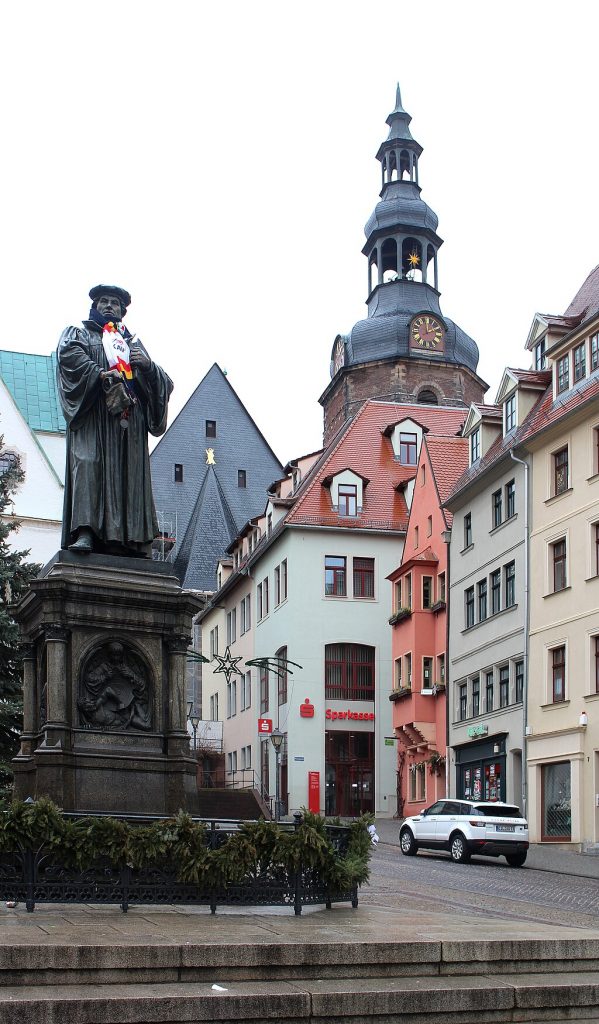
With is mighty belfry, St. Andrew´s Church rises above the market square in a most impressive manner. It is not only a dominating feature in urban development, but it also belongs to the most significant Luther places in general.
In the late Gothic pulpit, preserved almost unchanged, the Reformer gave the last sermons of his life. Martin Luther´s corpse was laid out in the chancel of the late-Gothic hall church on February 19, 1546 and was transported from there to Wittenberg on behalf of the Saxon Elector. The busts of Martin Luther and Philipp Melanchton were created by Johann Gottfried Schadow. In the side chancels, there are monuments of the Mansfeld Counts.
_____
St. Andrew’s Church is one of the most historically significant churches in the town of Eisleben, Germany, and holds a special place in the history of the Protestant Reformation. The church is closely connected with the life and final days of Martin Luther, whose influence reshaped Christianity across Europe in the sixteenth century.
The origins of St. Andrew’s Church date back to the late Middle Ages, when it was built as a parish church serving the growing population of Eisleben. Over time it became an important center of worship and religious life for the town. The church’s Gothic architecture, including its tall tower and spacious interior, reflects the style of many German churches constructed during this period.
St. Andrew’s Church is especially remembered for its connection to Martin Luther’s final sermon. In February 1546, Luther traveled to Eisleben, the town of his birth, to help resolve a dispute among local nobles. During this visit he preached several sermons at St. Andrew’s Church, including what is widely considered his last public sermon. Only a few days later, on February 18, 1546, Luther died in Eisleben.
Because of this historic event, the church has long been regarded as an important site connected with the Reformation. Visitors and historians come to Eisleben to see the places associated with Luther’s life, including the church where he last preached.
Today St. Andrew’s Church remains an active place of worship and a major historical landmark. Its connection with Martin Luther and the events surrounding his final days ensures its lasting importance in the story of the Protestant Reformation.
_____
Image Source/Credit:
• Photo Dguendel, CC BY 3.0
Related
Sorry, no records were found. Please adjust your search criteria and try again.
Sorry, unable to load the Maps API.