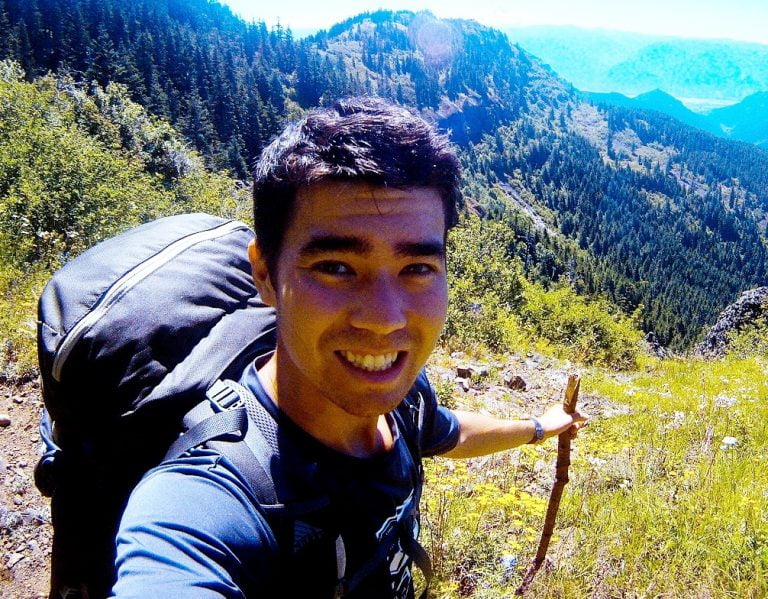
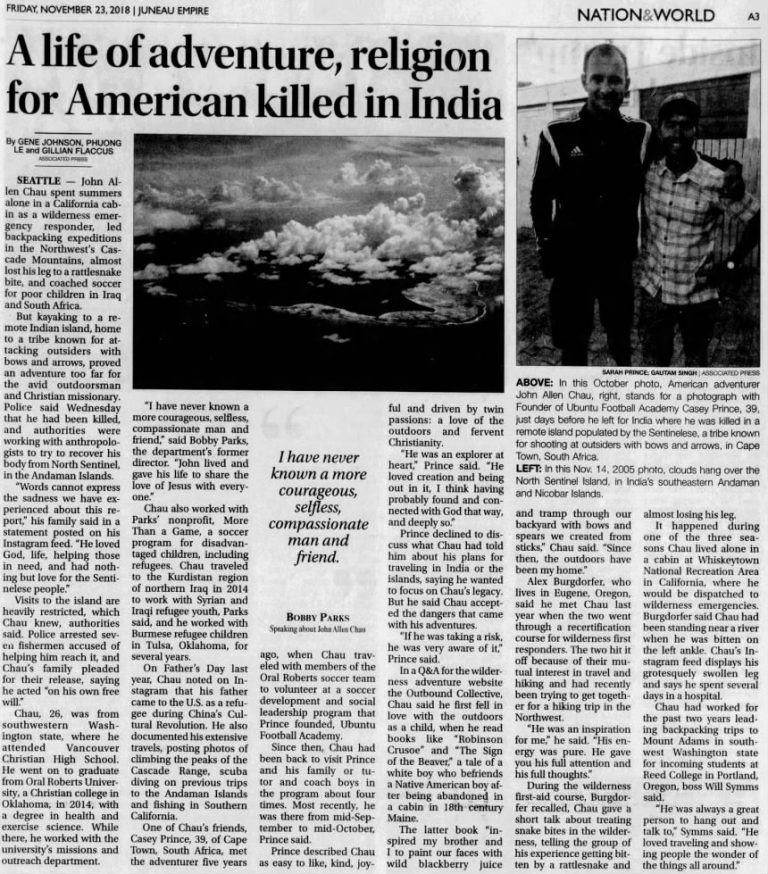
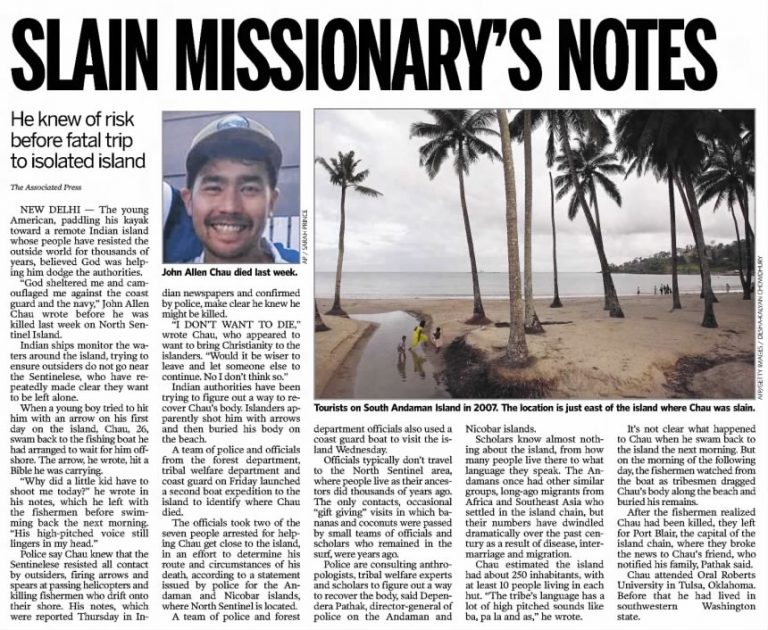
The death of John Allen Chau in November 2018 drew international attention and sparked intense debate about missionary work, isolation, and the ethics of contact with uncontacted peoples. While some admirers have described his death in martyr-like terms, many scholars, legal authorities, and human rights observers caution against using that framing, emphasizing instead the complex circumstances surrounding his final expedition.
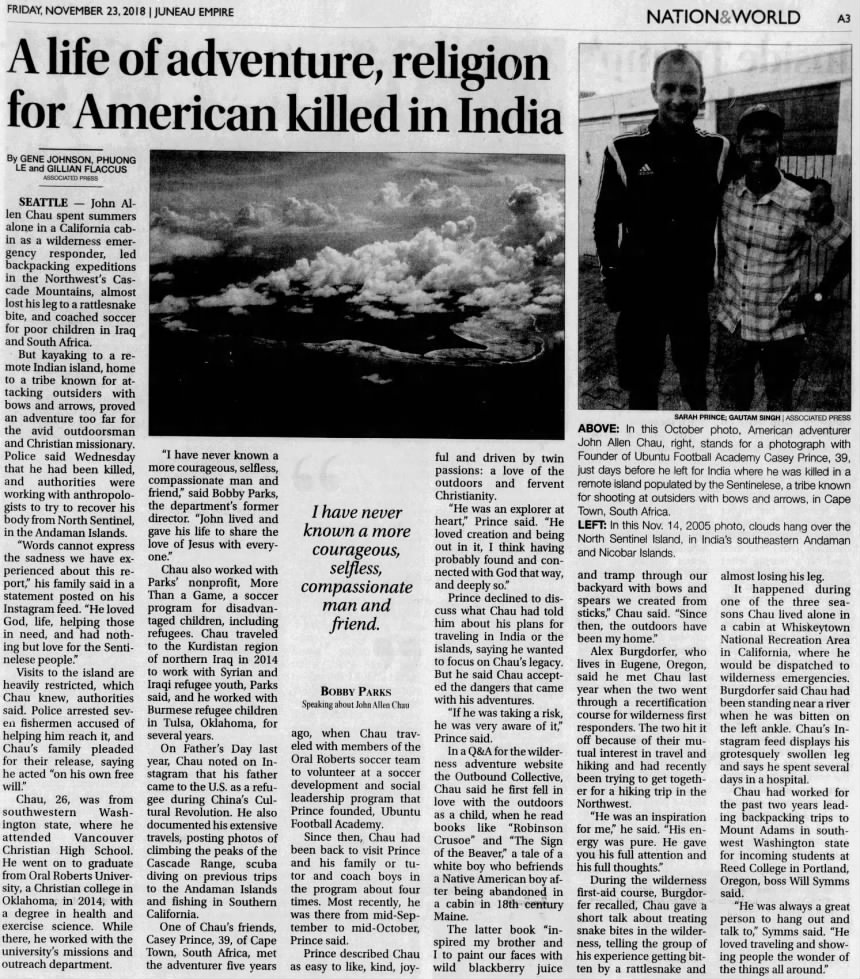
Chau, a 26-year-old American, traveled to the Andaman and Nicobar Islands in the Indian Ocean with the intention of making contact with the people of North Sentinel Island, home to the Sentinelese, one of the world’s most isolated Indigenous groups. The Sentinelese have long resisted outside contact, and the Indian government strictly prohibits unauthorized access to the island in order to protect both the tribe and outsiders from harm, particularly due to the community’s lack of immunity to common diseases.
Despite these restrictions, Chau made multiple attempts to reach the island. Reports indicate that he relied on local fishermen to approach the vicinity illegally and then paddled by canoe toward the shore. His stated motivation, recorded in personal journals, was religious: he believed he was called to share his Christian faith with the Sentinelese people. These actions placed him in direct violation of Indian law and longstanding policies designed to preserve the isolation and safety of the island’s inhabitants.
On his final approach, Chau attempted to make contact with the island’s residents. Accounts suggest that he was met with resistance from the Sentinelese, who responded defensively, as they had with previous outsiders. Chau was killed on or near the shore, and his body was reportedly seen but not recovered, in accordance with the Indian government’s decision not to recover remains from the protected territory.
The incident immediately raised difficult questions internationally. Some religious communities viewed Chau’s actions through the lens of missionary sacrifice, emphasizing his personal conviction and willingness to face danger for his beliefs. Others strongly criticized the expedition, arguing that it disregarded both legal boundaries and the well-being of an uncontacted population. Anthropologists and human rights advocates stressed that uncontacted tribes like the Sentinelese are extremely vulnerable to disease and cultural disruption, and that enforced isolation is often considered essential to their survival.
The government of India responded by reaffirming the strict protections surrounding North Sentinel Island. Officials emphasized that unauthorized contact is illegal and dangerous, and they took steps to ensure that no further attempts would be made to reach the island. The case also prompted renewed discussion about the balance between religious freedom, exploration, and the rights of Indigenous peoples to remain uncontacted.
Chau’s death continues to be interpreted in sharply different ways depending on perspective. For some, it represents a tragic example of zeal carried into forbidden and dangerous territory. For others, it is seen as an expression of deep personal conviction, though not without controversy regarding judgment and responsibility. The term “martyrdom” is therefore not universally accepted and remains a matter of interpretation rather than consensus.
Ultimately, the event is remembered less for any single label and more for the broader questions it raises. It highlights the enduring tensions between mission work and cultural boundaries, between individual conviction and collective responsibility, and between human curiosity and the right of isolated communities to remain undisturbed.
♦ _____ ♦
John Allen Chau, a Covenant Journey alumni, was martyred on November 17, 2018 by the Sentinelese tribal people on the island of North Sentinel. “When I heard the news of John’s death, I couldn’t believe it. I was numb. John loved people, and he loved Jesus. He was willing to give his life to share Jesus with the people on North Sentinel island,” said Mat Staver, Founder and Chairman of Covenant Journey and Liberty Counsel. “Ever since high school, John wanted to go to North Sentinel to share Jesus with this indigenous people,” said Staver.
Wikipedia:
John Allen Chau (December 18, 1991 – November 17, 2018) was an American evangelical Christian missionary who was killed by the Sentinelese, a tribe in voluntary isolation, after illegally traveling to North Sentinel Island in an attempt to introduce the tribe to Christianity.[3][4]
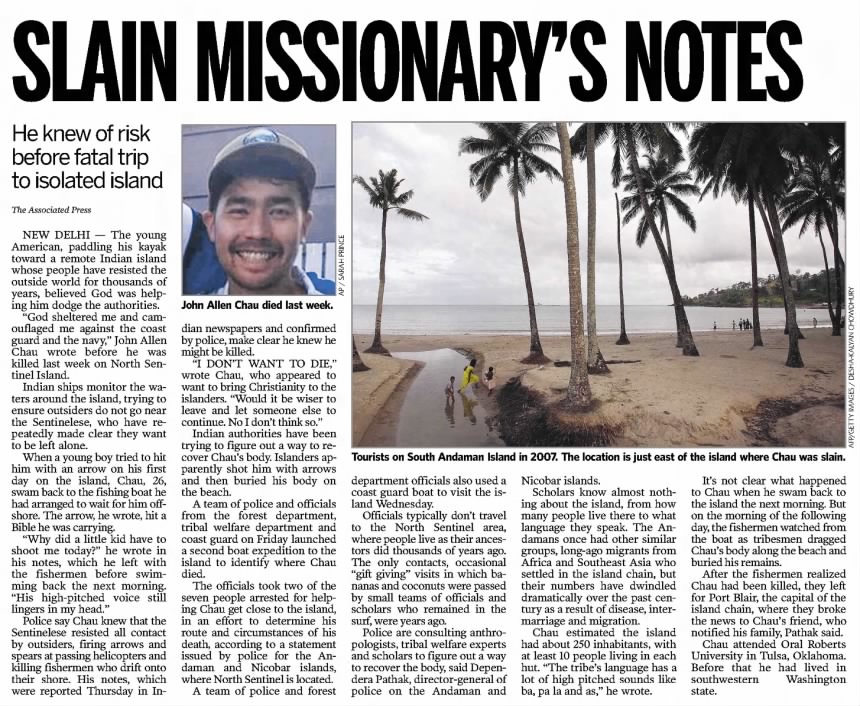
Later that day he made another attempt, this time landing on the island.
He laid out more gifts, then approached the hut he was chased from earlier, staying out of arrow range. About half a dozen Sentinelese emerged and began to “whoop and shout”. He walked closer to try to hear what they were saying. He tried to “parrot their words back to them”, and the Sentinelese burst out laughing. They were probably “saying bad words or insulting me”, he concluded. He sang worship songs and preached from Genesis. For a while the Sentinelese seemed to tolerate his presence.
Then a boy shot an arrow at him. The arrow struck the waterproof Bible he was holding. He pulled it out, gave it back to the boy, and hastily retreated. The Sentinelese had taken his kayak, so he was forced to swim almost a mile to the fishing boat.
“I‘m scared,” he wrote that night in his diary. “Watching the sunset and it’s beautiful.” He was “crying a bit” and “wondering if it’ll be the last sunset I see before being in the place where the sun never sets”.
“You guys might think I’m crazy in all this,” he wrote to his family, “but I think it’s worth it to declare Jesus to these people.”
Is this “Satan’s last stronghold”, he asked God – a place “where none have heard or even had a chance to hear your name?”
He decided he would make his next attempt without the fishing vessel floating nearby. Appearing alone might make the Sentinelese more comfortable, he thought. And if the approach went “badly”, this would spare the fishermen from having to “bear witness to my death”.
His diary makes it clear that he didn’t want to die, but accepted the possibility. “I think I could be more useful alive,” he wrote, “but to you, God, I give all the glory of whatever happens.” He asked God to forgive “any of the people on this island who try to kill me” – especially “if they succeed”.
Shortly after dawn on 16 November, the last day he was seen alive, John Chau asked the fishermen to drop him off alone. He knew the risks; but the people of North Sentinel were damned, and he was determined to save them.
He struck out once more for the shore.
_____
Image Source/Credit (in order):
• Associated Press. “Indian Island Police Struggle to Get Body of American.” KOMO, 22 Nov. 2018, komonews.com/news/local/indian-island-police-struggle-to-get-body-of-american-11-22-2018
• Newspapers.com, Juneau Empire, November 23, 2010 (www.newspapers.com/article/juneau-empire/195748711/)
• Newspapers.com, Newsday, November 24, 2018 (www.newspapers.com/article/newsday/195749113/)
Related
Sorry, no records were found. Please adjust your search criteria and try again.
Sorry, unable to load the Maps API.