
The life of Amy Carmichael is often remembered as a story of long endurance, practical compassion, and deep religious conviction. Born in 1867 in Ireland, she eventually spent more than half a century in India, where her work among vulnerable children left a lasting institutional and humanitarian legacy centered in Dohnavur.
Carmichael grew up in a relatively comfortable Protestant family in Ireland, but from an early age she displayed a strong sense of purpose and independence. As a young adult, she became involved in Christian service and felt drawn toward overseas mission work. After brief periods of ministry in Japan and later in South India, she settled permanently in India in the 1890s. It was there that her life’s work began to take shape in response to the social conditions she encountered.
While living and working in South India, Carmichael became aware of the vulnerability of children—especially young girls—who were at risk of exploitation through entrenched social and religious practices, as well as poverty. Rather than limiting her response to preaching or teaching alone, she focused on direct intervention. She began rescuing children and providing them with shelter, education, and long-term care.
In 1901, she formally established the Dohnavur Fellowship. What began as a small refuge gradually developed into a structured, self-sustaining community. The fellowship was designed not simply as an orphanage, but as a home environment where children could grow up with stability, education, and spiritual formation. Over time, hundreds of children passed through its care, many of whom had been rescued from dangerous or exploitative situations.
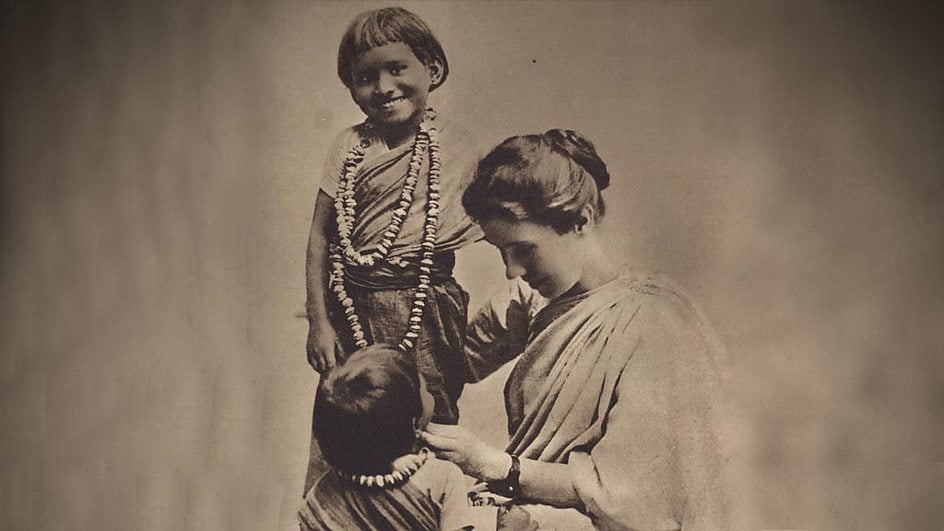
One of Carmichael’s most distinctive qualities was her commitment to cultural adaptation. Unlike many missionaries of her era who maintained strong Western separation from local customs, she adopted Indian dress, learned local languages, and lived in ways that reduced cultural barriers between herself and the people she served. This approach reflected her belief that meaningful service required humility, presence, and identification with those being helped.
Carmichael also became known for her discipline and organizational leadership. The Dohnavur Fellowship operated with clear structure, including education programs, healthcare, and vocational training. She emphasized the importance of long-term care rather than short-term intervention, aiming to provide children not only with safety but also with the skills needed for independent adult life. The fellowship became a model of sustained, community-based care in its context.
In addition to her practical work, Carmichael was a prolific writer. Her devotional and reflective works, including titles such as Gold by Moonlight, Things as They Are, and Edges of His Ways, explored themes of suffering, obedience, and faithfulness. These writings gained international readership and helped shape her reputation beyond India. They also offered insight into the spiritual motivations that sustained her demanding work over decades.
The impact of Carmichael’s life can still be seen in the continued existence of the Dohnavur Fellowship, which remains active in various forms, continuing its focus on care, education, and community support. Her work contributed to broader awareness of child vulnerability in South India and influenced later approaches to residential care and missionary engagement.
At the same time, modern evaluations of Carmichael’s legacy often consider the broader historical context of missionary activity during the colonial period. Scholars sometimes discuss the complexities of cultural interaction, the role of Western missions in India, and the long-term effects of such work. These discussions have added nuance to her legacy, placing her contributions within a wider historical and cultural framework.
Even with these complexities, Carmichael is widely recognized for her personal dedication, her willingness to remain in difficult circumstances for decades, and her focus on the practical care of children in need. She lived simply, worked tirelessly, and remained in India until her death in 1951.
Amy Carmichael’s life and impact are best understood as a combination of sustained commitment, institutional development, and personal sacrifice. Her legacy continues not only in the community she founded but also in the many readers and workers influenced by her writings and example. In the history of missionary service in India, she remains a significant figure whose influence endures through both her work and her words.
♦ _____ ♦
From Wikipedia:
Initially Carmichael traveled to Japan for fifteen months, but fell ill and returned home.[3] After a brief period of service in Ceylon (Sri Lanka), she went to Bangalore, India for her health and found her lifelong vocation. She was commissioned by the Church of England Zenana Mission. Carmichael’s most notable work was with girls and young women, some of whom were saved from customs that amounted to forced prostitution. Hindu temple children were primarily young girls dedicated to the gods, then usually forced into prostitution to earn money for the priests (i.e., Devadasi)[4] Families often sold their children to the temples if they did not want them, or if they needed extra money and fewer children to feed.[citation needed]
Carmichael founded the Dohnavur Fellowship[5] in 1901 to continue her work,[6] as she later wrote in The Gold Cord (1932). A popular early work was Things as They Are: Mission Work in Southern India (1903). Dohnavur is situated in Tamil Nadu, thirty miles from India’s southern tip. The name derives from Count Dohna, who initially funded German missionaries at the site in the early 19th century, on which Rev. Thomas Walker then established a school. Carmichael’s fellowship transformed Dohnavur into a sanctuary for over one thousand children who would otherwise have faced a bleak future.[7] Carmichael often said that her Ministry of rescuing temple children started with a girl named Preena. Having become a temple servant against her wishes, Preena managed to escape. Amy Carmichael provided her shelter and withstood the threats of those who insisted that the girl be returned either to the temple directly to continue her sexual assignments, or to her family for more indirect return to the temple. The number of such incidents soon grew, thus beginning Amy Carmichael’s new Ministry.[8] When the children were asked what drew them to Amy, they most often replied “It was love. Amma (They’re referring to Amy as their mother; Amma means mother) loved us.”[9]
Respecting Indian culture, members of the organization wore Indian dress and gave the rescued children Indian names. Carmichael herself dressed in Indian clothes, dyed her skin with dark coffee, and often travelled long distances on India’s hot, dusty roads to save just one child from suffering.
While serving in India, Amy received a letter from a young lady who was considering life as a missionary. She asked Amy, “What is missionary life like?” Amy wrote back saying simply, “Missionary life is simply a chance to die.” Nonetheless, in 1912 Queen Mary recognized the missionary’s work, and helped fund a hospital at Dohnavur.[10] By 1913, the Dohnavur Fellowship was serving 130 girls. In 1918, Dohnavur added a home for young boys, many born to the former temple prostitutes. Meanwhile, in 1916 Carmichael formed a Protestant religious order called Sisters of the Common Life.
_____
Image Source/Credit:
• Aishwarya A, Public domain, via Wikimedia Commons
Related
Sorry, no records were found. Please adjust your search criteria and try again.
Sorry, unable to load the Maps API.