
Tomb of Jonah, long regarded as the traditional grave of the biblical prophet Jonah, stands as a site of deep religious and historical significance. Located in the ancient city of Mosul, the tomb was associated for centuries with the story of Jonah, whose account is recorded in the Book of Jonah. Revered by Jews, Christians, and Muslims alike, the site reflected a shared heritage rooted in the ancient Near East.
The tomb was situated on a prominent hill known as Tell Nabi Yunus, meaning “Hill of the Prophet Jonah.” This location lies across the Tigris River from the ruins of ancient Nineveh, the very city to which Jonah was sent to preach repentance. According to biblical tradition, Jonah initially fled from his divine calling, only to be redirected after the well-known episode involving a great fish. Eventually, he delivered his message to Nineveh, leading to the city’s temporary repentance. The association of his burial place with this region gave the site a powerful sense of continuity with the biblical narrative.
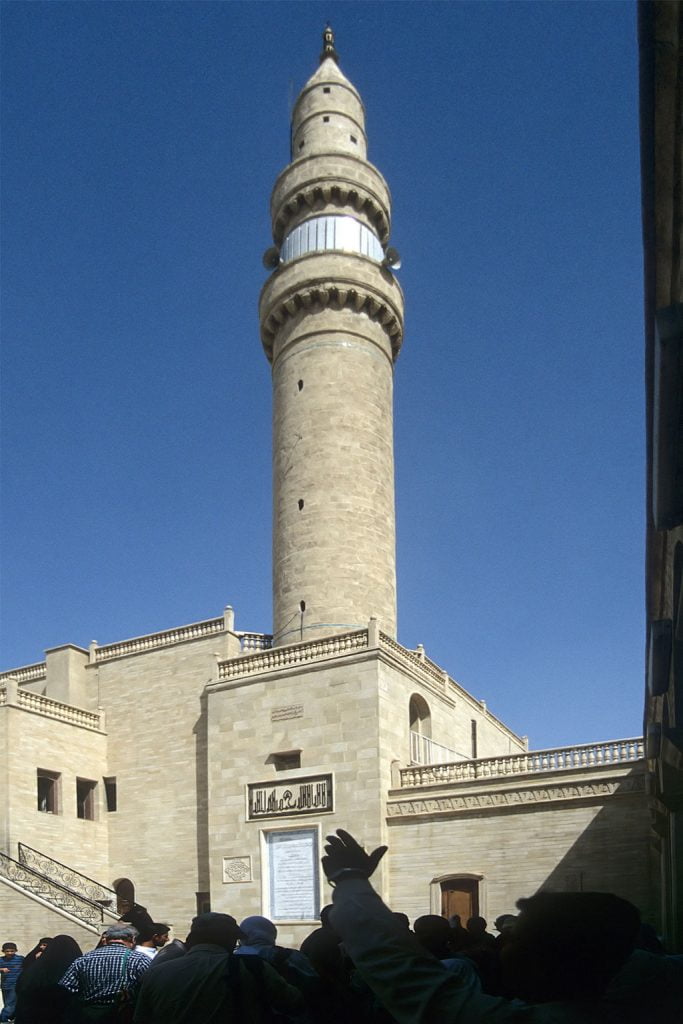
Over the centuries, the tomb became a place of pilgrimage and devotion. A mosque, known as the Mosque of the Prophet Yunus (the Arabic name for Jonah), was built over the site. This structure incorporated elements from earlier periods, including what some believed to be remnants of a Christian church and possibly even older Assyrian foundations. Worshippers would visit to pray, reflect, and honor the memory of the prophet. The site’s layered history reflected the many civilizations that had passed through the region, each leaving its mark while preserving the core tradition.
In Islamic tradition, Jonah (Yunus) is regarded as a prophet who demonstrated both human weakness and divine mercy. His story is often cited as an example of repentance and God’s compassion. This contributed to the enduring reverence for his supposed burial place in Mosul. Christian and Jewish visitors also recognized the significance of the location, seeing it as a tangible link to the biblical past.
Tragically, the site suffered severe damage in the 21st century. In 2014, during the occupation of Mosul by the extremist group ISIS, the mosque and the tomb were deliberately destroyed. This act was widely condemned as an assault on cultural and religious heritage. The destruction not only erased a historic structure but also disrupted a long-standing tradition of pilgrimage and remembrance.
Yet, even in destruction, the site has continued to yield historical insight. Following the liberation of Mosul, excavations beneath the mound revealed ancient Assyrian structures, including palace remains believed to date back to the reign of King Esarhaddon. These discoveries underscored the deep antiquity of the location and its importance long before it became associated with Jonah. The findings also highlighted how sacred sites are often layered upon earlier civilizations, creating a rich tapestry of history.
Today, efforts to restore and preserve the area reflect a broader desire to reclaim cultural identity and protect historical memory. While the original tomb structure may be gone, the legacy of the site endures in religious tradition and archaeological discovery. The traditional grave of Jonah remains a symbol of faith, repentance, and the enduring connection between ancient history and present-day belief.
_____
Image Source/Credit:
• Roland Unger, CC BY-SA 3.0 <https://creativecommons.org/licenses/by-sa/3.0>, via Wikimedia Commons
Related
Sorry, no records were found. Please adjust your search criteria and try again.
Sorry, unable to load the Maps API.