
The Old Musick Hall holds a distinguished place in musical and cultural history as the site of the first public performance of Messiah by George Frideric Handel. Located in Dublin, this now-vanished concert hall became the setting for an event that would leave a lasting mark on sacred music and charitable tradition.
Built in the early eighteenth century on Fishamble Street, the Old Musick Hall was designed as a venue for concerts and cultural gatherings. At a time when Dublin was a thriving center of intellectual and artistic life, the hall served as an important space for musical performance. Though modest by later standards, it was well regarded for its acoustics and its role in hosting public concerts, which were becoming increasingly popular among the city’s residents.
In 1741, George Frideric Handel traveled to Dublin at the invitation of the Duke of Devonshire, then serving as Lord Lieutenant of Ireland. Handel was already an established composer in London, known for his operas and oratorios, but his visit to Dublin would prove especially fruitful. During his stay, he completed Messiah, an oratorio based on biblical texts that traces the life, death, and resurrection of Jesus Christ.
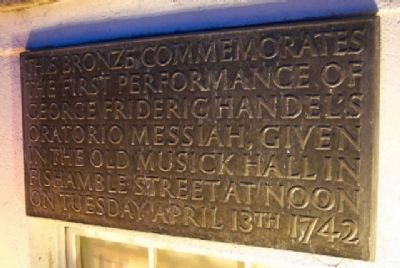
The premiere of Messiah took place on April 13, 1742, at the Old Musick Hall. The event was organized as a charitable concert, with proceeds designated for several worthy causes, including relief for prisoners’ debts and support for local hospitals. To accommodate as many attendees as possible, gentlemen were asked to remove their swords and ladies to forgo wearing hoop skirts—an indication of the overwhelming interest the performance generated.
The audience’s response was immediate and enthusiastic. Contemporary reports describe a deeply moving experience, with listeners struck by the beauty and power of the music. The performance featured a relatively small ensemble by modern standards, yet it conveyed a sense of grandeur and spiritual depth that has since become associated with the work. Particular attention was given to the “Hallelujah” chorus, which would later become one of the most recognizable pieces in Western music.
The success of the premiere helped establish Messiah as a work of enduring significance. Although it did not initially receive the same level of acclaim in London, it gradually gained recognition and became a staple of concert repertoires. Over time, it developed into a cherished tradition, especially during the Christmas and Easter seasons, and continues to be performed around the world.
The Old Musick Hall itself did not survive into the modern era. It was eventually replaced by other structures, and today its exact footprint is marked by a plaque and commemorative efforts on Fishamble Street. Yet its historical importance remains firmly established. The hall represents not only a physical location but also a moment in time when music, faith, and philanthropy came together in a remarkable way.
The legacy of that first performance extends beyond the realm of music. The charitable purpose of the event set a precedent that has often been followed in later performances of Messiah, reinforcing the connection between artistic expression and social good. Handel himself continued to support charitable causes through subsequent performances of the oratorio.
In reflecting on the Old Musick Hall and the debut of Messiah, one sees more than a single concert. It was an occasion that combined artistic excellence with a spirit of generosity, leaving an imprint that has endured for nearly three centuries. Though the building itself is gone, its contribution to cultural and musical history continues to resonate wherever Handel’s Messiah is heard.
_____
Image Source/Credit:
• First Performance of Handel’s Messiah Historical Marker. 20 Sept. 2024 (www.hmdb.org/m.asp?m=22450)
Related
Sorry, no records were found. Please adjust your search criteria and try again.
Sorry, unable to load the Maps API.