
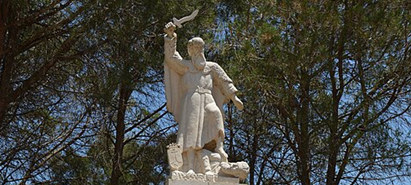
Perched high on the slopes of Mount Carmel, the Muhraqa Carmelite Monastery offers sweeping views of the Jezreel Valley and stands as a place of deep biblical memory. Among its most striking features is the statue of Prophet Elijah, a powerful visual reminder of one of the most dramatic events recorded in Scripture.
The site known as “El-Muhraqa,” meaning “the place of burning,” is traditionally associated with the account found in the First Book of Kings, where Elijah confronts the prophets of Baal in a test of divine authority. According to the biblical narrative, Elijah challenged them to call upon their god to ignite a sacrificial offering, while he would call upon the God of Israel. When the prophets of Baal failed, Elijah prayed, and fire descended from heaven, consuming the offering and demonstrating the supremacy of the Lord. This event, often referred to as the contest on Mount Carmel, is central to the spiritual significance of the location.
The statue of Elijah at the Muhraqa Carmelite Monastery vividly captures the intensity of that moment. Depicted in a commanding stance, Elijah is shown holding a sword, symbolizing his victory over the false prophets and his zeal for the worship of the true God. His posture conveys strength, determination, and unwavering faith. Unlike more serene religious sculptures, this statue emphasizes action and conviction, reflecting Elijah’s role as a bold defender of monotheism in a time of widespread idolatry.
The Carmelite monks who maintain the monastery have long venerated Elijah as a spiritual father of their order. The Carmelite Order traces its origins to hermits who lived on Mount Carmel in the medieval period, seeking to emulate the prophet’s life of prayer, solitude, and devotion. For them, Elijah represents not only a historical figure but also an enduring example of faithfulness and contemplative life. The statue, therefore, serves both as a commemoration of a biblical event and as a symbol of the Carmelite tradition.
Visitors to the monastery often find the statue to be a focal point of reflection. Set against the backdrop of the expansive landscape, it invites contemplation of the biblical story and its meaning. The surrounding view—stretching across the valley below—adds to the sense of connection between the physical setting and the ancient narrative. It is not difficult to imagine the events described in Scripture unfolding in such a dramatic environment.
In addition to its religious significance, the statue also holds cultural and historical value. It reflects the long-standing Christian presence on Mount Carmel and the efforts of the Carmelites to preserve and honor the traditions associated with the site. Over the years, the monastery has welcomed pilgrims and travelers from around the world, each drawn by the combination of history, faith, and natural beauty.
The statue of the Prophet Elijah at the Muhraqa Carmelite Monastery stands as more than a work of art. It is a vivid representation of a defining moment in biblical history, a symbol of steadfast faith, and a testament to the enduring legacy of Mount Carmel. For those who visit, it offers a tangible link to the past and a powerful reminder of the enduring call to devotion and truth.
_____
Image Source/Credit:
• Sdo216, CC BY-SA 4.0 <https://creativecommons.org/licenses/by-sa/4.0>, via Wikimedia Commons
Related
Sorry, no records were found. Please adjust your search criteria and try again.
Sorry, unable to load the Maps API.