
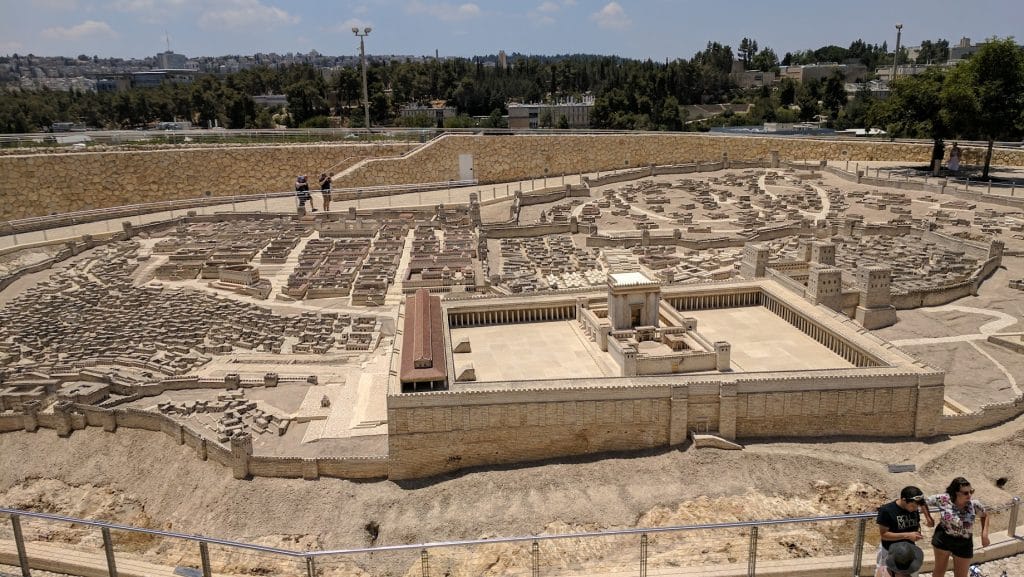
The model of ancient Jerusalem at the Israel Museum is one of the most remarkable visual reconstructions of the city as it stood during the late Second Temple period. Known as the Holyland Model of Jerusalem, it offers visitors a detailed and immersive glimpse into the appearance of the city at the time of Jesus Christ and the height of Herodian architecture.
Originally constructed in the 1960s, the model was the vision of Hans Kroch, a hotel owner who sought to commemorate his son, who had died in Israel’s War of Independence. The project was designed and built under the direction of Israeli historian and geographer Michael Avi-Yonah, who based the reconstruction on a careful study of ancient sources, archaeological findings, and historical descriptions. The model was first displayed at the Holyland Hotel in Jerusalem before being relocated in 2006 to its present home at the Israel Museum.
Built at a scale of 1:50, the model covers a vast area and includes the city’s walls, streets, and major structures as they would have appeared around the year AD 66, just before the destruction of Jerusalem by the Romans. Among its most striking features is the detailed representation of the Temple Mount, including the Second Temple as expanded by King Herod. The temple complex dominates the model, reflecting its central importance in the religious and civic life of ancient Jerusalem.
The model also depicts key landmarks such as the Antonia Fortress, Herod’s palace, the Pool of Bethesda, and the various gates and towers that formed the city’s defenses. Residential areas, marketplaces, and public spaces are rendered with remarkable precision, giving viewers a sense of the density and vitality of urban life in the ancient city. The surrounding topography, including hills and valleys, is carefully shaped to reflect the natural landscape that influenced Jerusalem’s development.
What makes the model especially valuable is its ability to bring together historical and archaeological knowledge into a single, coherent visual form. While no reconstruction can claim absolute accuracy, the Holyland Model represents a thoughtful synthesis of available evidence. It allows visitors to better understand the spatial relationships between different parts of the city and to visualize how historical events may have unfolded within this setting.
For students of history and the Bible, the model provides an invaluable educational tool. It helps illuminate the context of many events described in ancient texts, offering a clearer picture of the environment in which they took place. By seeing the city laid out in miniature, one can more readily grasp the scale of its buildings and the complexity of its design.
The legacy of the model extends beyond its educational value. It stands as a testament to the enduring fascination with Jerusalem’s past and the desire to preserve and interpret its history for future generations. Its relocation to the Israel Museum has made it accessible to a wider audience, ensuring that it remains a central attraction for visitors from around the world.
In its careful detail and thoughtful design, the model of Jerusalem serves as a bridge between past and present. It invites viewers to step back in time and consider the city as it once was, while also deepening appreciation for its lasting significance in history and faith.
_____
Image Source/Credit:
• Laliv Gal Pikiwiki Israel, CC BY 2.5 <https://creativecommons.org/licenses/by/2.5>, via Wikimedia Commons
Related
Sorry, no records were found. Please adjust your search criteria and try again.
Sorry, unable to load the Maps API.