
The Tower of David Museum, located near the Jaffa Gate entrance to the Old City of Jerusalem, is one of the most significant historical and cultural institutions in the region. Housed within an ancient citadel, the museum offers a sweeping view of Jerusalem’s long and complex history, tracing the city’s development across thousands of years.
Despite its name, the “Tower of David” is not directly connected to the biblical King David. The designation dates to the Byzantine period, when early Christians mistakenly associated the site with David’s palace. In reality, the citadel’s foundations date back to the Hasmonean period in the second century B.C., when the area was fortified to protect the city’s vulnerable western approach. Later expansions were carried out by Herod the Great, who constructed massive towers to guard his royal palace nearby. Portions of these ancient structures can still be seen today, forming the core of the citadel.
Over the centuries, the site has been repeatedly rebuilt and adapted by successive rulers, including the Romans, Byzantines, Crusaders, Mamluks, and Ottomans. Each period left its mark on the structure, resulting in a layered architectural record that reflects the diverse cultures and empires that have controlled Jerusalem. The present form of the citadel owes much to Ottoman renovations carried out in the sixteenth century under Sultan Suleiman the Magnificent.
The Tower of David Museum was established in 1989 with the aim of presenting the history of Jerusalem in a comprehensive and accessible way. Rather than focusing on a single period, the museum uses a series of exhibits to tell the story of the city from its earliest beginnings to the modern era. Artifacts, models, maps, and multimedia displays help visitors understand how Jerusalem has evolved over time, both physically and spiritually.
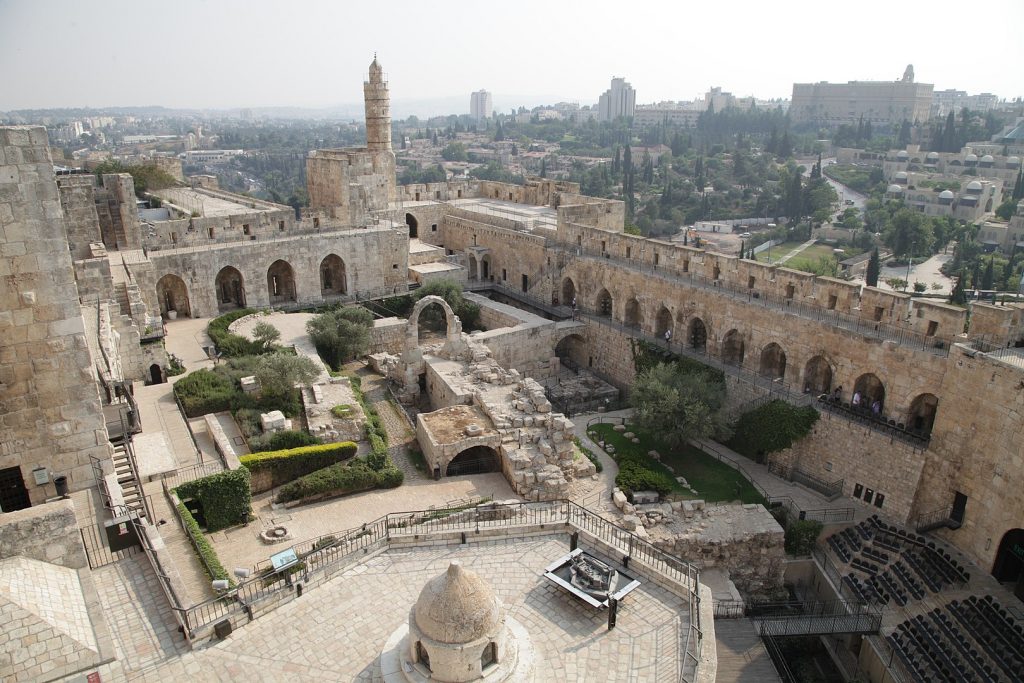
One of the distinctive features of the museum is its setting. The exhibits are integrated into the ancient halls and courtyards of the citadel itself, allowing visitors to experience history not only through displays but also through the very stones of the building. Walking through the site, one encounters remnants of different eras side by side, illustrating the continuity and change that have characterized Jerusalem’s past.
In addition to its permanent exhibitions, the museum hosts temporary displays, educational programs, and cultural events. It also offers panoramic views of the Old City from its towers, providing a visual connection between the historical narrative inside and the living city outside.
The legacy of the Tower of David Museum lies in its role as a bridge between past and present. Jerusalem is a city of deep religious significance for Jews, Christians, and Muslims alike, and its history is often marked by conflict as well as devotion. By presenting this history in a thoughtful and inclusive manner, the museum encourages visitors to appreciate the richness and complexity of the city’s heritage.
Today, the Tower of David Museum continues to attract visitors from around the world. It serves not only as a place of learning but also as a point of reflection, inviting all who enter to consider the many layers of history that have shaped Jerusalem. In doing so, it preserves the memory of the past while contributing to a deeper understanding of one of the world’s most remarkable cities.
♦ _____ ♦
Wikipedia:
The Tower of David Museum of the History of Jerusalem was opened in 1989 by the Jerusalem Foundation. Located in a series of chambers in the original citadel, the museum includes a courtyard which contains archeological remains dating back 2,700 years.
The exhibits depict 4,000 years of Jerusalem’s history, from its beginnings as a Canaanite city to modern times. Using maps, videos, holograms, drawings and models, the exhibit rooms each depict Jerusalem under its various rulers. Visitors may also ascend to the ramparts, which command a 360-degree view of the Old City and New City of Jerusalem.
As of 2002, the Jerusalem Foundation reported that over 3.5 million visitors had toured the museum.
_____
Image Source/Credit (in order):
• Photo Xavier Gillet, Bordeaux, France (xavier33300 on flickr) – Jerusalem 07/2012 CC 2.0
Related
Sorry, no records were found. Please adjust your search criteria and try again.
Sorry, unable to load the Maps API.