
Samson’s Tomb is a traditional site associated with the burial of Samson, one of the most dramatic and complex figures in the Old Testament. Though its identification rests on long-standing tradition rather than definitive archaeological confirmation, the site has drawn interest for centuries as a place connected with the life and death of this remarkable biblical hero.
Samson’s story is recorded in the Book of Judges, where he is presented as a man of extraordinary physical strength, set apart from birth as a Nazirite. His life was marked by a divine calling to deliver Israel from the oppression of the Philistines. Yet his story is also one of personal struggle, as his strength was often accompanied by impulsive decisions and moral weakness. Despite these flaws, Samson played a crucial role in the ongoing conflict between Israel and its enemies.
According to the biblical account, Samson met his end in Gaza, where he was captured by the Philistines after his strength was compromised. Blinded and imprisoned, he was brought into a temple during a public celebration. In a final act of strength and faith, he pushed apart the pillars of the structure, bringing it down upon himself and his captors. The text records that his family later retrieved his body and buried him “between Zorah and Eshtaol in the tomb of his father Manoah.” It is this description that has given rise to the traditional identification of Samson’s Tomb near the ancient region of Zorah.
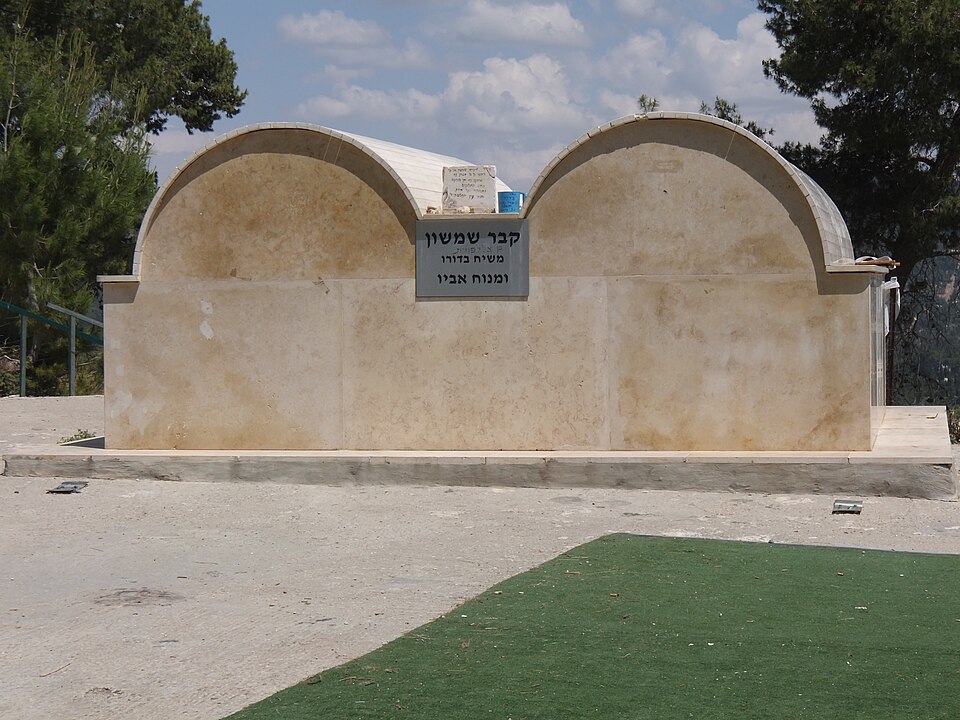
The site traditionally associated with Samson’s burial lies in the hills overlooking the Sorek Valley, a landscape that corresponds closely with the setting of the biblical narrative. The tomb itself is typically marked by a modest structure, often consisting of a small building or enclosure that protects the site. Over time, it has been maintained and venerated by various communities who recognize its connection to the biblical account.
The simplicity of the tomb reflects the nature of many traditional sites in the Holy Land. Rather than grand architecture, it offers a quiet place for reflection. Visitors who come to the site often do so with a sense of reverence, mindful of the story it represents. The surrounding landscape, with its rugged hills and open views, helps to evoke the world in which Samson lived and carried out his feats.
The significance of Samson’s Tomb lies less in archaeological certainty than in the enduring power of the story it represents. Samson’s life is one of contrasts—strength and weakness, faith and failure, judgment and redemption. His final act, in which he called upon God for strength one last time, is often interpreted as a moment of repentance and renewed faith. For many, the tomb serves as a reminder that even a flawed life can be used for a greater purpose.
As with many traditional biblical sites, scholars approach the identification of Samson’s Tomb with caution. There is no definitive evidence that confirms the exact location of his burial. Nevertheless, the continuity of tradition and the geographical alignment with the biblical text give the site a meaningful place in the landscape of biblical memory.
Today, Samson’s Tomb continues to attract visitors interested in the history and faith of the ancient world. It stands as a symbol of a powerful narrative that has been passed down through generations. In its quiet setting, the site invites reflection on the complexities of human character and the enduring themes of strength, failure, and redemption that define the story of Samson.
_____
Image Source/Credit:
• Davidbena, CC BY-SA 4.0
Related
Sorry, no records were found. Please adjust your search criteria and try again.
Sorry, unable to load the Maps API.