
The history of En Gedi is a story of survival, spiritual refuge, and continuous human presence in one of the most unlikely environments on earth. Nestled along the western shore of the Dead Sea, this desert oasis has supported life for thousands of years, offering fresh water, fertile soil, and shelter amid an otherwise harsh and arid landscape.
Archaeological evidence shows that human settlement at En Gedi dates back to the Chalcolithic period, around the 4th millennium BCE. Early inhabitants were drawn to the area by its reliable springs, including the well-known Nahal David and Nahal Arugot. These natural water sources created a unique ecosystem where agriculture could flourish despite the surrounding desert. Over time, En Gedi became a vital stopping point for travelers and traders moving through the region.
En Gedi holds a prominent place in biblical history, most notably in connection with King David. According to the biblical account, David sought refuge in the wilderness of En Gedi while fleeing from King Saul. The caves scattered throughout the cliffs provided natural hiding places, and one well-known episode describes David sparing Saul’s life in one of these caves. This story has long contributed to En Gedi’s reputation as a place of both danger and mercy, where moral choices were tested in isolation.
During the period of the Kingdom of Judah, En Gedi developed into an important settlement. Its strategic location near the Dead Sea made it valuable for both agriculture and trade. The area became especially known for the production of balsam, a highly prized aromatic resin used in perfumes, medicines, and religious rituals. This rare commodity brought considerable wealth and attention to the region, making En Gedi one of the economic centers of ancient Judea.
The importance of En Gedi continued into the Roman and Byzantine periods. By this time, it had grown into a well-established town with a thriving agricultural base. Terraced farming techniques were used to cultivate dates, grapes, and other crops, demonstrating the ingenuity of its inhabitants in adapting to the desert environment. The remains of a synagogue from this period, discovered in the 20th century, offer further insight into the community that once lived there. The mosaic floor of the synagogue is particularly notable, featuring intricate designs and inscriptions, including a mysterious warning against revealing the “secret of the town,” which many scholars believe refers to the method of producing balsam.
However, En Gedi’s prosperity was not to last indefinitely. The settlement was eventually abandoned, likely due to a combination of environmental changes, economic decline, and regional instability. Over the centuries, the oasis remained largely uninhabited, though it continued to be recognized for its natural beauty and historical significance.
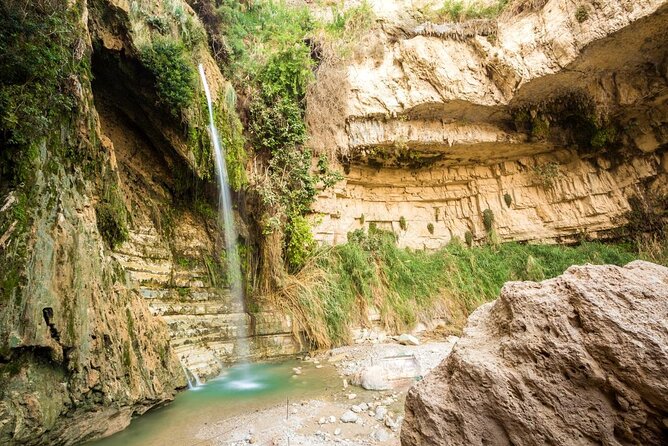
In the modern era, En Gedi was reestablished in the mid-20th century with the founding of Kibbutz Ein Gedi in 1956. The renewed settlement once again took advantage of the area’s natural resources, developing agriculture, tourism, and research. Today, visitors from around the world come to experience the lush vegetation, waterfalls, and wildlife that make En Gedi such a striking contrast to the surrounding desert.
The oasis is now part of a protected nature reserve, ensuring that its unique ecosystem and historical sites are preserved for future generations. Ibexes roam the cliffs, and a variety of plant species thrive thanks to the constant flow of fresh water. The combination of natural beauty and historical depth makes En Gedi a place where the past feels vividly present.
Throughout its long history, En Gedi has served many roles: a refuge for fugitives, a center of economic activity, a religious community, and a modern hub of tourism and conservation. Its enduring significance lies in its ability to sustain life and inspire human settlement in one of the most challenging environments imaginable.
In many ways, the story of En Gedi reflects the broader history of the region—marked by resilience, adaptation, and continuity. From ancient times to the present day, it has remained a symbol of life in the desert, a place where water and perseverance have allowed civilization to take root against all odds.
_____
Image Source/Credit:
• “Tel Aviv Gateway Masada, Ein Gedi Oasis and Dead Sea Private Tour – Book Tickets and Tours | Over the Planet.” Over the Planet, www.overtheplanet.com/en-SG/unique-experiences-with-tel-aviv-gateway-masada-ein-gedi-oasis-and-dead-sea-private-tour.a516293.
Related
Sorry, no records were found. Please adjust your search criteria and try again.
Sorry, unable to load the Maps API.