
The Life, Legacy, and Impact of Mary Moffat Livingstone
Mary Moffat Livingstone (1821–1862) occupies a significant yet often underappreciated place in the history of nineteenth-century missionary work in southern Africa. As the wife of David Livingstone and the daughter of pioneering missionaries, she lived a life marked by devotion, hardship, and quiet resilience. Though frequently overshadowed by her husband’s fame, Mary’s contributions to missionary life and her steadfast support of the work in Africa deserve careful recognition.
Mary was born at Kuruman, in present-day South Africa, where her parents, Robert Moffat and Mary Moffat (née Smith), were among the earliest missionaries of the London Missionary Society. Growing up on the mission station, Mary was immersed in African languages, customs, and daily life from an early age. Unlike many European women of her time, she was well adapted to the environment of southern Africa, a familiarity that would later prove invaluable in her own missionary experience.
In 1845, Mary married David Livingstone, who had already begun his work as a missionary and explorer. Their marriage united two individuals deeply committed to Christian service, but it also introduced significant challenges. The demands of missionary life, combined with the dangers and uncertainties of travel in the African interior, placed great strain on their relationship and family life.
Mary accompanied her husband on several journeys during the early years of their marriage, enduring difficult conditions that included long treks, extreme climates, and limited medical care. She gave birth to several children under these circumstances, often far from the support systems available in Britain. Her role was not merely that of a companion; she contributed to the work by maintaining the household, assisting with outreach, and engaging with local communities.
However, the realities of life in the interior led to prolonged separations. For the sake of their children’s education and health, Mary spent extended periods in Britain while David continued his explorations in Africa. These separations were emotionally taxing and reflected the broader challenges faced by missionary families during this era. Despite the distance, Mary remained committed to her husband’s work and to the cause they both served.
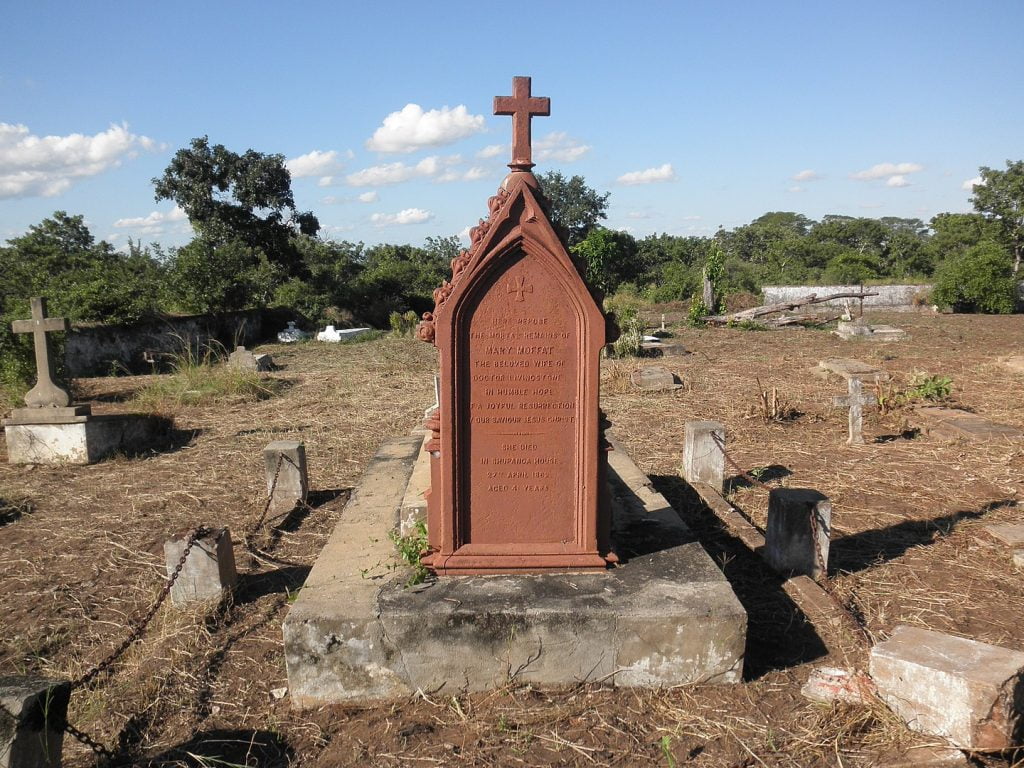
Mary’s later years were marked by both reunion and tragedy. In 1862, she returned to Africa to join David once more, traveling to the Zambezi region where he was engaged in exploration and missionary efforts. It was a difficult time, as the expedition faced numerous obstacles, including disease and logistical problems. Shortly after her arrival, Mary fell ill with malaria and died at Shupanga, Mozambique. She was buried there, far from her birthplace and family, a poignant reminder of the sacrifices made by those involved in missionary work.
The legacy of Mary Moffat Livingstone is closely tied to the broader story of missionary enterprise in Africa. While she did not leave behind extensive writings or public achievements comparable to her husband’s, her life exemplifies the often-overlooked contributions of missionary wives. These women played essential roles in sustaining mission stations, raising families under challenging conditions, and providing continuity in times of uncertainty.
Mary’s upbringing at Kuruman also highlights the importance of second-generation missionaries—those born and raised in the mission field. Her familiarity with local cultures and languages gave her a unique perspective and enabled her to navigate cross-cultural relationships with greater ease. In this sense, she represents a bridge between European and African worlds, embodying both the opportunities and complexities of that interaction.
Her impact can also be understood in terms of personal influence. As a partner to David Livingstone, she supported a figure whose work would gain international recognition. Her willingness to share in the hardships of his calling, even at great personal cost, contributed indirectly to the success of his mission. At the same time, her life serves as a reminder that such achievements were rarely the result of individual effort alone.
In recent years, there has been growing interest in recovering the stories of women like Mary, whose contributions were essential but often underrepresented in historical accounts. Her life invites a more balanced understanding of missionary history, one that acknowledges the sacrifices and resilience of entire families rather than focusing solely on prominent individuals.
Mary Moffat Livingstone’s story is ultimately one of quiet strength and enduring faith. She lived in an era when the demands of missionary service required extraordinary commitment, and she met those demands with courage and perseverance. Though her life was cut short, her example continues to shed light on the human dimension of missionary work and the enduring impact of those who labored faithfully, often beyond the spotlight of history.
_____
Image Source/Credit:
• Soccerman321, CC BY 3.0 <https://creativecommons.org/licenses/by/3.0>, via Wikimedia Commons
Related
Sorry, no records were found. Please adjust your search criteria and try again.
Sorry, unable to load the Maps API.